Data Maturity for U.S. Community Banks
Community-bank data capability model
Use this model to diagnose how reliably a community bank governs, structures, delivers, and improves its data—not to score the bank's full digital operating model.
When to use this model
Best suited to leaders deciding where data ownership, governance, architecture, quality, analytics delivery, and adoption must improve before data-dependent transformation can scale.
Scope boundary
Choose the digital maturity model instead when the decision spans customer experience, channels, operations, technology, risk, people, and third-party delivery as well as data.
Domains Covered
| Domain | Description |
|---|---|
| Strategy | Defines the enterprise direction for data management by setting intent, priorities, success measures, and a roadmap aligned to business goals and operating context. |
| Governance | Establishes authority, accountability, and control over data management through decision rights, policies, standards, stewardship, and enforcement mechanisms. |
| Architecture & Modeling | Designs and maintains the enterprise data blueprint and models to ensure consistent meaning, interoperability, and fitness for purpose across domains and platforms. |
| Delivery & Adoption | Operates data platforms and enables reliable data movement and consumption so data is available, trusted, and usable in workflows, analytics, and decision-making. |
| Learning & Improvement | Measures performance, monitors trends, identifies root causes, and drives continuous improvement through reassessment, prioritization, and execution oversight. |
Strategic Goal Groups Covered
| Goal Group | Description | Goals |
|---|---|---|
| Strategic Alignment & Investment | Ensure data capabilities are intentionally prioritized, funded, and delivered as measurable enablers of community bank business strategy, operating model, and risk posture. | 2 |
| Data Governance, Risk & Compliance | Establish clear decision rights, controls, and stewardship to reduce operational and regulatory risk while improving trust in data used for banking decisions and reporting. | 2 |
| Data Quality & Consistency | Increase confidence in operational, analytical, and regulatory data by improving accuracy, completeness, timeliness, and consistency across systems and vendors. | 2 |
| Architecture, Integration & Interoperability | Enable scalable, interoperable data flows and models that reduce duplication and improve speed to insight across core banking, digital, risk, and finance ecosystems. | 2 |
| Analytics, Delivery & Adoption | Ensure data is usable in day-to-day workflows and decision-making by improving availability, usability, and adoption of trusted analytics and data products. | 2 |
| Performance Measurement & Continuous Improvement | Use metrics and feedback loops to manage data capability performance, prioritize improvements, and sustain gains over time. | 2 |
Maturity Levels
L3 Domain Coverage Distribution
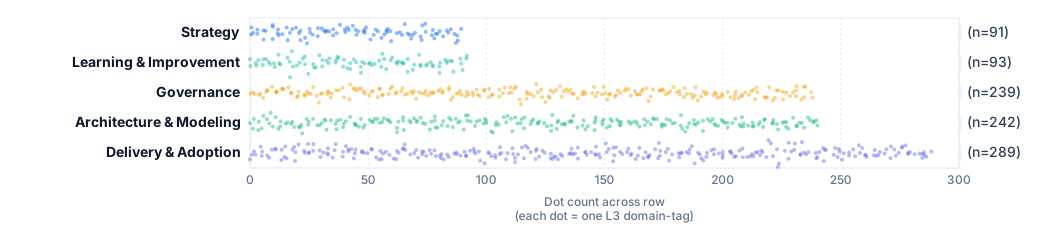
This chart shows the distribution of L3 diagnostic emphasis across domains. Each dot represents one L3 domain-tag mapping, so longer rows indicate domains with more detailed operational assessment coverage.
Longer rows indicate domains with greater diagnostic emphasis (more tag-weighted L3 mappings), while shorter rows indicate lighter coverage. This is intentional prioritization based on each domain's complexity. Higher local dot concentration within a row indicates more mappings accumulating around that domain's observed count range.
Strategic Goal Group-Domain Coverage Heatmap
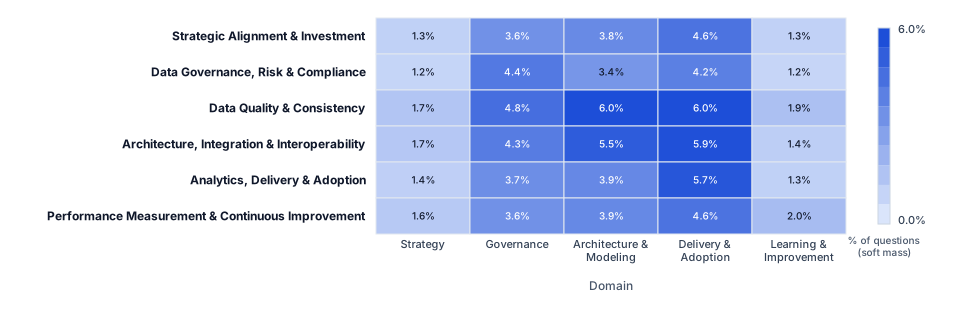
This heatmap shows how L3 question coverage is distributed across the intersection of strategic goal groups and domains. Darker cells indicate higher soft-normalized coverage mass for that pairing.
From an assessment standpoint, it helps identify where strategic intent and domain-level diagnostics are strongly coupled versus lightly represented, supporting prioritization and balance decisions in model design and interpretation.
Fact Sheet
| Architecture | 3-layer model (L1 Domains • L2 Categories • L3 Subcategories) |
|---|---|
| Coverage | 5 domains • 20 categories • 100 subcategories |
| Depth | 17 L1 • 167 L2 • 812 L3 questions |
| Progression | 6 maturity stages per capability • 5976 total maturity statements |
| Accountability | 8 roles mapped • 63.8% owned by primary role |
| Resolution | 47.76x L3-to-L1 diagnostic resolution |
| Cross-cutting | L1 35.3% • L2 12.6% • L3 9.4% multi-mapped |
Granularity Ratio
20x
Unique subcategories / unique domains
Signals Per Subcategory
8.12
L3 questions / unique subcategories
Role Span
L1 (4 roles) / L3 (8 roles)
Distinct roles across strategic to operational layers
Layer Comparison Matrix
| Layer | Multi-Tag Rate | Avg Tags per Question | Domain Balance Ratio |
|---|---|---|---|
| L1 | 35.3% | 1.71 | 2.68 |
| L2 | 12.6% | 1.16 | 3.24 |
| L3 | 9.4% | 1.17 | 3.19 |
Domain Coverage Distribution Across Layers
| Domain | L1 | L2 | L3 | |||
|---|---|---|---|---|---|---|
| Count | Share % | Count | Share % | Count | Share % | |
| Architecture & Modeling | 8 | 47.1% | 48 | 24.9% | 242 | 25.4% |
| Delivery & Adoption | 8 | 47.1% | 58 | 30.1% | 289 | 30.3% |
| Learning & Improvement | 5 | 29.4% | 18 | 9.3% | 93 | 9.7% |
| Governance | 5 | 29.4% | 50 | 25.9% | 239 | 25.1% |
| Strategy | 3 | 17.6% | 19 | 9.8% | 91 | 9.5% |
Structural Quality Indicators
Ontology Density
199.2
(L1 + L2 + L3 questions) / domains
Accountability Breadth
1.6
Distinct roles / domains
Coverage Evenness Score
93.7
L3 domain distribution uniformity (0-100)
Goal-Link Saturation
12
Goal-subcategory links / unique subcategories
Model Metadata
| Version | 1.0.0 |
|---|---|
| Industry | banking |
| Scope | USA (country) |
| Created | 2026-02-13 |