Digital Maturity Benchmarks, Surveys, and Scorecards
A practical guide to the artifacts teams need after selecting a maturity framework: structured surveys, consistent scoring logic, credible benchmarks, and scorecards that support roadmap decisions.
A digital maturity benchmark quantifies how an organization’s capabilities compare to peers across defined dimensions. Surveys collect structured role-based responses, and scorecards translate those responses into weighted, evidence-backed maturity ratings tied to execution priorities.
For framework selection, use analyst model comparison. For interpreting maturity ratings, use levels and scorecard interpretation. For banking context, see digital banking maturity benchmarking.
- Mid-market organizations (500–5,000 employees; ~$100M–$2B revenue)
- CIO, CDO, CTO, or Head of Digital / Transformation
- Active digital or AI initiatives with a decision-grade baseline need
What you get: the artifacts
If you’re searching for digital maturity benchmarks, frameworks, surveys, or scorecards, these are the tangible outputs a professional assessment should produce.
- Survey instrument and response coverage by role / segment
- Quantified maturity scorecard by dimension (overall + segments)
- Benchmark view: peer band + industry averages + gap to leaders
- Visuals: radar charts, heatmaps, and board-ready scorecard slides
- A prioritized 12–18 month roadmap linked back to quantified gaps
Prefer an advisor-led engagement? See Digital Maturity Assessment. If you want to run this internally, see the self-serve tool.
Benchmark vs Survey vs Scorecard: what each component does
Teams often use these terms interchangeably, but each serves a different decision purpose in an enterprise maturity benchmarking process.
| Component | Purpose | Output | Risk If Missing |
|---|---|---|---|
| Survey | Capture structured, role-based capability evidence | Response data by role, function, and dimension | Decision-making depends on anecdotes, not evidence |
| Benchmark | Provide enterprise maturity benchmarking context vs peers | Peer-relative position and gap-to-leader view | Scores lack strategic context and urgency |
| Scorecard | Convert evidence into weighted maturity decisions | Dimension ratings, heatmaps, and priority signals | No clear prioritization logic for leadership |
Survey structure: how we capture digital maturity
The survey is structured around 8–12 dimensions from the DUNNIXER digital maturity model, with questions tailored for different roles and functions.
Typical assessments cover leaders and practitioners across technology, business units, and supporting functions, using a mix of Likert and multiple-choice questions.
- Role-specific question sets for executives, functional leads, and practitioners
- Coverage across strategy, customer and product, data and AI, technology, operating model, and governance
- Designed to complete in ~15–25 minutes per participant (with 45–60 minute interviews available for key stakeholders)
- Typically 5–10 stakeholders to balance breadth and depth
How to design a digital maturity assessment survey
A defensible capability maturity survey design method should balance comparability, role relevance, and decision-grade scoring.
- Dimension selection: Define 8-12 domains aligned to strategy, operating model, and digital capability benchmarks.
- Role segmentation: Tailor question sets for executives, functional leaders, and delivery practitioners.
- Question scaling logic: Use consistent response scales and maturity anchors per question.
- Weighting methodology: Weight dimensions by risk, strategic importance, and execution constraints.
- Evidence validation: Use interviews and artifact checks where high-stakes claims need confirmation.
Scoring: from responses to maturity levels
Each question feeds into one or more dimensions of the model. Scores are calculated per dimension and then rolled up to an overall maturity view.
The scoring engine highlights where responses diverge across roles or segments, helping you see misalignment as well as overall strength.
A simplified example:
| Dimension | Score | Interpretation |
|---|---|---|
| Strategy | 3.2 / 5 | Digital ambition is defined, but not fully tied to funding and KPIs. |
| Data & AI | 2.7 / 5 | Foundations exist, but data quality, access, and governance are uneven. |
| Technology | 3.8 / 5 | Modern platforms in place, with pockets of legacy holding some areas back. |
We map scores into a 5-level maturity scale so executives can interpret what “2.9” or “3.4” means in practice. For the full 1–5 definitions (and how to read a scorecard and benchmark), see Digital Maturity Levels (1–5).
Why benchmarks without roadmaps fail
Many organizations stop at scoring. Without translation into funded initiatives, ownership, and governance cadence, benchmark reports become static artifacts.
- Static ratings do not define sequencing or dependency management.
- Unweighted gap lists do not tell leaders what to fund first.
- No governance integration means progress is not tracked consistently.
- No roadmap linkage weakens accountability for execution outcomes.
Decision-grade maturity work should flow from benchmark to scorecard to a prioritized roadmap and execution cadence.
2026 update: AI-assisted maturity survey design
Many teams now use AI-assisted drafting to accelerate survey creation, but model-generated questions still require governance controls and human review.
- Use AI to draft role-specific questions, then validate wording and intent with domain owners.
- Keep scoring rubrics and maturity anchors stable so time-series comparisons remain valid.
- Use automated quality checks to detect ambiguous or duplicated questions before launch.
- Pair automation with governance review to preserve auditability and decision traceability.
External benchmarks: where you stand vs peers
Benchmarks are built from anonymized assessment data and grouped by industry, size band, and (where relevant) geography. The goal is to give you directional, decision-ready context, not a misleading league table.
We typically show benchmark context in three layers:
- Peer group: similar size + sector profile
- Industry averages: aggregated directional baseline
- Best-in-class: top-quartile profiles to clarify the gap
- Percentile rank vs peers at overall and dimension level
- Gaps to best-in-class profiles by dimension
- Heatmaps of strengths and weaknesses across segments
Scorecards, heatmaps, and roadmaps
The output your executives see is a concise scorecard and roadmap, not a raw survey dump. Dimensions, scores, and benchmarks are visualized so priorities are clear.
Sample maturity scorecard (sanitized)
Example for a mid-market SaaS company (anonymized and aggregated).
| Dimension | Your score | Peer avg | Industry avg | Gap to leaders |
|---|---|---|---|---|
| Data & Analytics | 3.2 | 2.8 | 3.0 | -0.8 |
| Technology Infrastructure | 2.9 | 3.1 | 3.2 | -1.1 |
| Digital Operations | 3.5 | 3.3 | 3.4 | -0.5 |
| AI & Innovation | 2.7 | 2.5 | 2.6 | -1.3 |
| Governance & Culture | 3.1 | 3.0 | 3.1 | -0.9 |
| Overall maturity | 3.1 | 2.9 | 3.0 | -0.9 |
Interpretation: strong operations baseline, but a clear gap in AI enablement and infrastructure—often a signal to tighten vendor evaluation, data foundations, and modernization sequencing.
- Scorecards summarizing maturity by dimension and segment
- Heatmaps highlighting where capabilities are lagging or leading
- A 12–18 month roadmap organized by workstream, linked back to quantified gaps

Radar chart example (your scores vs peer benchmark).
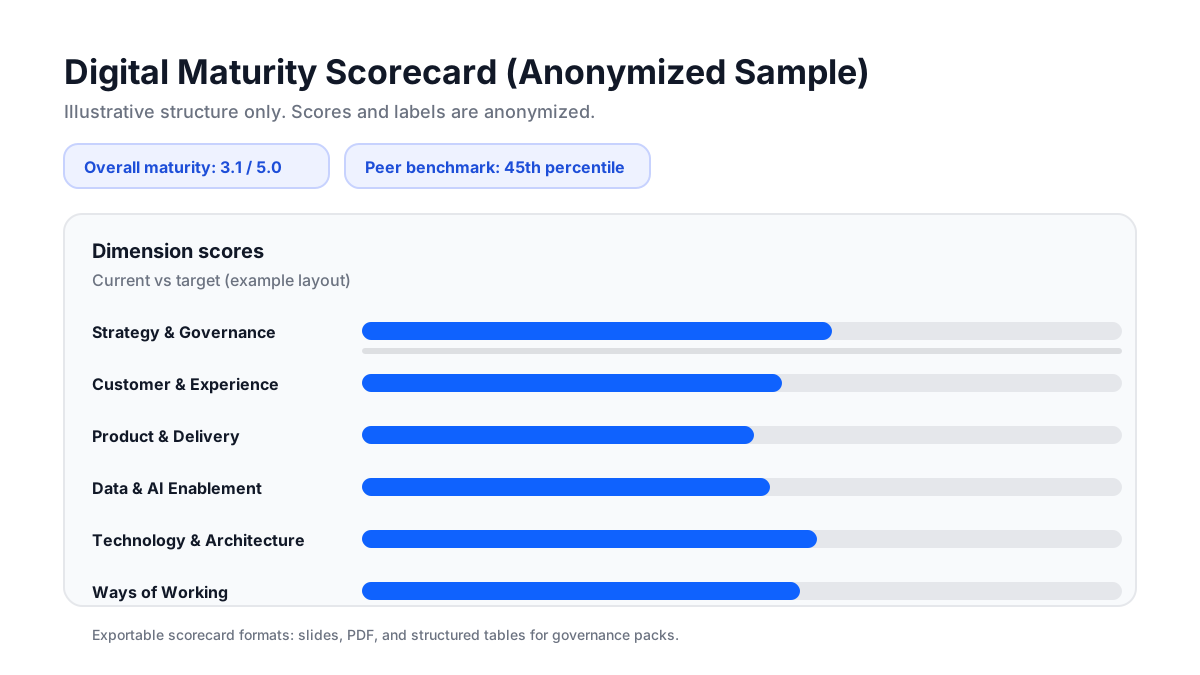
Scorecard slide (anonymized example).

Roadmap excerpt (anonymized example).
Want to see a scorecard in context? Start with the Digital Maturity Assessment.
Engagement options and next steps
The same survey, scoring, benchmark, and scorecard engine powers both delivery modes—consulting-led and self-serve.
Turn benchmarks into decisions
Whether you want a consulting-led engagement or a self-serve option, the same survey, scoring, and benchmark engine sits behind both. Prefer a practitioner-led team to facilitate interviews, executive working sessions, and board readouts? Our Digital Maturity Assessment engagement covers exactly that.
Comparing providers? See Digital Maturity Assessment.
Ready to move from theory to a baseline and roadmap?
Author
Ahmed Abbas - Founder & CEO, DUNNIXER
Former IBM Executive Architect with 26+ years in IT strategy and enterprise architecture.
Advises CIO and CDO teams on digital maturity, portfolio governance, and decision-grade modernization planning. View author profile on LinkedIn.
Frequently asked questions
Practical questions CIOs and digital leaders ask about digital maturity surveys, scoring, benchmarks, and scorecards.