Best Digital Maturity Assessment Consulting Firms for Banks
A practical comparison of the consulting firms banks shortlist for maturity assessment, benchmarking, and transformation-readiness decisions.
Banks typically evaluate these firms against a broader banking maturity assessment framework, not just general consulting reputation. For the central topic hub, see banking maturity assessment consulting.
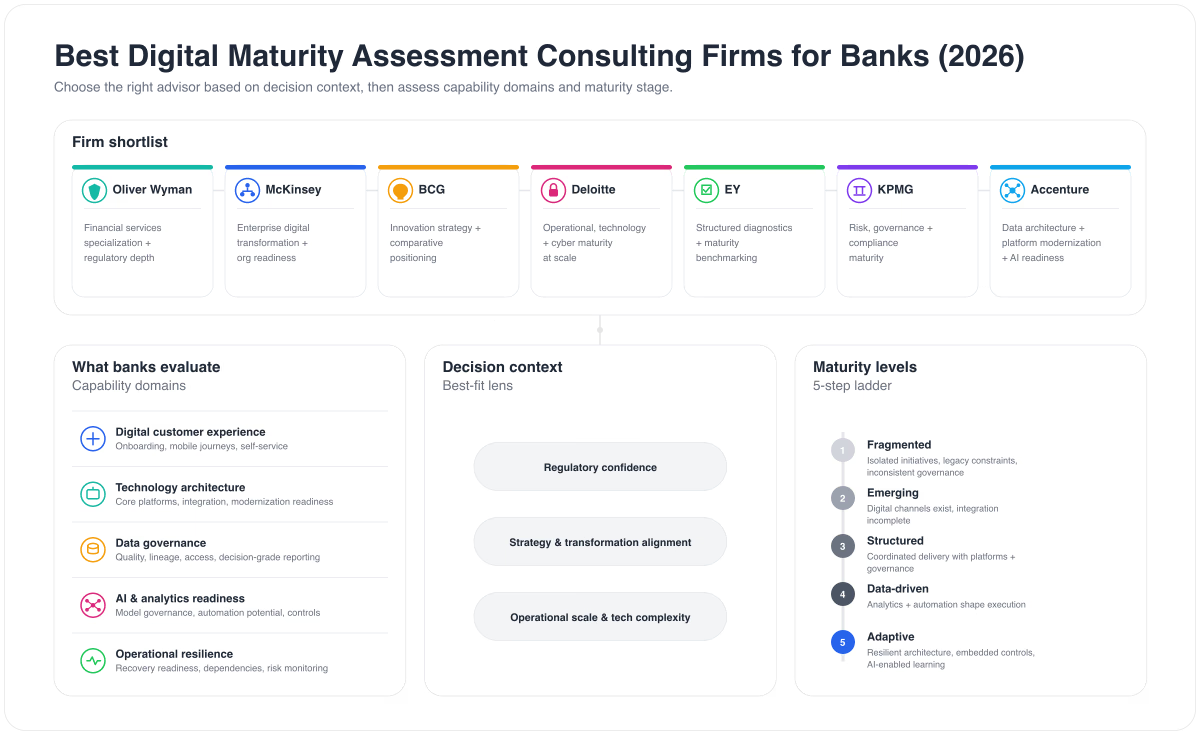
Quick answer: best digital maturity assessment consulting firms for banks
Digital maturity assessment consulting for banks evaluates how well a bank's technology, operating model, governance, controls, and data capabilities support digital transformation. The consulting firms most commonly shortlisted for that work are:
- Oliver Wyman: strongest financial services specialization and regulatory depth
- McKinsey: enterprise digital transformation and organizational readiness
- BCG: innovation benchmarking and strategic positioning
- Deloitte: operational, cyber, and technology maturity at scale
- EY: structured diagnostic platforms and maturity benchmarking
- KPMG: regulatory, governance, and compliance maturity
- Accenture: data architecture, platform modernization, and AI readiness
These firms make the shortlist because of their financial-services specialization, maturity assessment methodology, benchmarking capability, and relevance to banking operating models.
At a glance
- Best for regulatory depth: Oliver Wyman
- Best for strategy: McKinsey and BCG
- Best for implementation-heavy estates: Deloitte and Accenture
- Best for benchmarking-led diagnostics: EY
- Best for control and compliance maturity: KPMG
Top digital maturity assessment consulting firms for banks
| Firm | Best for | Typical bank context |
|---|---|---|
| Oliver Wyman | Financial services specialization and regulatory depth | Risk, regulatory, and sector-specific maturity analysis |
| McKinsey | Enterprise digital transformation and organizational readiness | Strategic competitiveness and operating-model readiness |
| BCG | Innovation strategy and comparative positioning | Benchmarking future-state capability and peer ambition |
| Deloitte | Operational, technology, and cyber maturity at scale | Large legacy estates and implementation-heavy modernization |
| EY | Structured maturity assessment and evidence-based benchmarking | Cross-domain diagnostics with more systematic reporting |
| KPMG | Risk, compliance, and regulatory maturity | Governance, AML, control effectiveness, and remediation pressure |
| Accenture | Data architecture, platform modernization, and AI readiness | Technology-enabled transformation and delivery feasibility |
Some banks also work with independent advisory firms that focus specifically on maturity assessment and transformation readiness rather than large-scale implementation. That can be useful when the executive objective is diagnostic clarity rather than downstream delivery sourcing.
Why choosing the best firm is an executive decision
For banks, maturity assessment is rarely a generic advisory exercise. It is usually meant to inform transformation sequencing, regulatory remediation, technology modernization, control effectiveness, or competitive positioning. That makes firm selection an executive judgment, not a procurement exercise.
When regulatory assurance matters most
Banks under supervisory pressure or remediation demands usually need firms that can frame maturity in a language risk, audit, and governance functions can challenge and use.
When strategy is the main objective
Executive teams evaluating competitiveness, transformation ambition, and organizational readiness often need a broader strategic lens rather than a narrow control review.
When operational scale dominates
Large legacy estates, fragmented technology stacks, and cyber complexity tend to favor firms that can translate maturity findings into implementation-feasibility judgments.
When neutrality is the priority
Independent advisors can be useful when leadership wants a baseline that is less tied to vendor preference, systems-integration incentives, or preselected program designs.
What banks evaluate in a digital maturity assessment
| Capability | Typical evaluation focus |
|---|---|
| Digital customer experience | Onboarding, mobile journeys, self-service, and service consistency across channels |
| Technology architecture | Core banking platforms, integration complexity, legacy constraints, and modernization readiness |
| Data governance | Data quality, lineage, accessibility, and decision-grade reporting across business and risk domains |
| AI and analytics readiness | Model governance, automation potential, data foundations, and control alignment |
| Operational resilience | Process stability, recovery readiness, third-party dependencies, and risk monitoring |
Digital maturity levels in banking
Banks are typically assessed across a small number of maturity stages that show whether capabilities are isolated, coordinated, scalable, and adaptive.
| Level | Description |
|---|---|
| Fragmented | Digital initiatives are isolated and constrained by legacy systems, manual workarounds, and inconsistent governance |
| Emerging | Digital channels exist but integration across operations, controls, and data remains incomplete |
| Structured | Platforms, governance, and operating models support coordinated digital delivery across functions |
| Data-driven | Analytics, automation, and evidence-based decisions shape execution across business and risk domains |
| Adaptive | The bank continuously evolves capabilities through resilient architecture, embedded controls, and AI-enabled learning |
These stages are usually evaluated through a structured banking maturity assessment framework.
How the main firm profiles differ
Oliver Wyman for financial services depth
Oliver Wyman is often the strongest match when a bank needs maturity assessment work grounded in financial-services realities rather than generic transformation language. Its relevance is highest where the assessment must reflect sector-specific constraints, supervisory expectations, and governance discipline.
McKinsey for enterprise digital transformation
McKinsey is typically most relevant when leadership wants a strategic view of digital competitiveness, organizational readiness, and the bank's capacity to support large transformation ambitions. Its value is strongest when executive teams want maturity findings tied to broader business performance and operating-model choices.
BCG for innovation benchmarking and comparative positioning
BCG is often useful when the maturity conversation extends beyond current-state digitization into future operating models, comparative ambition, and innovation capacity. That profile is especially relevant where leaders want to know whether investment is building durable capability or simply funding isolated initiatives.
Deloitte for operational, technology, and cyber maturity
Deloitte is commonly favored when the bank's challenge is execution complexity rather than strategic ambiguity. Large legacy estates, broad third-party dependencies, and modernization programs with operational-risk consequences all make this profile more relevant.
EY for structured maturity diagnostics and benchmarking
EY is a strong candidate when leadership wants a more systematic, evidence-based diagnostic that can span digital, cybersecurity, risk, and transformation readiness. A platform-enabled assessment model can improve speed, comparability, and reporting consistency across domains.
KPMG for risk and compliance maturity
KPMG is a natural fit when the maturity question centers on governance discipline, regulatory readiness, AML effectiveness, or control maturity. For banks, the key value is translating regulatory pressure into a coherent view of institutional capability rather than treating compliance as a narrow rules exercise.
Accenture for data, platform, and AI readiness
Accenture is commonly shortlisted when the assessment is closely tied to platform modernization, data architecture, AI enablement, and technology delivery feasibility. In banking, that matters when innovation ambitions are constrained by fragmented infrastructure or weak data foundations.
Where DUNNIXER fits
No single consulting firm is best across all banking maturity assessment objectives. Some banks therefore look for a more independent advisor that focuses specifically on baseline clarity, benchmarking logic, and transformation-readiness diagnosis rather than large-scale implementation.
Used in that way, the DUNNIXER Digital Maturity Assessment is relevant because it gives executives a structured way to interpret maturity across regulatory resilience, operational scalability, control effectiveness, technology enablement, and sequencing confidence without making the comparison page read like a sales pitch.
To compare this provider-selection view with peer-comparison evidence, continue to digital banking maturity benchmarks.
Frequently asked questions
Quick answers on firm selection, scope, and how banks use maturity assessments in practice.