Institutional real estate investment decisions
The Four Levels That Shape Institutional Real Estate Decisions
A diagnostic model for locating capital constraints, decision authority, and execution rights.
Why property decisions cross organizational boundaries
A vacant floor, an aging plant, or a tenant requesting a substantial incentive can look like an asset-management decision. The asset team can identify the problem, estimate the impact on net operating income (NOI), and recommend an intervention. Yet the proposal may compete with other uses of capital, exceed delegated authority, affect corporate liquidity, or require consent from a lender or joint-venture partner. The operational problem and the place where it can be resolved may be different.
Four connected levels offer a useful way to trace that distinction: asset, portfolio, corporate, and external control. This is a working analytical model for diagnosing institutional decisions, rather than a prescribed industry governance structure. Institutions will distribute responsibilities differently, and a single committee or executive may act at several levels.
Within any arrangement, four functions deserve separate attention. Practical influence determines whose operating knowledge shapes a proposal. Economic judgment assesses its attractiveness against available alternatives. Formal approval establishes who may commit the organization. Legal execution establishes whether contracts, consents, and other requirements permit the action to proceed. These functions may sit with different parties. An asset manager who has the strongest view of leasing prospects may have neither the budget to act nor the authority to sign.
The diagnostic question follows: where does the decision become constrained, which party can remove that constraint, and which apparent delay is an appropriate safeguard?
The four decision levels
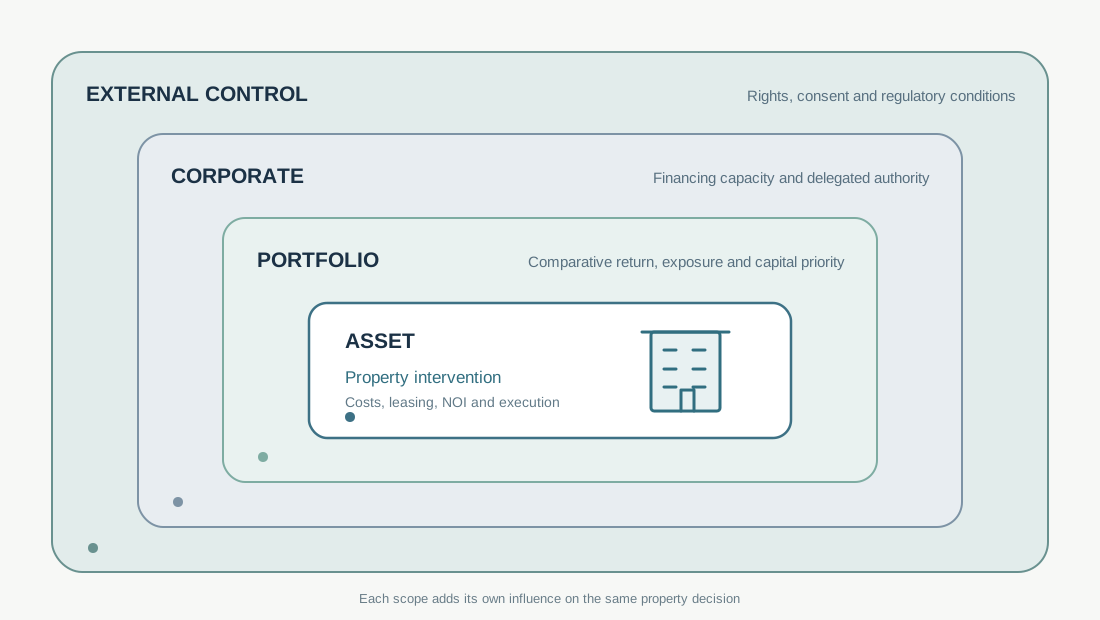
Asset level: What should happen to this property?
The asset level develops the property-specific judgment. Leasing and tenant strategy, operating budgets, maintenance programs, capital expenditure (CapEx), refurbishment, repositioning, and the property business plan converge here. The governing economic question is how an intervention changes expected occupancy, rental income, operating costs, condition, and NOI, taking account of the execution risk required to obtain that result. A team might favor a refurbishment because it believes the existing specification is weakening leasing prospects. Its evidence should identify the affected space, tenant demand, lease-up assumptions, disruption, cost, and timing. That recommendation can be commercially well founded even when the institution ultimately declines to fund it. The asset level establishes what could create value at the property; how that value ranks against other uses of institutional capital is decided at the next level.
Portfolio level: Is this the best use of capital?
Portfolio judgment places the asset proposal alongside competing opportunities. A credible refurbishment case can lose priority to another property with stronger incremental returns, a necessary defensive investment, debt reduction, or a disposal that releases capital. Portfolio managers compare performance, sequence CapEx, manage sector and geographic exposures, and determine which assets warrant retention, improvement, or sale. Their assessment should consider concentration, risk-adjusted returns, funding capacity allocated across properties, and the timing of alternatives. A delayed project may reflect a deliberate capital choice made at portfolio level. Conversely, a portfolio that evaluates proposals only as separate asset cases can overlook the opportunity cost of keeping capital committed to lower-priority holdings.
Corporate level: Can the organization authorize and fund it?
At the corporate level, a selected investment must fit the organization's financing capacity, liquidity position, borrowing strategy, leverage and risk limits, reporting responsibilities, and formal approval architecture. Management, investment committees, boards, or shareholders may control different decisions and signing authorities. Their role can affect both the price of capital and the speed with which a proposal becomes an authorized commitment. As one documented example, Globalworth Real Estate Investments Ltd's investment committee terms of reference cover acquisitions, disposals, development, CapEx, loan and debt matters, and leases within a delegated-authority framework. Matters beyond relevant thresholds are recommended to its board for approval. The document describes one company's arrangement and states no monetary thresholds.
External-control level: What rights and conditions govern execution?
An internally approved decision may still depend on rights held outside the approving organization. Financing agreements, joint-venture documents, property registration requirements, regulation, valuation requirements, audit and assurance, and contractual restrictions can condition or prevent execution. A disposal, for example, may be subject to lender consent: Gowling WLG's English-law discussion of consent restrictions explains how financing documents can require approval before a borrower sells a secured asset. External control also includes contractual co-ownership rights. A CMS briefing on real estate joint-venture governance describes 50/50 arrangements in which both shareholders decide reserved matters, potentially including approval or material amendment of a business plan and the level or terms of third-party debt. The precise consent rights depend on the documents and applicable law.
The four levels at a glance
| Level | Central question | Typical decisions or controls | Outcomes most directly affected |
|---|---|---|---|
| Asset | What should happen at this property? | Leasing, operations, repairs, CapEx, repositioning | Occupancy, rent, costs, condition, NOI |
| Portfolio | Is this the best portfolio use of capital? | Capital ranking, exposure, hold/improve/sell | Allocation quality, concentration, opportunity cost, timing |
| Corporate | Can the institution authorize and fund it? | Financing, liquidity, leverage, delegated approvals | Cost of capital, liquidity, approval speed, financing capacity |
| External control | What rights and requirements affect execution? | Lender and JV consent, valuation, legal and regulatory controls | Transaction certainty, timing, covenant compliance, enforceability |
How the levels connect in a repositioning decision
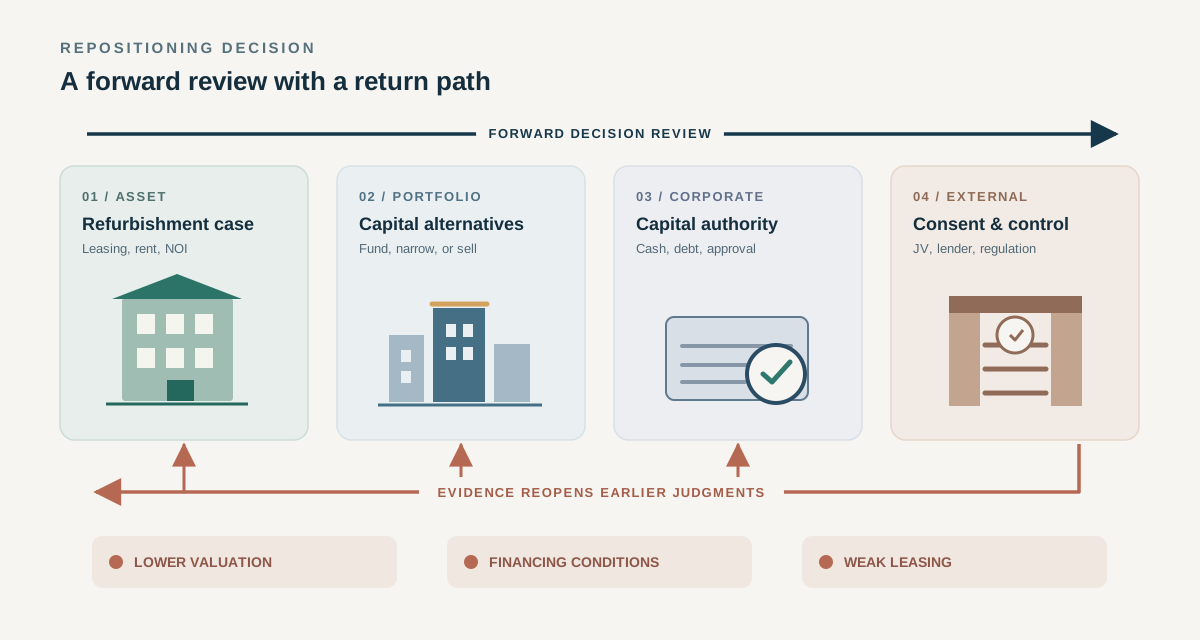
Consider an illustrative property with declining occupancy. The asset team concludes that dated common areas and an unsuitable floor configuration are limiting leasing prospects. It proposes a refurbishment, with a business case that links spending to expected absorption, incentives, rent, downtime, and eventual NOI. That proposal begins as an asset-level judgment, informed by leasing evidence and the team's knowledge of the building.
The portfolio team then tests it against other calls on capital. It may prefer work at another asset, require a narrower scope, or revisit whether selling the property would produce a better risk-adjusted result. A positive asset-level return estimate is only the entry point to that comparison. If the project clears the portfolio test, corporate management must determine whether it fits available cash, financing commitments, leverage limits, and the applicable authorization process. Formal approval may rest with management, an investment committee, or the board, depending on the institution's rules.
Execution may introduce another set of conditions. A joint-venture agreement could reserve material business-plan amendments or debt decisions to both partners. A lender could require consent under the financing documents. Applicable property and regulatory requirements may also affect the proposed works. These requirements should be identified while the investment case is being formed, because they can change the feasible schedule, transaction structure, or project economics before funds are committed.
The movement is also backward. Suppose a valuation comes in below the assumption used in the investment case. The RICS Red Book Global Standards supports valuation work used for investment analysis, secured lending, and financial reporting. A single valuation exercise can inform portfolio judgment, the lender relationship, and corporate reporting, although each use may involve its own valuation basis and requirements.
One specific financing route is explained in CMS's UK briefing on loan-to-value covenant defaults. Where an LTV covenant is tested against property market value, a reduced valuation can create a potential breach. Depending on the loan terms, a borrower may have cash-deposit or prepayment cure rights; a lender may consider a waiver with conditions such as a cash trap or a limited waiver period. Corporate management may then have to preserve liquidity, adjust financing, or reduce project scope. Whether a valuation change triggers any of this depends on the loan documents and the governing law.
Financial reporting can add another channel. For institutions using IFRS and the fair value model for investment property, IAS 40, as summarized by the IFRS Foundation, requires remeasurement at each reporting period, with changes in fair value recognized in profit or loss as they occur. Institutions applying a cost model or a different accounting regime have different reporting effects. Meanwhile, if leasing after the first phase of works is weaker than forecast, the asset team may need to reopen the original assumptions and the portfolio team may reconsider the hold-versus-sell decision. The approval chain works as a feedback system: later evidence can invalidate an earlier case.
Diagnosing the real constraint
The practical use of the model begins with a stalled decision. Identify the triggering issue, then reconstruct the actual decision path. What evidence did the asset team provide? Was the proposal rejected on its economics, deprioritized against competing investments, held for funding, referred above an authority limit, or conditioned by an external right? Each explanation points to a different remedy.
Consider a property whose leasing performance remains weak while refurbishment is repeatedly deferred. The visible symptom sits at the asset level, but the binding constraint could be portfolio prioritization, a corporate liquidity requirement, or a lender restriction. More detailed leasing reports may improve the evidence without changing the reason for delay. Equally, asking the board to approve a project may accomplish little if the joint-venture business plan cannot be amended without partner agreement.
A useful decision record separates the person who recommends an action from the person who judges its relative economic merit, the person or body authorized to approve it, the budget holder, and the party entitled to sign or consent to execution. It should also capture the decision sought, its alternatives, financial assumptions, material conditions, approvals already obtained, evidence still required, and the consequence of waiting. These are proposed diagnostic disciplines; institutions will record decisions in their own ways.
This separation makes delay interpretable. A queue caused by incomplete assumptions calls for better analysis. A queue caused by unclear delegated authority calls for clarification. A financing covenant that protects a lender's agreed position requires compliance, negotiation, or a change in the transaction. Treating all three as an asset-manager performance problem obscures where action is possible.
How decision friction reaches investment outcomes
The four levels exert different pressures on financial performance. Asset decisions principally alter property income, operating expenditure, tenant retention, and condition. Portfolio choices determine where scarce capital is deployed and whether exposure and opportunity cost are justified. Corporate choices influence funding cost, leverage, liquidity, and the ability to commit at the required time. External rights and rules determine whether an otherwise authorized action can close and remain compliant. Total investment return emerges from the interaction of those judgments over the holding period.
When the levels are poorly coordinated, several adverse outcomes are possible. Delayed leasing or refurbishment may defer rental income; weak sequencing may lead to cost overruns or intervention after a leasing window has passed. A financing decision made without sufficient regard to the business plan may constrain a viable project. Delayed acquisition or disposal approval may miss the intended market timing, while continued investment in a weaker asset can crowd out a stronger opportunity elsewhere in the portfolio. A flawed hold-versus-sell judgment can persist because the party with the most immediate evidence lacks a route to reopen the capital decision.
There are also legal and balance-sheet exposures. A transaction advanced before required consent may create contractual or compliance risk; a project justified on an outdated valuation or funding assumption may place additional pressure on leverage and liquidity. These are plausible causal pathways, and their frequency and cost remain unmeasured. The severity and direction of any effect depend on the asset, documents, market conditions, decision timing, and available alternatives.
Designing proportionate reviews and approvals
Multiple reviews impose time and information costs, yet they can prevent unauthorized commitments, excessive leverage, concentration risk, or investment based on weak assumptions. A lender's consent right or a board's reservation of authority may be integral to the agreed capital structure. The quality of governance is better judged by whether each review addresses a distinct material risk and reaches the decision maker with enough evidence to act.
Proportionality begins with the size, reversibility, funding implications, and legal conditions of the proposal. Routine operating expenditure within an approved business plan should require a different decision path from an unplanned repositioning funded with additional borrowing. For a larger commitment, effective preparation means identifying the approval threshold, financing constraints, and consent requirements before the investment case reaches its final review. Conditions should be explicit: approval may depend on an updated valuation, financing headroom, tenant commitments, or a specific partner consent.
Avoidable friction arises when the same question is repeatedly reviewed without new evidence, when authority is unclear, when the budget owner is absent from deliberation, or when an external consent issue emerges only after internal approval. Necessary control exists when a reviewer tests a genuinely separate risk or holds a right that another party cannot waive. Both can coexist in the same approval path. Improving decision speed requires tracing what each step protects and redesigning handoffs where information is lost, while preserving the controls the transaction actually requires.
Making decision histories useful
The value of this model is clearest after a difficult decision has concluded. Leaders can compare the original asset case, portfolio ranking, funding judgment, approval route, external conditions, and realized outcome. That record can show whether an assumption was wrong, a constraint was recognized too late, an approval was appropriately withheld, or a delay changed the economics. It can also identify cases where several reviews added protection at little incremental cost.
For institutional investors, investment outcomes depend on property selection and asset execution, and on how property evidence reaches portfolio allocation and the next use of capital, how corporate capital and authority are applied, and how external rights shape the transaction that can actually be completed. These interactions can materially influence income, valuation, liquidity, risk, and total return. Assessing them requires specific decision histories and observed results. Establishing that coordination failures cause recurring investment losses would require evidence from completed decisions and credible counterfactuals; organizational complexity on its own supports only a hypothesis.
References
- IFRS Foundation, IAS 40 Investment Property.
- RICS, Red Book Global Standards: 50th anniversary.
- CMS, Loan to Value default?, April 20, 2023.
- CMS, Real Estate Joint Ventures: Governance and Management, December 2024.
- Globalworth Real Estate Investments Ltd, Investment Committee Outline Terms of Reference and Procedures.
- Gowling WLG, Lenders beware! Consents come under closer court scrutiny, June 21, 2018.
Explore the Institutional Real Estate collection
Author
Ahmed Abbas - Founder & CEO, DUNNIXER
Former IBM Executive Architect with 26+ years in IT strategy and enterprise architecture. Advises technology providers and delivery leaders on architecture establishment, integration boundaries, decision governance, and complex technology delivery. View author profile on LinkedIn.