Institutional real estate investment decisions
Who Can Actually Authorize a Real Estate Investment Decision?
Tracing the legal entities, approval mandates, signing powers, and external consents that make institutional real estate decisions executable.
Senior Support and Formal Decision Authority
A material real estate decision may have the full support of senior management and still require several distinct acts before it can be implemented. The investment rationale may be settled, the commercial terms agreed in principle, and the relevant executives aligned. Execution depends on whether the correct legal entity, authorized approver, signatory, and external consent parties have each completed their required role.
Institutional real estate operating models distribute decision power differently across corporate groups, funds, property-owning special purpose vehicles, joint ventures, financing arrangements, and delegated management organizations. The person directing investment strategy may have considerable influence over an asset without holding formal authority to approve a particular transaction involving it.
A chief investment officer may support a disposal and determine that it is consistent with portfolio objectives. Formal Approval may nevertheless sit with an investment committee, an entity board, or shareholders under a reserved-matters provision. A committee may issue a Recommendation that carries significant institutional weight while lacking the power to bind the contracting company. Even after Approval, the proposed signatory must have authority to act for that company.
The distinction also applies between parent companies and their subsidiaries. Group leadership may determine investment priorities, but the property-owning subsidiary remains a separate legal entity with its own governance obligations. Christine Tretzmueller-Szauer, writing for Herrington Carmichael on subsidiary governance, explains that a subsidiary's directors owe their duties to that company rather than to its shareholders or another group company. The analysis concerns UK corporate governance, but illustrates why a parent's strategic direction and a subsidiary's formal decisions must be distinguished.
Corporate hierarchy, brand identity, and transaction size provide organizational context. Authority depends on the governing entity, documents, mandates, and transaction conditions. A modest transaction may require an external party's consent, while a larger transaction may fall within an appropriately constituted delegation.
For investment leadership, the practical objective is to establish an auditable chain from the proposed commercial decision to the acts that make it effective. That chain begins by separating the different forms of decision power.
The Six Forms of Decision Power
Decision authority becomes easier to trace when six distinct functions are recorded separately. The following classification is a working discipline for examining material real estate decisions; institutions may label these functions differently in their own governance documents.
Influence is the ability to shape a preferred outcome. A group chief executive, principal investor, portfolio manager, or senior stakeholder may influence investment strategy, transaction timing, counterparty selection, or acceptable commercial terms. Influence can determine which proposals advance through an organization; authorizing the resulting commitment requires a separate mandate.
Recommendation is the formal proposal of a course of action. An investment team may prepare an acquisition memorandum, an asset manager may propose a capital expenditure program, or a committee may recommend an asset sale. Recommendation supplies the analytical and commercial basis on which the authorized decision-maker acts.
Approval is the formal authorization to proceed with an identified action under the relevant governance arrangements. Approval may rest with an entity board, shareholders, an investment committee, or a person holding delegated authority. Its validity depends on the mandate, applicable limits, required conditions, and matters reserved to another decision-making body.
Signing authority is the authority to execute documents that legally bind the relevant entity. A person may be authorized to approve a proposal but lack the power to sign the resulting agreement. Conversely, an authorized signatory may execute an agreement following valid Approval without personally determining its commercial merits.
External consent is the satisfaction of approval or permission rights held outside the immediate internal decision process. Such rights may belong to lenders, joint venture partners, shareholders, regulators, or other parties under applicable agreements and requirements. An internally approved transaction can remain conditional on External consent.
Execution is the completion of the transaction or operational action. Depending on the decision, it may involve funding, settlement, registration, transfer of title, commencement of works, implementation of a lease, or operational handover. Execution establishes whether the authorized action has achieved its intended legal and operational result.
These six powers can belong to different people, corporate bodies, legal entities, and organizations. Some may be exercised by the same person, but their purposes remain distinct. A complete decision record should establish which powers were required, who held them, and how their exercise was evidenced.
Authority Begins With the Legal Entity
The starting point for tracing decision authority is the entity whose rights or obligations will be affected. An institutional investment organization may operate through a recognizable group name, yet the legal actor in a transaction may be a property company, holding company, fund vehicle, joint venture entity, or another subsidiary.
Three questions establish the initial entity position. Which legal entity owns the property? Which entity will enter the proposed contract? Which entity will borrow, grant security, incur an obligation, or receive transaction proceeds? The answers may identify a single entity or several entities participating in different aspects of the same decision.
Consider an asset managed by a central portfolio team but legally owned by an SPV. The team's mandate may permit it to negotiate a disposal, prepare the investment case, and recommend the sale. Formal Approval may belong to the SPV's board under its governing documents. If another group company provides a guarantee or undertakes a related obligation, that company may also need to exercise its own authority.
Authority must therefore be traced through the governing documents and valid delegations of each relevant legal entity. A group investment policy can establish a common internal process, but the authority it creates or delegates must be evaluated against the legal position of the entity taking the action.
The trace becomes more involved where ownership and management are separated. An investment manager may have broad discretion under a management agreement, while specific transactions remain subject to fund-level, entity-level, or investor approvals. Joint venture arrangements add further distinctions: a management board may control ordinary operations while selected strategic decisions require partner or shareholder consent.
The entity-first approach asks which organization will act, through what authority, and subject to which additional rights or conditions. Where several entities participate, each requires its own authority trace.
The Documents That Determine Authority
Authority is established through the interaction of corporate governance documents, delegations, transaction agreements, and applicable legal requirements. The following table identifies the principal documents to examine and the questions each can resolve.
| Document | What it can determine | What to check |
|---|---|---|
| Articles of association | Corporate decision-making powers and governance procedures | Board powers, shareholder rights, decision procedures, and relevant restrictions |
| Shareholder agreements | Contractual rights affecting decisions within the entity | Reserved matters, consent thresholds, affected parties, and conditions |
| Board and committee mandates | Responsibilities assigned to particular corporate bodies | Scope of authority, reserved matters, quorum requirements, and reporting obligations |
| Delegation-of-authority schedules | Authority delegated to executives, officers, or management functions | Transaction categories, financial limits, conditions, exclusions, and current validity |
| Board or shareholder resolutions | Specific approvals, authorizations, and appointments | Approving body, approved action, limits, conditions, and effective date |
| Powers of attorney | Authority granted to an appointed person to act for an entity | Granting entity, authorized acts, document types, amendment powers, and continuing validity |
| Financing agreements | Contractual restrictions and lender consent requirements | Disposal covenants, security provisions, permitted transactions, consent conditions, and release mechanics |
| JV reserved-matters schedules | Decisions requiring partner, member, or shareholder participation | Covered decisions, approval rights, voting requirements, and consent evidence |
| Regulatory and registration requirements | External permissions and formalities affecting effectiveness | Required approvals, filings, registrations, eligible actors, and completion conditions |
These documents perform different functions. Articles and shareholder agreements establish the entity's governance position. Mandates and delegation schedules allocate authority within that structure. Resolutions and powers of attorney can evidence particular authorizations. Financing and JV agreements may impose additional contractual conditions, while registration requirements govern aspects of completion.
The quality of a delegation depends on its definition and continuing validity. In Brodies' guidance on delegating corporate authority, Martin Ewan, Greg Costello, and Susannah Scott describe terms of reference as establishing the boundaries of delegated powers. They also identify responsibilities typically reserved to the board and the need for a clear process to amend or revoke delegations. A mandate relied upon in an earlier transaction may therefore have been revised before the present decision.
Signing requirements deserve separate examination. James Waddell's Stevens & Bolton guidance on document execution provides an England and Wales illustration. It explains that where a non-director signs on a company's behalf, the relevant authority must come from the board rather than an individual director. It also distinguishes authority to execute a deed, which must itself be granted by deed. These jurisdiction-specific mechanics illustrate why commercial Approval and Signing authority require separate evidence.
The applicable documents depend on the proposed decision, the acting legal entity, the value and nature of the commitment, the conditions attached to it, and the date on which authority is exercised. An authority assessment should identify the operative version of each relevant document and any limitations affecting the proposed action.
Why the Authority Chain Matters to Investment Execution
A commercially attractive decision can encounter material execution constraints when its authority chain has not been established. An acquisition may satisfy the investment criteria and have management support, yet remain dependent on Approval from an entity or investor body that has not acted. A sale may be negotiated on acceptable terms while a lender's consent or a joint venture partner's reserved-matter approval remains outstanding. These conditions can affect whether and when the proposed transaction proceeds.
The potential consequences extend beyond transaction timing. An agreement signed without sufficient authority may create questions over enforceability or require corrective action. A capital project or leasing decision may be delayed while the appropriate delegated limit is confirmed. Financing documentation may restrict disposals, additional indebtedness, or security arrangements, potentially introducing further conditions, transaction expense, or negotiations. An incomplete record can also create disputes over who approved a commitment and whether that Approval covered the terms eventually executed.
Joint venture governance provides a concrete illustration. In its analysis of real estate JV governance, CMS identifies constitutional amendments, material business-plan changes, and the level or terms of third-party debt as examples of matters that may be reserved to shareholders. Such provisions can give a minority investor veto rights over specified decisions. Their effect depends on the actual JV arrangements, whatever the commercial preference of the majority investor or management team.
The same investment proposal may therefore require different forms of authority for its commercial selection, contractual commitment, financing treatment, and completion. Establishing those requirements early allows transaction sequencing to reflect the parties whose participation is necessary. Authority is part of investment execution: it connects the commercial decision to a legally and operationally effective result.
A Practical Authority Map for Material Decisions
Investment leaders can make the authority chain explicit by recording six elements for each material decision. The proposed map should accompany the investment proposal and transaction workstream, with underlying documents and evidence identified for each element.
- Decision: What exactly is proposed? Define the action sufficiently to distinguish an acquisition from an option to acquire, an asset disposal from a refinancing, or an approved capital budget from authorization to enter a particular construction contract. Record the commercial scope and conditions that could change the required authority.
- Legal entity: Which entity owns the asset or will enter the obligation? Identify the contracting, borrowing, security-granting, and proceeds-receiving entities as applicable. Establish which entity's governing documents control each necessary act.
- Recommender: Who prepares and recommends the action? Identify the investment team, asset manager, committee, or other function responsible for the Recommendation, including the formal document or process through which it is submitted.
- Approver: Who has formal authority, and within what limits? Record the applicable board, committee, shareholder, or delegated executive mandate. Identify transaction thresholds, reserved matters, voting conditions, and whether further Approval is required if the proposed terms change.
- Signatory: Who can legally bind the entity? Identify the authorized person or persons, the basis of Signing authority, the documents they may execute, and any conditions governing execution.
- External consents: Which lenders, partners, shareholders, or authorities must act? Identify each required External consent, its contractual or legal basis, the relevant decision-maker, the evidence of satisfaction, and any conditions to be fulfilled before Execution.
Each entry should point to verifiable evidence of authority, such as a committee charter, current delegation schedule, board resolution, power of attorney, financing provision, or written consent.
The map is prepared per decision and per legal entity because authority changes with context. A director may be authorized to sign for one SPV but have no equivalent power in another. A portfolio manager may approve ordinary operating expenditure within a delegated limit while requiring separate Approval for a disposal or financing amendment. A transaction involving multiple companies can require several distinct approvals, even when the same individuals sit on their respective boards. Recording each element separately makes these dependencies visible and distinguishes completed authorizations from outstanding actions.
Apply the Map Throughout the Decision
The authority map has value throughout the investment process. Each stage presents a different question about the readiness of the proposed action.
Before analysis, identify the relevant legal entities, potential authority constraints, and required decision participants, ahead of substantial work on a transaction structure. A proposal involving an SPV disposal, secured asset, or JV interest may require specific approvals or consents that influence its feasible terms. Establishing those dependencies at the outset helps the investment team assess a transaction on an executable basis.
Before approval, verify the approving body's mandate, the legal entity to which that mandate applies, and the current delegation limit. Confirm that the proposed transaction falls within the relevant authority and that any required quorum, reserved-matter process, or additional approval condition can be satisfied. Where the commercial terms change materially, reassess whether the existing Approval still covers the proposal.
Before signing, confirm the signatory's authority to bind the particular entity and check whether outstanding conditions affect execution. Where relevant public registers are available, a director's appointment can be checked against the applicable register. For an attorney, the underlying instrument should be examined for scope and validity, including authority to agree amendments. The Stevens & Bolton guidance cited earlier illustrates these checks in an England and Wales context.
Before funding or closing, confirm that the required External consent has been obtained and that associated conditions have been satisfied. This may involve lender approval of a disposal, release of security, JV partner consent, shareholder authorization, or an applicable regulatory permission. The completion team should distinguish consents already effective from commitments to provide consent later, and sequence funding, release, transfer, and settlement accordingly.
After completion, retain the evidence connecting the approved decision to its completed outcome. The transaction record should contain the relevant Approval, executed documents, external consents, required registration evidence, and confirmation of settlement or operational implementation. Any final conditions, amendments, or post-completion actions should be reconciled against the authority map.
A Hypothetical Property Sale
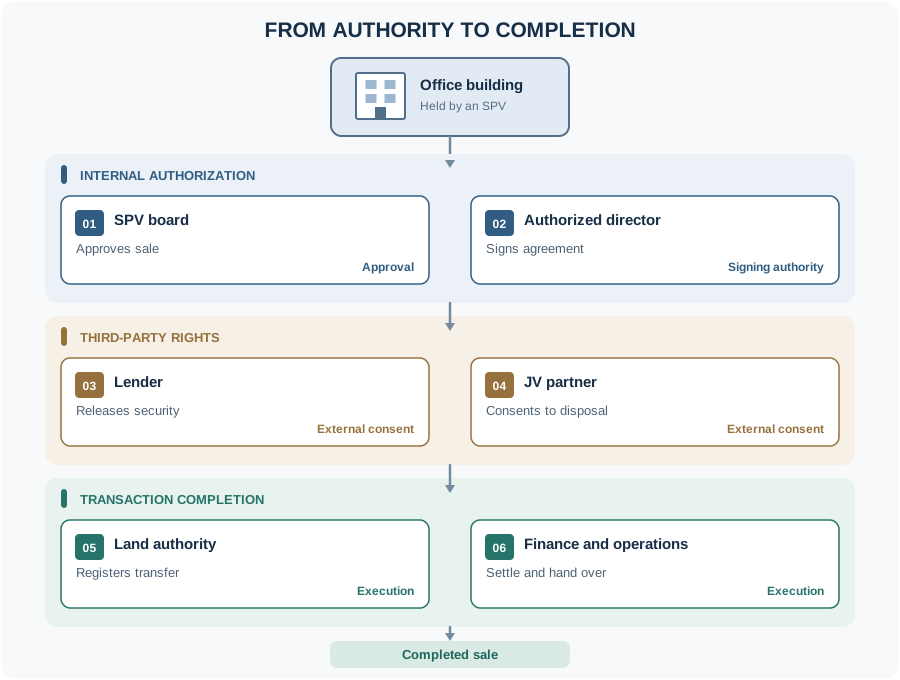
Consider a hypothetical institutional portfolio in which the investment team recommends selling an office building owned by an SPV. Senior management supports the sale, and the portfolio team has negotiated acceptable commercial terms. The property is subject to lender security, and the SPV operates within a joint venture arrangement that reserves asset disposals for partner consent.
The initial portfolio proposal represents Recommendation, informed by the Influence exercised by senior investment leadership. Converting it into a completed sale requires six distinct actions.
- The property-owning SPV's board approves the sale. The board exercises Approval under the SPV's applicable governance arrangements. Its resolution should establish the transaction being authorized, the relevant terms, and any conditions or delegations necessary to proceed.
- An authorized director signs the agreement. The director exercises Signing authority for the SPV. The basis for that authority and the applicable execution requirements must cover the agreement being signed. Board Approval and contractual execution are separately evidenced acts.
- The lender releases its security. The relevant financing provisions determine the required External consent and release mechanics. A useful illustration appears in Taylor Wessing's discussion of the facility arrangements in Macdonald Hotels Ltd v Bank of Scotland Plc [2025] EWHC 32 (Comm). The facility described included a negative pledge and a no-disposals undertaking, with provision for a disposal to be permitted by prior written approval of the Majority Lenders. These mechanics illustrate how financing arrangements may condition a sale on lender consent; the hypothetical transaction's own facility terms would govern its requirements.
- The JV partner provides reserved-matter consent. The partner exercises External consent under the applicable JV agreement. Jonathan Cantor and Gregory Nash, in Burges Salmon's discussion of property JV governance, explain that strategic matters such as changes to the business plan or asset sales may be reserved to JV members rather than the management board. Whether this consent is required, and how it is given, depends on the specific agreement.
- The land authority registers the transfer. The relevant registration requirements are satisfied so that the transfer achieves its intended legal effect. This is part of Execution and must follow the applicable documentation and procedural requirements.
- Finance and operations complete settlement and handover. The relevant functions complete the financial and operational components of Execution, including settlement, records, and transfer-related handover obligations.
Agreement at one stage does not complete the others. The portfolio team's Recommendation and senior management's Influence support the commercial choice. The SPV board's Approval establishes internal authorization, and the director's Signing authority enables the contractual commitment. The lender and JV partner exercise separate External consent rights. Registration, settlement, and handover complete the relevant elements of Execution.
Actual sequencing depends on the governing documents, contractual conditions, and registration arrangements. Some approvals may be obtained before signing, while other steps may be coordinated at closing. Each necessary authority and consent must be identified, obtained at the appropriate point, and evidenced before the action that depends upon it.
The Decision Record That Leadership Needs
The decisive question for an institutional real estate investment leader is which legal entity was involved, who could recommend, who could approve and within what limits, who could sign, what external consents were required, and what made the decision legally and operationally effective.
Following that chain clarifies accountability at each point. It also provides a basis for distinguishing an investment proposal ready for consideration, a decision validly authorized, a contractual commitment properly executed, and a transaction whose remaining conditions have been satisfied.
For leadership, the resulting record has continuing value after completion. It establishes the basis on which the institution acted, identifies the authority exercised by each participant, and preserves evidence that the intended result was achieved. Such a record makes a material real estate decision more executable, accountable, and defensible.
References
- Christine Tretzmueller-Szauer, Herrington Carmichael, Corporate Governance of a Subsidiary in a Group Context, November 20, 2024.
- Jonathan Cantor and Gregory Nash, Burges Salmon, Corporate Governance in Property Joint Ventures: What You Need to Know, June 17, 2026.
- Justin Coaley and Gérard Maitrejean, CMS, Real Estate Joint Ventures: Governance and Management, December 2024.
- Martin Ewan, Greg Costello, and Susannah Scott, Brodies LLP, Four Top Tips for Delegating Corporate Authority, July 29, 2024.
- James Waddell, Stevens & Bolton LLP, Execution of Documents: Top Ten Q&As, March 12, 2020.
- Taylor Wessing, Navigating Lender-Driven Consent to Secured Hotel Sale: Implied Terms, Assignment Clauses, Execution, February 18, 2025.
Explore the Institutional Real Estate collection
Author
Ahmed Abbas - Founder & CEO, DUNNIXER
Former IBM Executive Architect with 26+ years in IT strategy and enterprise architecture. Advises technology providers and delivery leaders on architecture establishment, integration boundaries, decision governance, and complex technology delivery. View author profile on LinkedIn.