Institutional real estate investment
One Real Estate Ownership Lifecycle, Many Operating Models
How five institutional ownership structures route investment decisions through different authorities, approvals, and execution responsibilities
Published: October 28, 2026
By Ahmed Abbas, Founder & CEO, DUNNIXER
The Common Ownership Lifecycle Can Create a False Impression
Institutional real estate owners confront a broadly similar set of investment and management decisions. They establish strategy and allocate capital, acquire properties, manage leasing and operations, authorize capital expenditure and repositioning, arrange financing and valuations, review portfolio performance, and decide when assets should be retained or disposed of. Together, these investment and management decisions form the ownership lifecycle, a common language for understanding the business of real estate ownership.
That common language can create a misleading impression of organizational similarity. Legal structure, capital source, governance, financing arrangements, and external rights determine how an institution turns an investment proposal into an authorized and executed decision. Two owners considering the sale of comparable buildings may require different approving bodies, consents, signatories, and records before the transactions can proceed.
The distinction is between the ownership lifecycle and the operating model. The lifecycle identifies the decisions an owner must manage. The operating model establishes which entities and people participate in those decisions, the authority each holds, the conditions attached to exercising that authority, and the sequence through which the outcome becomes effective.
A portfolio manager may formulate a disposal recommendation, an investment committee may endorse it, a board may grant formal approval, and an authorized director may execute the sale documents. Depending on the ownership structure, a lender, partner, trustee, or shareholder may hold an additional consent right. Implementation may involve different internal teams and external providers.
Understanding an institutional owner requires tracing a particular decision through the legal entity, delegation arrangements, governing documents, and external obligations that apply to it. Organizational titles and committee names provide useful starting points, but their actual powers must be established.
Private Groups
Private groups may concentrate strategic and investment authority among family shareholders, a parent company, or a relatively small executive group. Senior principals can remain closely involved in acquisitions, financing, major capital expenditure, and disposals. Communication between the people proposing and deciding an action may be relatively direct, while formal committee structures and delegation arrangements may be less visible than those of publicly traded organizations.
The defining analytical issue is the relationship between personal influence and legal authority. A family principal may determine investment priorities, express a preference about a sale, or resolve disagreement between executives. The legal ability to approve or execute the resulting transaction depends on the relevant company's governance and delegation arrangements.
In their analysis of family-office governance for Morgan Lewis, Brian Slough and John Boxer write that heavy principal involvement calls for a clear line between the authority of principals and that of staff, and they describe a delegation matrix that sets out which decisions the principal keeps exclusively. They place family councils in a separate sphere, focused on the governance of the family itself, while business governance is implemented through corporate structure, governing documents, committee charters, and delegation of authority. Their subject is the family office, and the same separation between family arrangements and corporate authority is relevant when a private group holds real estate.
Consider a privately held property company whose investment director recommends selling an asset. A family shareholder may support the transaction, yet the legal seller could be a subsidiary whose directors or authorized representatives must approve or execute the sale. The parent's delegation policy may require additional approval.
The relevant evidence may include the ownership chain, constitutional documents, board resolutions, delegated-authority schedules, and financing arrangements. These establish where principal influence enters the process and where formal corporate authority sits.
Listed Companies
Listed companies route real estate decisions through corporate governance structures that may extend across operating subsidiaries, property-holding companies, and the listed parent. Board mandates, shareholder rights, internal controls, audit requirements, and market-disclosure obligations can each affect a material property decision.
The listed corporate brand identifies the public group, while the building may belong to a subsidiary or another controlled vehicle. The ownership structure determines which entity holds the immediate authority over the asset, whether parent-level approval is required, and which entity executes the transaction documents.
A disposal could originate with an asset-management team, receive investment committee endorsement, proceed through a subsidiary board, and then require additional authorization under the listed parent's delegation framework. The applicable route depends on the group's governing documents and the decision's characteristics.
Internal approval, contractual execution, and public disclosure are separate events. A transaction may have completed one governance stage while remaining subject to further authorization or contractual conditions. Public disclosure follows its own regulatory triggers and timing requirements.
The distinction is illustrated by Stibbe's analysis of the revised EU Market Abuse Regulation disclosure regime. From June 5, 2026, where inside information arises in a protracted process, only the final event or circumstance must be disclosed, as soon as possible upon its occurrence; an intermediate step no longer has to be disclosed at that stage. Issuers must still keep intermediate inside information confidential, and if confidentiality is compromised or can no longer be ensured, the information must be disclosed immediately.
An operating-model assessment should identify the asset-owning entity, the management and board approval sequence, the authority to execute, and the separate responsibility for determining disclosure obligations. Consolidated reporting and centralized investment oversight may coexist with distinct legal approval routes across subsidiaries.
REITs
REITs introduce distinctions between investment management, asset ownership, investor interests, and formal transaction authority. Depending on the structure, responsibilities may be distributed among a REIT manager, board, trustee or custodian, property-holding vehicles, lenders, regulators, and investors.
A manager may establish portfolio strategy, assess an acquisition or disposal, negotiate commercial terms, and recommend action. Final authorization and execution may belong to another entity or require approvals under the trust deed, constitutional documents, investment mandate, or applicable regulatory framework.
Hong Kong's rules for authorized REITs show how this division can work in a trust structure. The Securities and Futures Commission's key regulatory requirements for REITs require the manager to manage the REIT in the sole interest of its holders and to ensure that the REIT has proper legal title to the real estate it owns. The trustee has a fiduciary duty to hold the REIT's assets, must oversee the manager's activities, and must be independent of the manager.
That illustration concerns trust-structured REITs in one market. Corporate REITs and other jurisdiction-specific structures allocate ownership, management, and authority differently, so the actual legal form and governing documents determine which responsibilities apply.
For example, a REIT manager could recommend a disposal because an asset no longer fits portfolio strategy. The next questions concern how that recommendation becomes formally authorized, which entity holds the legal interest being sold, what role any trustee or custodian performs, and whether investors, lenders, or other parties possess approval or consent rights.
The same distinctions can affect leasing mandates, financing decisions, capital expenditure, related-party arrangements, and changes to investment strategy. Each decision may involve a different allocation of managerial discretion and formal authority.
Joint Ventures
Joint ventures place particular weight on negotiated rights between shareholders or partners. Their operating models are shaped by the joint venture agreement, the governance of the property-owning vehicle, and the division of responsibilities between the parties.
One partner may lead asset management, leasing, development, or financing while other partners retain approval rights over specified matters. An investment committee or board can authorize routine decisions within a delegated mandate while major leases, business plans, budgets, refinancing, redevelopment, and disposals remain subject to reserved-matter provisions.
The operating partner's responsibilities must be read alongside its contractual authority. A partner preparing and negotiating a sale may require another investor's consent before the transaction proceeds. A non-operating investor can exercise decisive influence through reserved rights while having limited involvement in daily property management.
Deadlock provisions form part of this operating structure. Brodies' discussion of joint venture deadlock mechanisms describes situations where parties cannot agree on material decisions at board or shareholder level, causing the business to stall. Agreements may provide continuation mechanisms, including escalation, cooling-off periods, or a casting vote, as well as structured exit mechanisms. The source addresses joint ventures generally; these contractual mechanisms can also be relevant to real estate joint ventures.
The pathway for a disposal depends on whether the sale is a reserved matter, which investors must consent, what approval thresholds apply, and what procedure governs disagreement. A proposal may be commercially developed and supported by the operating partner while awaiting another party's contractual consent.
Those dependencies influence how a transaction should be scheduled and monitored. A pending partner decision represents a different condition from incomplete asset analysis or an outstanding board paper, even when all three appear under the same investment approval process.
Government-Linked Platforms
Government-linked platforms can combine commercial real estate investment activity with mandates established by a state shareholder, parent organization, or other public-sector ownership body. Their legal forms and governance arrangements vary, so the relationship between public ownership and operational authority has to be established for each platform.
A platform may operate through a commercial company with its own board, subsidiaries, executives, and investment committees. Its governing documents or shareholder mandate may establish investment objectives, delegated powers, reserved decisions, and reporting obligations. Other structures may allocate authority differently.
The OECD Guidelines on Corporate Governance of State-Owned Enterprises, 2024 Edition provide an international reference standard for the state ownership relationship. They call for the state to establish broad mandates and expectations, allow state-owned enterprises full operational autonomy to achieve defined objectives, refrain from intervening in their management, and respect the independence of their boards. These principles describe how the ownership relationship is intended to function; they make no finding about any particular platform or jurisdiction.
For a government-linked real estate owner, analysis begins with the actual legal entity and its mandate. A property sale might fall within the delegated authority of the platform's board. Alternatively, governing arrangements could reserve specified transactions for a parent organization or shareholder.
The relevant questions concern the entity's constitutional documents, shareholder arrangements, board delegations, external restrictions, and powers granted to management. Government association alone provides no definitive approval route.
Why No Universal Workflow Exists
The operating-model differences across these five ownership structures arise from several interacting conditions. Legal and ownership structures establish which entities hold assets and exercise corporate powers. Sources of capital introduce different investor relationships, mandates, and accountability arrangements. Delegation limits determine which decisions management can take independently and which must move to committees, boards, or shareholders.
Board and committee mandates add another layer. Two institutions may both maintain investment committees, yet one committee may possess delegated approval authority while the other provides recommendations. The operative mandate establishes the committee's role in the decision.
Financing restrictions can introduce consent requirements, covenants, or conditions connected to particular assets and transactions. Partner and shareholder rights may reserve decisions to parties outside the day-to-day management structure. Regulatory and reporting obligations can create separate approval, oversight, documentation, and disclosure responsibilities.
The allocation of work between internal teams and external providers further shapes implementation. One owner may manage underwriting, asset management, legal coordination, and transaction execution largely in-house. Another may depend on an external investment manager, property manager, development manager, or administrator. Outsourcing operational work changes the responsibility chain while the underlying legal authority remains subject to the applicable contractual and governance arrangements.
These eight sources of variation interact. A joint venture can sit within a listed group, a government-linked investor may participate through a fund structure, and a privately owned group may use multiple financing and property-holding vehicles. Ownership categories provide useful starting points, while the operative documents and decision-specific rights determine the actual pathway.
One Property Sale, Five Possible Pathways
Consider the hypothetical decision to sell the same income-producing building under five alternative ownership structures. Each pathway in the table is illustrative, and the actual route would depend on the governing documents and rights applicable to the owner.
| Ownership model | Where the sale may be approved | Who may propose it | What else to check |
|---|---|---|---|
| Private groups | Executive or owner-level approval, followed by any required authority within the selling entity | Investment director, asset manager, or senior executive | Parent-company delegation, director authority, family influence, and the legal seller |
| Listed companies | Subsidiary-board or delegated corporate approval, subject to relevant parent-level mandates | Investment or portfolio-management team | Parent and subsidiary authority, shareholder rights, internal controls, and disclosure obligations |
| REITs | Approval through the applicable REIT or property-vehicle governance arrangements following a manager recommendation | REIT manager or investment-management team | Trustee or custodian role where applicable, vehicle authority, fund documents, and investor rights |
| Joint ventures | Partner or shareholder consent under the JV agreement, together with required company approvals | Operating partner or designated asset manager | Reserved matters, consent thresholds, deadlock mechanisms, and signatory authority |
| Government-linked platforms | Platform-board approval or parent/shareholder authorization within the applicable mandate | Investment team, portfolio executive, or platform management | Entity mandate, delegation limits, reserved shareholder powers, and external restrictions |
Any of these pathways may also require lender consent, execution by an authorized signatory, and completion of the applicable land registration process. Agreement on the commercial merits of a sale is one stage; authorization, contractual execution, and transfer may involve additional parties and conditions.
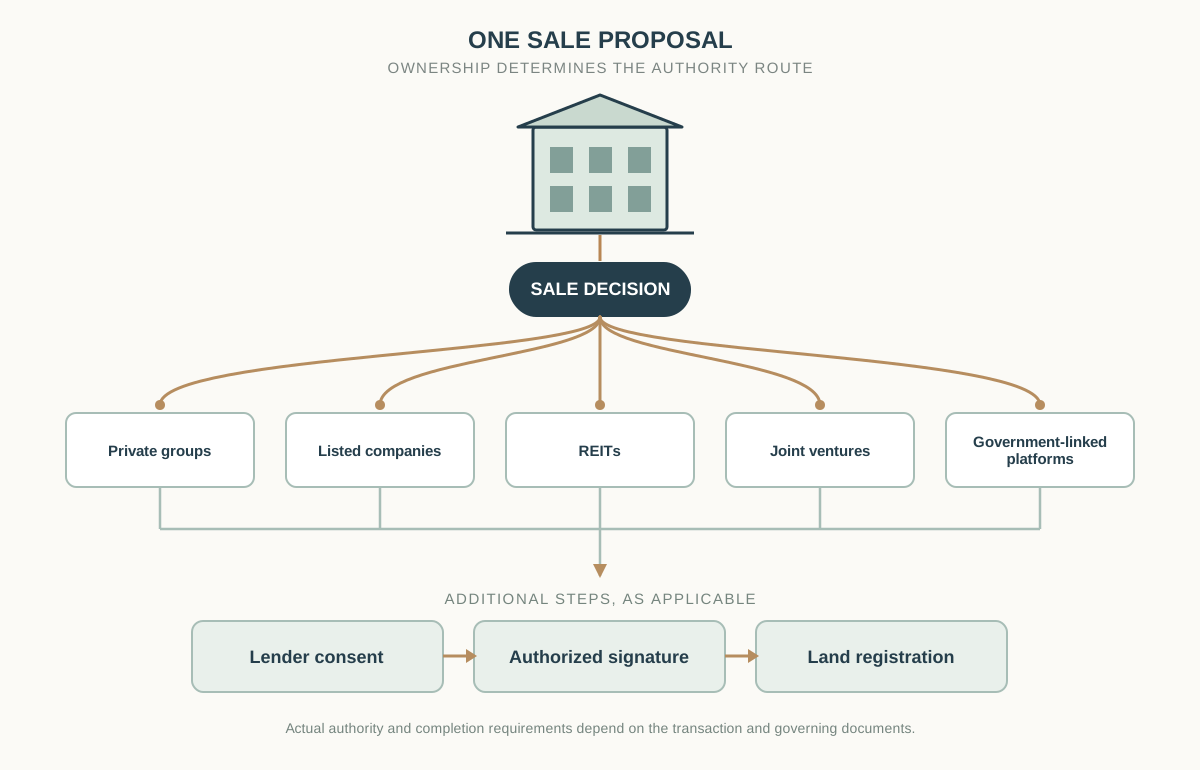
The comparison shows how the same decision in the ownership lifecycle can carry different decision dependencies. In one structure, the decisive approval may rest with an executive. In another, the proposal may require partner consent, trustee involvement, parent authorization, or another entity's formal decision. Its progress should be assessed against the specific stages completed and the obligations remaining.
Why These Differences Matter
Understanding the operating model allows an investment executive to identify the actual decision-makers before committing resources or interpreting transaction progress. The person responsible for negotiations may be the correct commercial counterpart while formal approval rests elsewhere. The approving body may become involved only when a recommendation reaches a defined stage. Mapping these roles clarifies where discussions should occur and what each participant can authorize.
The same understanding improves interpretation of delays. A transaction awaiting partner consent presents a different decision dependency from one awaiting internal investment analysis, lender approval, or execution by a property-holding entity. Each requires a different response, and the distinction enables accountability to be assigned to the party controlling the outstanding action.
It also supports more meaningful comparisons between organizations. Committee counts, approval stages, staffing structures, and transaction timelines are difficult to interpret without recognizing differences in mandates and external rights. A like-for-like comparison should consider the decisions each institution controls and the obligations imposed on its process.
Controls and information systems benefit from the same precision. Workflow design can distinguish recommendation from authorization, record external consents separately, apply entity-specific signatory rules, and preserve evidence of implementation. Without those distinctions, a system could treat an endorsement as final approval or allow commitments before necessary consents are obtained.
For investment outcomes, the value lies in making transaction dependencies visible early enough to manage them. Correctly identifying authority, consent, and execution requirements can help protect transaction timing, reduce the possibility of unauthorized commitments, and provide a clearer basis for responsibility when circumstances change.
How to Analyze an Institution's Operating Model
A practical assessment begins with the common ownership lifecycle to identify the material decisions the institution must make. Each decision is then traced through the ownership and governance structure to establish how it is recommended, authorized, executed, and recorded. Six questions provide a consistent basis for that reconstruction.
Which legal entity is acting?
Identify the entity that owns the asset, incurs the obligation, enters the contract, or exercises the relevant right. Establish its relationship to any parent, fund, trust, or joint venture.
Who recommends the action?
Determine who develops the investment case, prepares supporting analysis, negotiates commercial terms, and submits the proposal. Establish whether that function sits with an internal team, external manager, or partner.
Who formally approves it?
Trace delegation limits, committee mandates, board powers, shareholder rights, and reserved matters. Distinguish advisory endorsement from authority to proceed.
Who can sign for the entity?
Establish which officers, directors, trustees, representatives, or other authorized parties can execute the relevant documents, and the authorization on which their signing authority depends.
Which external consents are required?
Identify applicable lender, investor, partner, trustee, regulatory, or other third-party consent requirements, including the conditions and decision stages to which those rights apply.
Who implements and records the outcome?
Identify who completes the action, updates corporate and asset records, carries out registration or reporting requirements, and preserves evidence connecting approval to implementation.
Apply these questions separately to each material decision and each relevant entity. Authority over a routine lease may differ from authority over a major lease, redevelopment, financing, or disposal. The resulting map should identify the decision sequence, the responsible parties, and the rights and conditions governing each stage.
Conclusion
The ownership lifecycle provides a useful map of the investment and management decisions institutional owners face. It enables owners, managers, investors, and counterparties to discuss comparable activities across different organizational structures. The operating model supplies the authority structure needed to turn that map into a workable decision process.
For investment leaders, the appropriate unit of analysis is the specific decision within the relevant legal entity. That approach makes organizational comparisons more defensible, assigns accountability to the parties holding actual authority, and supports controls that reflect the conditions under which commitments can be made.
The ownership lifecycle explains what institutional owners must manage. The operating model explains who can act, through which authority, and under what conditions. Recognizing that distinction helps prevent false comparisons, incorrect accountability, and decision processes built around assumptions that the institution's governing arrangements do not support.
References
- Brian P. Slough and John T. Boxer, Morgan, Lewis & Bockius LLP, Family Office Governance: From Informal Decisions to Durable Systems, September 23, 2026.
- Stibbe, MAR: Revised Regime on Disclosure of Inside Information, June 2, 2026.
- Securities and Futures Commission, Hong Kong, Real Estate Investment Trusts: Key Regulatory Requirements, last updated October 13, 2025.
- David Millar, Susannah Scott, Izzy Deane, Amy Heffernan, and Louise Shaw, Brodies LLP, Joint Ventures: Deadlock Provisions, July 28, 2026.
- Organisation for Economic Co-operation and Development, OECD Guidelines on Corporate Governance of State-Owned Enterprises, 2024 Edition, OECD Publishing, 2024.
Explore the Institutional Real Estate collection
Author
Ahmed Abbas - Founder & CEO, DUNNIXER
Former IBM Executive Architect with 26+ years in IT strategy and enterprise architecture. Advises technology providers and delivery leaders on architecture establishment, integration boundaries, decision governance, and complex technology delivery. View author profile on LinkedIn.