Institutional real estate investment management
Every Hold-or-Sell Decision Starts at Acquisition: Mapping the Institutional Real Estate Ownership Lifecycle
The decisions that determine an asset's exit begin with the mandate, change during ownership, and return to the portfolio when capital is released.
The transaction picture leaves out the ownership decisions
The familiar real estate investment sequence is easy to draw: identify a property, acquire it, operate it, and eventually sell it. Purchase and sale are conspicuous milestones, with signed documents, committee approvals, and measurable cash movements. Between them, however, the institution makes recurring decisions about income risk, expenditure, valuation, debt, and the continuing use of capital. Those decisions can change both the price an eventual buyer will pay and whether the owner can afford to hold the asset until that buyer appears.
An acquisition model might assume a particular leasing trajectory, a refurbishment at a specified point, and an exit under a given capital-market scenario. If occupancy weakens, refurbishment costs rise, or lending terms change, those assumptions need to reach more than the asset manager. They alter the capital available elsewhere in the portfolio and the authority needed to pursue an alternative plan.
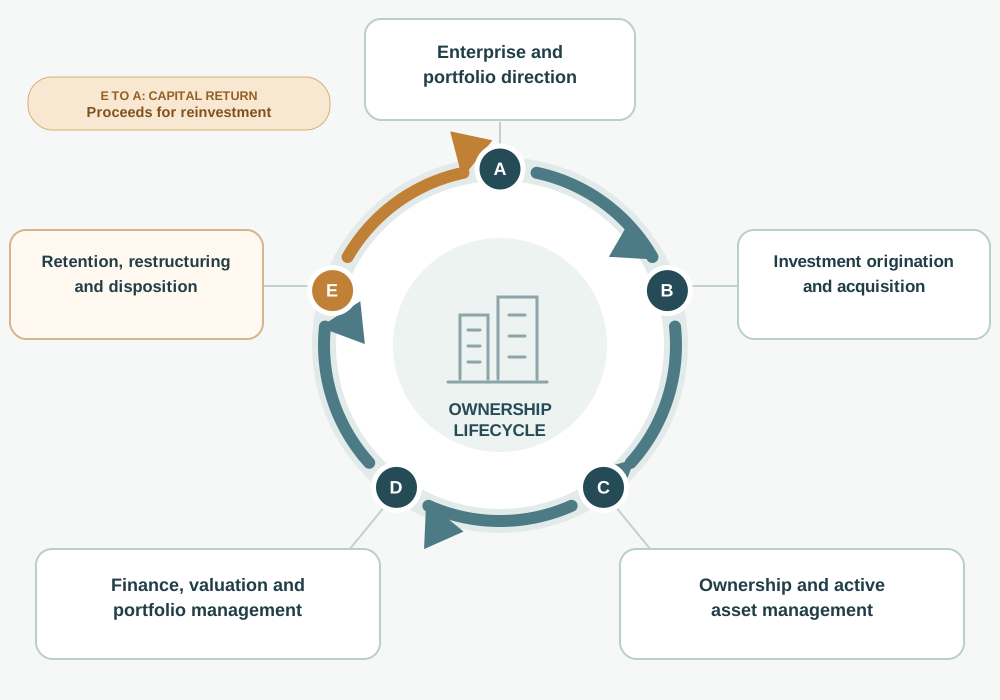
DUNNIXER's working map describes five connected phases of institutional real estate ownership. The map's value for investment leadership lies in the dependencies among those phases and the information that must travel in both directions.
A model of continuous institutional ownership
The ownership lifecycle comprises the full set of decisions through which an institution sets investment direction, commits capital, acquires legal control, assumes operational responsibility, manages income and asset condition, records and values performance, manages financing, determines the asset's future, and reallocates the capital ultimately released. Legal authority belongs within that structure: a business plan, debt amendment, major capital expenditure (CapEx), or sale proceeds allocation may require approval from different bodies even when the underlying economics arise from the same operating event.
DUNNIXER presents the map as a working reference model of the domain and its interdependencies. Institutions differ in procedures, approval structures, and terminology; the phases are neither a prescribed sequence nor a claim about universal practice. Several activities run concurrently, and others recur throughout ownership.
The distinction that matters is between a workflow and a decision system. A workflow records the steps required to complete an action. A decision system also carries forward the assumptions that justified it, the evidence that may invalidate those assumptions, and the constraints and decision rights governing the next use of capital. An investment committee approves an acquisition at a single moment, but the investment case it approved should remain available for examination for as long as the institution owns the asset.
Five connected phases of ownership
A. Enterprise and portfolio direction
This phase produces the investment mandate: what the institution may buy, where it may invest, the return and liquidity it seeks, and how existing holdings should contribute to the portfolio. Shareholder or parent-company objectives set the underlying capital purpose; portfolio strategy and allocation translate that purpose into exposures; and capital availability and investment capacity determine the room to act. The mandate also constrains decisions made years later, when an asset's performance, concentration, or liquidity needs have changed.
B. Investment origination and acquisition
This phase converts a mandate and current funding capacity into an acquired asset with defined obligations. Underwriting and scenario analysis establish the return case and downside tolerances, while investment-committee or executive approval authorizes the capital commitment and its conditions. Asset onboarding then connects transaction evidence to the teams that must manage contracts, cash flows, debt, compliance, and the business plan. The principal output is an owned asset whose legal, financial, and operational responsibilities have been absorbed.
C. Ownership and active asset management
This phase confronts the acquisition case with operating reality. Leasing and tenant strategy affect income security and occupancy; capital-expenditure planning tests what the building needs against expected returns; and performance monitoring exposes deviations that warrant intervention. The phase produces operating income and expenses, occupancy and asset-condition evidence, CapEx requirements, and revised business plans. Those outputs need to reach funding and portfolio choices as well as property-level reporting.
D. Finance, valuation and portfolio management
This phase translates operating and contractual evidence into comparable financial information and capital choices. Asset valuation provides a view of worth under the applicable valuation purpose; financing and covenant monitoring establish debt headroom and restrictions; and capital reallocation connects property-level results to investment capacity. The phase produces accounts, valuations, debt assessments, liquidity views, and portfolio comparisons. Its judgments can reopen an asset plan or change the feasible terms of the next acquisition.
E. Retention, restructuring and disposition
This phase determines the future use of the asset and its capital. A hold-versus-sell review can lead to continued ownership, additional CapEx, repositioning, refinancing, partial restructuring, or disposal. A major intervention tests alternatives to an immediate exit; financial derecognition and proceeds allocation connect a completed disposal to accounting and capital decisions. The phase's output is a choice about retention or realization, followed where relevant by proceeds available for reinvestment, distribution, or another corporate purpose.
Why the lifecycle runs on several clocks
Leasing, budgeting, accounting, compliance, valuation inputs, and performance monitoring are continuous or recurring activities. Acquisition, refinancing, major CapEx, restructuring, and disposal are triggered by opportunities, maturities, exceptions, and approvals. These clocks overlap. The same asset may be operating normally, preparing a refurbishment, negotiating a debt extension, and undergoing a sale assessment in the same quarter.
A left-to-right workflow cannot show the resulting competition for capital and authority. A proposed refurbishment affects the business plan and forecast cash flows; financing terms can determine whether it is executable; a sale process may change the merit of committing the expenditure at all. Each activity has its own process, yet the investment decision depends on a shared assessment of value, timing, risk, and funding.
The dependencies connecting the phases
The five phases each consume decisions or evidence produced elsewhere. Their principal connections can be summarized without turning the map into a sequential checklist.
| Lifecycle phase | Depends on | Produces or affects |
|---|---|---|
| Enterprise and portfolio direction | Shareholder objectives, available capital, risk and return requirements | Investment mandates and portfolio limits |
| Investment origination and acquisition | Mandate, funding, market opportunity, underwriting and diligence | A completed investment requiring onboarding |
| Ownership and active asset management | Acquisition assumptions, leases, budgets and asset condition | Income, expenses, CapEx requirements and revised plans |
| Finance, valuation and portfolio management | Operating records, contracts, debt terms and market evidence | Accounts, valuations, covenant results and capital comparisons |
| Retention, restructuring and disposition | Performance, valuation, future CapEx, financing constraints and strategic fit | Hold, improve, refinance or sell decisions and capital proceeds |
The apparent handoffs conceal two-way dependencies. Acquisition depends on funding capacity, but acquisitions also consume that capacity. Operating plans inform valuations, but financing terms can limit the plans management may approve. Disposal releases capital, but the portfolio's need for capital can bring forward a disposal. No major investment decision stands alone.
How information moves forward and backward
The forward path is recognizable. Portfolio strategy sets the mandate for underwriting; underwriting supplies the assumptions and sensitivities for acquisition approval; acquisition transfers contracts and obligations through onboarding; operation generates income and condition evidence; valuation and financing review convert that evidence into asset and debt judgments; retention or disposal determines the asset's next use; and capital redeployment changes the capacity available for the next investment. Every transition should retain the reasoning and conditions attached to the preceding decision.
The harder path runs backward. Weak leasing reduces expected income or prolongs vacancy. That change may lower an asset's valuation, and a lower lender valuation can raise loan-to-value ratios, reduce borrowing headroom, or place pressure on a covenant. CMS's briefing on loan-to-value defaults sets out what lenders and borrowers face when an LTV covenant is at risk: how the property valuation is commissioned, which cure rights may apply, and the initial options open to each side. Actual test dates, thresholds, and remedies depend on the financing agreement and market context. A financing constraint can then delay CapEx, require fresh equity, or accelerate a disposal review.
Valuation also reaches different committees for different purposes. The RICS Red Book Global Standards describes valuation's role across financial reporting, secured lending, and investment analysis. The valuation basis, evidence, date, and intended use must remain clear when those decisions interact. An accounting valuation and a lender-commissioned valuation need not be identical, even when both respond to the same underlying deterioration in property economics.
Where an institution reports under IFRS and applies the IAS 40 fair value model to investment property, a change in fair value is recognized in profit or loss as it occurs. The IFRS Foundation's IAS 40 summary also specifies that entities choose either the fair value or cost model as their accounting policy for investment properties. For a fair-value-model reporter, then, changing property economics can affect reported results while related lender valuations affect financing decisions. The routes through the accounts and the loan agreement are distinct, but leadership must understand their combined effect on returns and options.
Feedback can also run in the other direction. New CapEx might strengthen the leasing proposition, improve occupancy, and support higher sustainable income, although its funding cost and execution risk must be tested against those benefits. A successful leasing intervention can extend the defensible holding period or improve exit terms. The connection between leases and exit timing is explored in modeling research by Amédée-Manesme, Barthélémy, and Baroni: in their simulations, lease break options and greater market-rent volatility shorten the optimal holding period, while longer secured cash flow extends it. Those results come from a specified simulation model and indicate direction; they do not predict the right exit date for any individual asset.
The reverse flow finally reaches origination. An asset sold after a costly leasing turnaround has supplied evidence about the assumptions that were reasonable at acquisition, the limits of intervention, and the capital tied up during execution. Sale proceeds may fund a new purchase, repay debt, or support distributions. The next mandate and underwriting case should inherit both the released capital and the lessons learned. Otherwise, the institution recycles money but discards part of the evidence generated while earning it.

One operating issue, portfolio-wide consequences
Consider an illustrative asset with declining occupancy. Performance monitoring first establishes whether the change reflects tenant-specific events, a weakening local leasing proposition, or a broader shift in demand. The asset team revises leasing assumptions, incentives, expected downtime, and the operating forecast. Variance analysis then shows the difference from the acquisition case and the most recently approved business plan.
Asset valuation tests the revised income outlook and relevant market evidence. In parallel, financing and covenant monitoring examines debt-service coverage, LTV headroom under the lender's applicable valuation, and any restrictions on additional borrowing or spending. Portfolio management recalculates expected returns and asks what carrying the asset would consume in liquidity and management capacity. A property-level occupancy problem has now become a financing and allocation problem.
The hold-versus-sell review can compare tenant incentives, refurbishment, refinancing, repositioning, and sale. Incentives may require authority to trade near-term cash flow for occupancy. Refurbishment may require a new CapEx authorization, funding source, and construction-risk tolerance. Refinancing may require lender consent and different covenants. Repositioning may change the mandate's risk exposure; disposal requires sale authority and an assessment of proceeds after costs and debt obligations. Each path has a different timing, return distribution, and claim on scarce capital.
The decision matters beyond the asset. Approving refurbishment may defer another acquisition; selling may create liquidity while crystallizing a disappointing result; refinancing may preserve the hold option but absorb financing capacity. The institution can choose rationally only when the same revised evidence reaches the asset, treasury, valuation, portfolio, and approval functions before their separate processes commit it to incompatible outcomes.
What the connected view changes for investment leadership
Governance should follow the investment decision across functions. When a forecast deteriorates enough to change the approved return case, the issue should have a defined route from asset management to valuation, treasury, portfolio leadership, and the body authorized to change the plan. Clear thresholds for escalation are more valuable than an additional committee if the decision arrives without the evidence needed to judge it.
Acquisition assumptions should remain visible throughout ownership. The initial investment case ought to be preserved alongside later approved revisions, actual leasing outcomes, CapEx commitments, and the explanation for departures from the original plan. Without that history, performance reporting can measure movement against last year's budget while losing sight of the capital thesis that justified the asset's inclusion in the portfolio.
Operating information should be usable for valuation, refinancing, and portfolio comparisons at the point when choices are still open. That means reconciled contracts, occupancy evidence, cash-flow forecasts, and debt conditions, with a clear record of their dates and approval status. A valuation change presented without its leasing assumptions, or a covenant report prepared from an obsolete business plan, may be individually complete yet insufficient for an investment decision.
CapEx approval needs two lenses: the building-level case for intervention and the portfolio-level opportunity cost. An economically attractive improvement can still be the wrong commitment if it consumes capital needed for maturities, concentration reduction, or a higher-priority acquisition. Equally, an asset's weak current return may understate the value of a funded and executable improvement program. The decision belongs where property economics and portfolio constraints can be judged together.
Disposition should feed learning as well as liquidity. In a 2008 study of UK property fund managers, MacCowan and Orr found that portfolio restructuring was a principal driver of disposals, alongside asset underperformance and market expectations. That research is specific to its period and market, but it reinforces the value of reviewing a sale against both the asset plan and the institution's changing portfolio purpose. Post-investment and post-disposition review should inform future underwriting, including lease risk, CapEx timing, financing flexibility, and realistic exit choices.
Records should remain traceable from acquisition authorization and onboarding through accounting, disposal approval, financial derecognition, and proceeds allocation. IAS 40's treatment of disposal gains and losses in profit or loss illustrates one reporting connection; management must also preserve the investment logic needed to explain the realized result. In this sense, the lifecycle map gives leadership a practical means to examine governance, decision rights, controls, and information architecture against the decisions they are intended to support.
Real estate as a capital-and-evidence system
Every building generates evidence through leases, expenditures, cash flow, and physical condition. That evidence changes valuation, financing headroom, prospective returns, and the choices the owner can authorize. Those choices, in turn, determine which assets receive capital, which are restructured, and which leave the portfolio. The quality of institutional ownership depends on how faithfully the economic evidence survives each change of responsible team or approving body.
The hold-or-sell decision therefore starts with the acquisition case, evolves through the actual ownership experience, and reaches beyond the sale itself. Proceeds return to the institution alongside information about what worked, what failed, and which risks were mispriced. The next investment decision begins with that capital, that evidence, and a mandate capable of using both.
References
- IFRS Foundation — IAS 40 Investment Property, standard summary
- CMS — Loan to Value default? (April 20, 2023)
- RICS — Red Book Global Standards, 50th-anniversary page
- Amédée-Manesme, Barthélémy, and Baroni — The Optimal Holding Period for a Commercial Real Estate Portfolio: Taking the Lease Structure into Account (2014)
- MacCowan and Orr — A Behavioural Study of the Decision Processes Underpinning Disposals by Property Fund Managers (2008)
Explore the Institutional Real Estate collection
Author
Ahmed Abbas - Founder & CEO, DUNNIXER
Former IBM Executive Architect with 26+ years in IT strategy and enterprise architecture. Advises technology providers and delivery leaders on architecture establishment, integration boundaries, decision governance, and complex technology delivery. View author profile on LinkedIn.