Institutional real estate investment decisions
One Property, Many Truths: Why Real Estate Records Cannot Be Treated as Interchangeable
Understanding the distinct authority of commercial, legal, operational, accounting, valuation, and financing records in institutional real estate investment decisions.
The illusion of a single property record
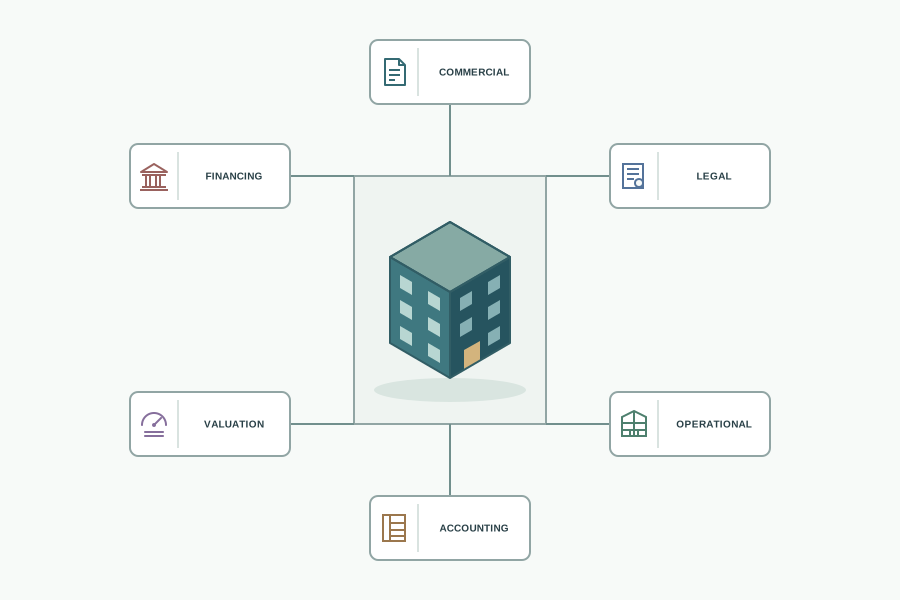
A property may appear as one asset in an investment portfolio, yet the institution that owns or manages it encounters several different representations of that asset. The lease schedule describes contracted commitments. The land register establishes registered ownership. The operational record captures the condition and use of the building. The general ledger records recognized financial activity. The valuation report estimates value. The financing agreement establishes obligations and restrictions associated with borrowed capital.
Each representation can be correct while presenting a materially different picture of the same property.
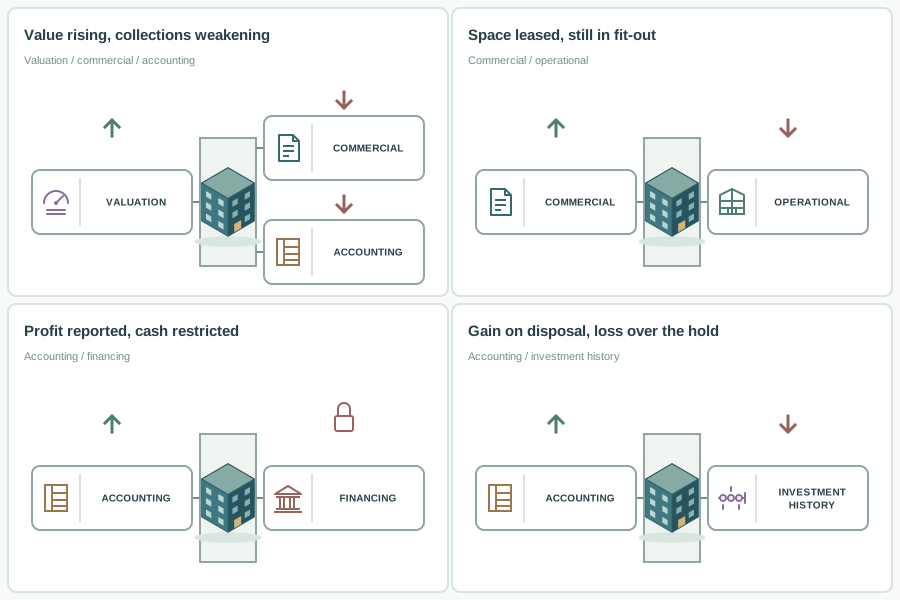
Consider an office building with a recently signed lease, a refurbishment under way, a valuation prepared before the latest leasing activity, and a financing agreement that restricts distributions. Its commercial position may have improved, its physical condition may remain transitional, its reported value may reflect an earlier date, and its accounting profit may exceed the cash available to its owner.
The differences arise because the records answer different questions. Contractual entitlement, registered ownership, physical readiness, accounting recognition, estimated value, and lender-controlled cash are distinct attributes of an investment.
An investment decision built on these records needs every material claim tied to the record that governs the question being answered, to the relevant legal entity, to an effective date, and to the status of the underlying event. The records then have to be reconciled with one another.
Each property record has authority for a particular purpose, and no individual record provides the complete investment position.
The six record classes
Six record classes provide a practical way to distinguish the principal representations of an institutional real estate asset.
Commercial records describe the property's contractual economic relationships with occupiers. Leases, contracted rent, occupancy schedules, incentives, expiry profiles, and tenant commitments establish what has been agreed commercially. They support analysis of contracted income and leasing exposure, provided that the relevant commencement dates, conditions, and definitions are preserved.
Legal records establish ownership, rights, restrictions, and enforceable obligations. Land registers, sale agreements, leases, corporate documents, and other legal instruments identify the parties holding particular rights and the conditions governing their exercise. Which instrument or register settles a given legal question depends on the jurisdiction and on how far the transaction has progressed.
Operational records describe the property's physical and functional state. Building condition, maintenance activity, fit-out progress, project delivery, handover, access, and actual use determine what the asset can presently support. These records distinguish space that is contractually committed from space that is physically ready, available, or in use.
Accounting records capture recognized income, expenditure, assets, and liabilities for a reporting entity and period. The general ledger and supporting financial records establish the amounts recognized under the applicable accounting policies. Their treatment of accruals, capital expenditure, receivables, and valuation movements serves financial reporting purposes, which may differ from the timing of related cash flows.
Valuation records provide estimated value for a defined purpose, at a defined date, using stated assumptions. The International Valuation Standards Council (IVSC) standards glossary defines Market Value and Market Rent as estimated amounts for an exchange or a lease "on the valuation date." Their meaning is therefore inseparable from the date, basis, and assumptions of the valuation, and a valuation report records an estimate made under those conditions.
Financing records define debt obligations, security, covenants, restrictions, and lender rights. Facility agreements and associated security documents determine the contractual framework within which the borrowing entity operates. They establish the calculations, testing dates, distribution conditions, and lender protections applicable to the financing.
These classes overlap in subject matter because they concern the same asset and related entities. Their authority remains purpose-specific. A lease may be relevant to accounting and valuation, for example, without determining either the recognized accounting amount or the independent valuation conclusion.
Authority depends on the question
Which record to rely on depends on the exact question the decision needs answered.
| Question | Record that governs it | What it does not settle on its own |
|---|---|---|
| What obligations has a tenant contracted to perform? | The executed lease and applicable amendments | When rent is received or how income is recognized in the accounts |
| Who holds registered legal ownership? | The relevant land register | Who controls every investment decision or ultimately bears the economic outcome |
| What income or expenditure has been recognized? | The general ledger and supporting accounting records | Cash available for distribution or the property's market value |
| What is the estimated value for a stated purpose and date? | The valuation report | The realized sale price or value at another date or under different assumptions |
| What lender rights and covenant calculations apply? | The financing agreement and applicable amendments | Accounting profit or performance measured using the owner's internal definitions |
| Has an organizational decision been authorized? | The relevant approval record | Whether funding has been provided or the authorized action completed |
Legal ownership illustrates why the governing question matters. In England and Wales, DAC Beachcroft's analysis of the registration gap explains that a purchaser does not become the legal owner until registration is completed. Completion of a purchase and registered legal ownership can therefore fall at different points in the same transaction.
The same requirement for precise authority applies to financing. In their discussion of financial covenants, Matthew Dunn and Ciara Buckley of Arthur Cox emphasize that the precise wording of each covenant definition, including its carve-outs and assumptions, can decide whether a covenant is met when it is tested. A ratio calculated on the owner's internal definitions is a different measure from the contractual one, even when the two share a name.
The same holds across all six classes: each record is authoritative within its own purpose, and its authority stops at the edge of that purpose.
Why the records may legitimately differ
Differences between property records frequently arise from the structure and timing of the underlying transactions. A lease may be signed before its rent commencement date. Commercial records can properly show a committed tenant while the immediate cash collection position remains unchanged. Lease execution, commencement, occupation, and payment are separate events.
A similar separation can arise between a property transaction and legal registration. In the England and Wales example described by DAC Beachcroft, the purchaser holds only equitable ownership between completion and registration, and becomes the legal owner when registration is completed. The distinction depends on that jurisdiction's legal framework and should be assessed under the applicable law elsewhere.
Accounting introduces another timing basis. Paragraph OB17 of the Financial Accounting Standards Board's Statement of Financial Accounting Concepts No. 8 explains that accrual accounting depicts economic effects in the periods in which they occur, even when the corresponding cash receipts or payments occur in another period. That is the underlying reason recognized income and cash collected can diverge; the exact treatment depends on the applicable accounting standards and the terms of each transaction.
Valuation can produce a further difference without contradicting the lease. Market Rent, as defined by the IVSC, estimates the amount for which a property interest should be leased between willing parties on the valuation date under specified conditions. The contractual rent agreed with an actual tenant may reflect different market conditions, incentives, lease terms, or negotiation circumstances. Both amounts can be valid for their respective purposes.
Operational and organizational events also proceed through identifiable stages. Capital expenditure may receive investment committee approval before procurement, funding, execution, or completion. Operational handover may follow legal completion because access arrangements, outstanding works, or practical readiness require separate actions. An approval record and an operational progress record can consequently report different statuses at the same reporting date.
Entity boundaries add a further dimension. A property-owning company may hold title, a different group entity may provide guarantees, and a fund or holding company may report consolidated results. A statement about cash, liabilities, or control must identify the entity to which it applies.
A difference between records does not by itself indicate an error. It may reflect different definitions, dates, entities, contractual conditions, or stages of completion. Reconciliation establishes which explanation applies and whether the records remain consistent once those differences are recognized.
The danger of treating records as interchangeable
Using a record to answer a question outside its authority can change the apparent economics of an investment. Contracted rent may be presented as immediately collectible income even though commencement or incentive provisions affect payment. Signed leases may be counted as physical occupancy without confirming that the space is ready for occupation. Recognized accounting income may be treated as available cash despite outstanding receivables or financing restrictions.
Legal and contractual conclusions are equally sensitive to the choice of record. A completed transaction may be described as fully registered ownership when the relevant registration remains outstanding. A corporate approval may be interpreted as evidence that an obligation has been funded or discharged. Economic exposure can be attributed to the entity holding title without examining contractual arrangements elsewhere in the ownership structure.
Valuation information can be misread in its own way. An estimated value prepared at an earlier date can be compared directly with current income or costs without adjusting for the relevant timing and assumptions. A valuation movement may then be mistaken for realized investment performance.
Financing restrictions can further alter the conclusion. Cash recognized within the property-owning entity may be subject to distribution tests, reserve requirements, or lender controls. The investor's usable cash position may therefore differ from the balance suggested by a financial report.
At portfolio level, these distinctions matter for comparability. Properties measured using different occupancy definitions, valuation dates, accounting periods, or ownership boundaries can look comparable while measuring different things. An investment memorandum or portfolio report assembled from such measures may become difficult to defend or reproduce because the governing records and adjustments have not been made explicit.
The decision risk arises when a valid statement from one record is treated as if it established a wider conclusion than that record supports.
How this can affect an investment decision
The effect on a decision is clearest when one record presents a favorable position and another reveals a constraint that bears on the same decision.
Valuation rising while cash collection deteriorates
A property may record an increase in estimated value while its immediate collection performance weakens. Valuation records may reflect revised market rents, assumptions about future leasing, or changes in other valuation inputs. At the same time, Commercial records may show tenant payment obligations that remain outstanding, while Accounting records show growing receivables and weaker cash receipts.
The valuation movement and collection deterioration address different aspects of performance. For a hold decision, the investor must assess whether the assumptions supporting estimated value remain credible alongside the observed collection position. For refinancing, the distinction may be more immediate because debt service depends on cash generation and the facility's contractual definitions.
Contracted occupancy high while space remains operationally unavailable
Commercial records may show that a substantial portion of a building has been leased. Operational records may simultaneously show that leased space remains under fit-out, awaits handover, or cannot yet support occupation.
Both statements can be accurate. The lease establishes a contractual commitment, while the operational record establishes physical readiness and actual use. The difference becomes material when an acquisition model assumes that committed space already contributes to operating income or when an asset plan relies on the space being available for a particular purpose.
The investor should distinguish contracted occupancy, commenced occupancy, physically available space, and actual use according to the decision being made. The relationship among those measures determines how commercial progress translates into operating performance and future cash generation.
Accounting profit positive while debt restrictions limit usable cash
Accounting records may show a profitable period while Financing records impose restrictions on the cash that can be distributed. Arthur Cox notes that cash trap mechanics have become a common protection for lenders on real estate financings: after a cash trap event, surplus cash left once the rent and debt-service account waterfall has run is held in a blocked account. A separate lock-up ratio may have to be met before the borrower can pay dividends. These are market-practice illustrations, and each facility sets its own terms.
An investor considering a distribution or refinancing must therefore examine the facility's own calculations, testing dates, and restrictions. Positive accounting profit supports an assessment of reported performance; the financing agreement determines the lender-imposed conditions governing the use of cash.
An accounting gain on disposal without a positive lifetime return
A disposal may generate a recognized accounting gain while the investment's return since acquisition remains negative. In the IFRS context, the MNP summary of IAS 40 Investment Property explains that a disposal gain or loss is determined by comparing net disposal proceeds with the asset's carrying amount. Under the fair value model, changes in fair value are recognized in profit or loss in the periods in which they arise.
The disposal calculation therefore starts from the carrying amount at disposal, which may already reflect earlier valuation movements. Measuring the return since acquisition requires the full investment history: acquisition expenditure, subsequent capital contributions, operating cash flows, financing flows where relevant, and net realization proceeds, measured consistently for the investment entity and return definition concerned.
No single record is sufficient to establish the full investment position.
One property, six records: a worked example
Consider a hypothetical multi-let office building at a reporting date. Its leasing position appears favorable, but the six record classes describe different stages of the same investment.
Commercial records show that a new lease has been signed but remains within a rent-free period. The tenant is contractually committed, improving contracted occupancy and the future income profile, although no rent has yet been received.
Legal records establish registered ownership and the rights and obligations attaching to the leases. They identify the legal entities responsible for contractual performance without determining the building's physical readiness or cash collection position.
Operational records show that one floor included in contracted occupancy remains under fit-out and is unavailable for occupation. The lease establishes a commercial commitment, while maintenance and project records establish the outstanding work.
Accounting records show rental income recognized in the ledger in accordance with the applicable accounting treatment, although no cash has yet been collected under the new lease. Recognition and receipt therefore describe different financial positions.
Valuation records contain the latest valuation, prepared at an earlier date. Its assumptions include estimated market rent for vacant space. The valuation reflects its stated basis and date, so leasing and fit-out progress since then sit outside it.
Financing records establish the facility's interest-cover test and its contractual definition of qualifying income or cash flow. The calculation may treat rent-free periods and receivables differently from management's reported income measures. The facility also establishes applicable distribution restrictions.
Separately, the investment committee has approved a refurbishment that remains unfunded and incomplete. Authorization, funding, and implementation are distinct statuses.
The resulting headline measures require qualification. "Occupancy" may mean contracted, commenced, or physically occupied space. "Income" may describe contracted rent, recognized income, collections, or lender-defined income. "Value" reflects the earlier valuation date and its assumptions. "Available cash" depends on receipts, expenditure, the relevant entity, and financing restrictions.
All these measures can be valid at the same reporting date, and each means something only once its governing record is identified.
Reconciliation as an investment discipline
The practical response is to make record authority an explicit part of investment review. An acquisition case, hold-or-sell recommendation, refinancing proposal, or portfolio report should allow the reader to establish six points for every material claim.
- What question is being answered?
- Which record controls that question?
- Which legal entity does it concern?
- What is the effective date?
- Is the information actual, recognized, estimated, approved, or completed?
- How does it reconcile with the other relevant records?
The first two questions establish purpose and authority. The third prevents property-level and group-level claims from being combined without recognizing differences in legal ownership, reporting boundaries, and economic exposure. The fourth preserves chronology: an executed lease, a current ledger balance, an earlier valuation, and a future covenant test may each have a different effective date.
The fifth question requires particular care because the status of an amount or event changes how it may be used. Actual information records an observed event or condition. Recognized information reflects treatment under applicable accounting requirements. Estimated information depends on a defined methodology and assumptions. Approved information establishes that an authorized decision has been made. Completed information establishes that an action or process has reached its specified completion state.
These statuses can coexist. An expenditure may be approved before it is incurred, recognized after a qualifying event, and paid at another date. A lease may be executed before occupation or collections begin. A property may have an estimated market value while its eventual sale price remains unknown. Each status supports a different judgment about commitments, performance, obligations, or future action.
Reconciliation means explaining the differences among these positions rather than forcing them into a single number. It may require an explicit bridge from contracted rent to recognized income and cash collections, from registered ownership to economic exposure, from valuation assumptions to the current commercial position, or from accounting cash to funds permitted for distribution under the financing agreement.
The outcome should preserve the originating records and make the adjustments intelligible. A decision-maker should be able to trace a material figure to its governing record, understand the date and entity involved, identify its status, and follow the explanation connecting it with other relevant measures.
This approach also improves consistency across a portfolio. Comparable measures require consistent definitions and dates, with differences disclosed where they affect interpretation. Authority stays with each of the six record classes; reconciliation supplies the investment-level view across them.
Conclusion
The apparent simplicity of a single real estate asset conceals several distinct economic, legal, and operational positions. Each becomes visible through records created for a particular purpose, under particular rules, at a particular date.
For investment leaders, the value of reconciling those records lies in the decisions it makes possible. A leasing improvement can be assessed alongside physical readiness and cash collection. An accounting result can be understood in relation to financing restrictions. An estimated valuation can be considered alongside the assumptions and subsequent events that affect its usefulness. A disposal result can be placed within the investment's complete economic history.
The objective is a decision record that preserves the authority exercised by each participant, keeps material claims traceable, explains differences explicitly, and allows the investment conclusion to be reconstructed from the evidence available at the relevant date.
A property has several purpose-specific truths that become decision-useful when their relationships are established. Sound investment judgment depends on knowing which record governs each question and how the records fit together.
References
- Reynolds, Rachael, and Guy Knight. DAC Beachcroft. "Bridging the Registration Gap." June 5, 2024. Bridging the Registration Gap.
- Financial Accounting Standards Board. "Conceptual Framework for Financial Reporting, Chapter 1: The Objective of General Purpose Financial Reporting." Statement of Financial Accounting Concepts No. 8, as amended December 2021. Paragraph OB17. Concepts Statement No. 8, Chapter 1.
- International Valuation Standards Council. "Standards Glossary." Updated March 2020. Standards Glossary.
- MNP LLP. "IAS 40 Investment Property." Financial Reporting Snapshot. June 2021. IAS 40 Investment Property.
- Dunn, Matthew, and Ciara Buckley. Arthur Cox. "Arc of the (Financial) Covenant: Issues for Project and Real Estate Finance." May 6, 2021. First published in Butterworths Journal of International Banking and Financial Law, April 2021. Arc of the (Financial) Covenant.
Explore the Institutional Real Estate collection
Author
Ahmed Abbas - Founder & CEO, DUNNIXER
Former IBM Executive Architect with 26+ years in IT strategy and enterprise architecture. Advises technology providers and delivery leaders on architecture establishment, integration boundaries, decision governance, and complex technology delivery. View author profile on LinkedIn.