Institutional real estate investment decisions
One Investment Decision Is Actually Seven Different Events
A reconstruction model for authority, execution risk, and the transition from investment case to operating asset.
The illusion of the single decision
“We acquired the property.” “The investment was approved.” “The transaction closed.” Each statement may be accurate, yet each may describe a different point in a much longer sequence. For an institutional investor, that distinction matters when establishing who exercised authority, when the organization became exposed to a transaction, and whether the asset was ready to deliver the performance assumed in the investment case.
Committee approval provides authority to proceed within defined parameters. Signing can create contractual commitments while leaving conditions unresolved. A completed transfer of consideration and property rights can precede operational readiness. Using one milestone as shorthand for the entire acquisition obscures the intervening responsibilities and the evidence needed to test execution.
DUNNIXER proposes a seven-event working model for examining a single acquisition: Recommendation, Approval, Signing, Funding, Registration, Accounting recognition, and Operational implementation. The seven categories describe distinct questions of judgment, authority, commitment, financing, legal rights, financial reporting, and management. The model is an analytical decomposition of one acquisition. Depending on structure and jurisdiction, events can overlap, share a date, or require additional steps, so the number of separate dates varies from one transaction to the next.
The practical task is to identify the evidence for each event, the legal entity involved, the authority exercised, and the conditions that remained open at that point. That makes the acquisition reconstructable as a sequence of decisions and actions.
The seven events behind the decision
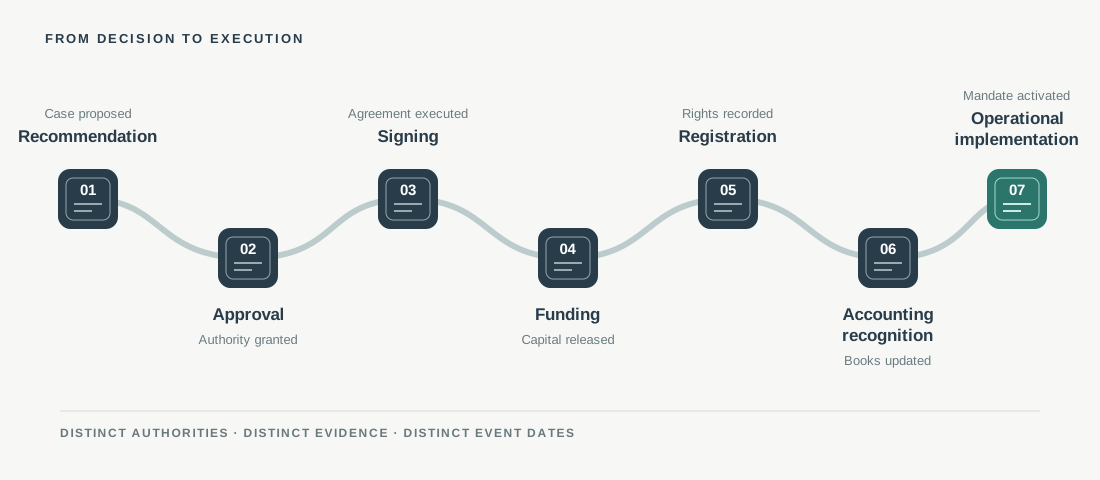
Recommendation
Recommendation is the investment team’s formal expression of the case for proceeding. It translates underwriting, due diligence, proposed financing, and asset strategy into a proposition for an authorized decision-maker. The recommendation also establishes the baseline against which later changes can be tested: purchase price, return assumptions, planned capital expenditure, lease-up expectations, material risks, and proposed mitigations. A recommendation may be revised, withdrawn, or rejected before any approval is issued. Its evidence lies in the submitted investment memorandum, models, supporting diligence, and documented revisions. Accountability at this stage concerns the quality and completeness of the case presented, including assumptions that remain subject to verification.
Approval
Approval records the decision of a committee, executive, or board with the requisite authority to permit an acquisition to proceed. The resolution may set a maximum price, financing limits, conditions, delegated powers, or an expiry date. What matters is the precise decision made and the boundaries placed on subsequent execution. One illustrative governance arrangement appears in Globalworth Real Estate Investments Ltd’s investment committee terms of reference: matters within delegated thresholds sit within the committee’s scope, while matters beyond those thresholds are referred for board approval. The document describes one company’s framework and serves here as an example of how such authority can be allocated.
Signing
Signing is the execution of the acquisition agreement by an authorized representative of the relevant legal entity. The critical evidence includes the signed agreement, its effective provisions, the identity and capacity of signatories, and outstanding conditions. Investment authority and contract-signing authority may be held by different persons. Under the English-law transaction mechanics described by Higgs LLP, exchange makes a transaction legally binding, while payment and transfer at completion may follow later; a contract may also be conditional on a future event. Other legal systems and deal structures require their own analysis. The signing date therefore needs to be read alongside the contract’s conditions and completion mechanics.
Funding
Funding concerns the availability and deployment of the equity, debt, or combined capital needed to complete the acquisition. Treasury instructions, lender drawdown requirements, security documents, and settlement confirmations establish whether financing is ready and when money is released. Moore Barlow’s discussion of real estate finance conditions precedent describes requirements borrowers must satisfy before lenders become obliged to lend, including lender-addressed valuations, title reports, and insurance evidence. A financing commitment in principle, a facility agreement, an approved drawdown, and actual cash movement can mark different states. Funding review should date availability, release, and settlement separately, since an agreed financing structure and deployed cash can belong to different dates.
Registration
Registration concerns the recording of ownership or another legally relevant property right by the responsible authority. Its timing and legal consequences depend on local property law, the nature of the interest, and the transaction structure. As DAC Beachcroft explains for England and Wales, a purchaser may hold equitable ownership after completion while formal legal ownership awaits registration at HM Land Registry. That example exposes a consequential separation between contractual and registered rights; it should not be generalized to every jurisdiction. Registry extracts, lodged applications, completion statements, and legal opinions may establish different aspects of the ownership position at different dates.
Accounting recognition
Accounting recognition determines when and how the acquired property, consideration, and related liabilities enter financial reporting under the entity’s applicable accounting standards. For entities applying IFRS to an owned investment property, IAS 40, paragraphs 16 and 20, establishes recognition conditions based on probable future economic benefits and reliably measurable cost, followed by initial measurement at cost including transaction costs. Paragraph 67 ties the seller’s disposal date to the recipient obtaining control under IFRS 15. These provisions turn on the transaction facts, so the recognition date can differ from both the signature date and the registration date. Finance should preserve its conclusion, accounting entries, and supporting transaction evidence.
Operational implementation
Operational implementation marks the transition into active asset management. The appointed manager must obtain usable lease data, tenant contacts, rent schedules, service agreements, budgets, maintenance histories, compliance records, and responsibilities for current obligations. Legal completion may be achieved while information transfers, vendor arrangements, or operational control processes remain unfinished. A practical record of this event includes an accepted handover checklist, reconciled tenant and financial records, assigned operating responsibilities, and evidence that the ownership plan can be executed. The initial investment case becomes an operating mandate only when the asset team can act on it with the information and authority it needs.
One transaction, several clocks
Consider the following hypothetical timeline for one acquisition. The months are invented to show how the milestones can separate.
| Month | Event | Milestone evidenced |
|---|---|---|
| January | Recommendation | Investment case submitted |
| February | Approval | Committee authority recorded |
| March | Signing | Purchase agreement executed |
| April | Funding | Financing released |
| May | Registration | Ownership entered on the register |
| May | Accounting recognition | Asset recorded in the accounts |
| June | Operational implementation | Operational handover completed |
Calling this a “March acquisition” emphasizes contractual commitment; calling it a “May acquisition” emphasizes registered rights or the recorded asset. Neither label alone establishes when the initial investment judgment was made, when the institution became economically exposed, or when the asset team could begin delivering the operating plan. For performance attribution, the chosen anchor date can affect calculations of transaction lead time, carry, income commencement, and time-to-value.
The gaps also vary by transaction. Exchange and completion can be simultaneous under the English-law mechanics described above, and in those cases separate events occupy one calendar date. The analytical distinction remains useful because the underlying documents, conditions, authorities, and consequences remain distinct.
Different events, different decision-makers
An institutional acquisition passes through several forms of authority. The investment team owns the recommendation and the assumptions supporting it. An investment committee, delegated executive, or board issues approval. A designated representative signs on behalf of the acquiring entity, with legal counsel examining the agreed obligations. Treasury and the lending counterparties govern funding and release mechanics. Property registries establish the recorded legal position in the relevant system; finance assesses recognition in the accounts; asset management takes responsibility for implementing the ownership plan.
These roles may be concentrated in a small number of people or distributed across a larger organization. Either way, the question is what authority was actually exercised at each event. A job title, corporate announcement, or signature establishes no presumption that one person controlled the entire acquisition chain. For accountability, identify the actor and legal entity associated with each event, then connect that actor to the decision or execution record within the scope of their authority.
What can happen between approval and implementation
Approval may be granted subject to additional diligence, investment limits, or financing terms that remain unresolved when negotiations advance. A revised purchase price, altered seller covenant, or new capital requirement can move execution outside the approved parameters. The resulting issue is whether fresh authority was obtained and whether the updated investment case was presented to the correct decision-maker.
Financing can introduce another interval of uncertainty. Drawdown conditions may remain open, lender terms may change, or funds may be unavailable on the expected settlement date. Partner consent can create a separate dependency. In its briefing on real estate joint-venture governance, CMS identifies reserved matters that can require shareholder agreement, including business-plan changes and third-party debt. Financed assets may also carry lender consent restrictions on disposals, as illustrated by Gowling WLG’s English-law discussion. The actual consent requirement must be established from the transaction’s governing documents.
Following contractual commitment, title or registration problems can complicate the legal ownership position. Accounting recognition may also differ from the anticipated timeline or classification in the original investment case, requiring finance to reassess the reporting treatment. At the operational handover, incomplete leases, inaccurate rent rolls, unclear service responsibilities, or delayed access to asset data can impair execution of the management plan.
These are potential failure points, and how often they occur is an empirical question this model leaves open. A reconstruction should determine which risks were real in the particular transaction, what decisions were taken in response, and whether the eventual outcome was attributable to investment judgment, execution, external events, or a combination.
How separation affects investment outcomes
The interval between recommendation and approval can change the relevance of market assumptions, financing quotes, and asset-level diligence. Between approval and signing, renegotiated terms can alter the economics accepted by the committee. Between signing and funding, the institution may carry conditional obligations, deposit exposure, hedging commitments, or financing risk, depending on the agreement and capital structure. The relevant exposure date needs to be established from the actual contracts and cash flows.
Funding and registration affect settlement certainty, legal-risk management, and the timing of deployable capital. Recognition affects the financial statements and the reporting periods against which results are assessed. Operational implementation governs how quickly the manager can collect revenue, manage costs, implement the approved capital program, and address tenant obligations. Delayed or incomplete handover may change the timing of income and execution of the asset strategy even where the original acquisition assumptions remain commercially sound.
The effect on total return is transaction-specific. Some timing gaps will be immaterial; others could affect financing cost, operating performance, or time-to-value. The point of the model is to make the causal analysis possible. A well-supported recommendation can lead to a weak realized outcome if execution or onboarding falls short, just as disciplined execution cannot rescue an investment thesis built on erroneous assumptions.
Why public evidence can be misleading
Corporate disclosures can be useful evidence of a reported milestone, but their language often compresses transaction history. “Approved” may refer to a formal resolution or a management-level decision. “Acquired” may indicate signing, completion, or another event selected for the purpose of the announcement. The statement itself rarely contains the full authority record, conditions-precedent status, settlement documentation, registration evidence, accounting memorandum, and asset-management handover.
Readers should distinguish what a document affirmatively proves from what it leaves unknown. A dated announcement proves that the organization communicated a statement on that date, and the date of each underlying event still has to be established from other records. Absence works the same way: “not publicly disclosed” does not mean the event or control did not exist. A defensible assessment records those unknowns as unknowns and draws no conclusion about governance or execution from information that was never published.
How to reconstruct a completed investment decision
The reconstruction begins with one acquisition identifier and follows each event through its documentary trail. The following questions connect chronology, legal identity, decision rights, conditions, exposure, and implementation without assuming that one record can answer them all.
| Question | What it establishes |
|---|---|
| What happened at each event, and on what date? | A milestone chronology with distinct effective and recording dates |
| Which legal entity acted? | The actual buyer, contracting party, borrower, registered holder, or reporting entity |
| Who recommended, approved, signed, and executed the transaction? | Decision rights, delegated authority, accountability, and any required reapproval |
| Which document proves each event? | The evidentiary link from the investment memorandum and resolution through contract, funding, register, accounts, and handover records |
| What conditions remained outstanding at each stage? | Unresolved approvals, financing dependencies, consents, and completion obligations |
| When did economic exposure begin? | Cash deployment, binding obligations, deposits, and other transaction-specific risks |
| When did legal ownership become effective? | The legally relevant transfer and registered-rights position under applicable law |
| When did accounting and operational control begin? | The basis for financial recognition and the date the asset-management team could execute the plan |
A satisfactory reconstruction may contain unresolved questions. Recording an uncertainty and its evidentiary source is more reliable than assigning a convenient date or attributing authority to the nearest senior executive.
Management implications
The practical requirement is a traceable chain connecting the investment memorandum and versioned underwriting to approval conditions, executed agreements, financing and settlement evidence, registration records, recognition decisions, and operational acceptance. Each workflow can retain its own responsible team and system of record. Continuity arises from shared transaction identifiers, explicit milestone dates, cross-references to authoritative documents, and documented treatment of outstanding conditions.
Handoffs warrant particular attention. An amended commercial term should be intelligible against the approval that authorized it. A funding change should remain visible to the investment and finance teams. A post-completion operational exception should be traceable to the obligations and assumptions transferred from the acquisition team. Management benefits when the history of the asset survives changes in personnel and reporting cycles, allowing subsequent performance reviews to distinguish thesis quality from delivery quality.
Conclusion
An acquisition progresses from an analytical proposition through formal authority, contractual obligations, capital deployment, established rights, financial reporting, and active management. Each transition changes what the institution can do, what it owes, what it owns, or what it can measure. The important dates are therefore those that explain the actual transition of responsibility and risk.
When an investment exceeds or misses its case, the decisive evidence may sit outside the committee paper: a condition that delayed completion, an amendment that altered exposure, a registration issue, or an operating responsibility that transferred late. Reconstructing the entire chain allows leaders to locate the cause at the event where it arose and assess the result against the authority, information, and obligations that existed at the time.
References
- IFRS Foundation. IAS 40 Investment Property. 2026 issued edition.
- CMS. Real Estate Joint Ventures: Governance and Management. December 2024.
- Higgs LLP. Commercial Property: Exchange of Contracts, How We Get There? May 19, 2025.
- Moore Barlow. Understanding Conditions Precedent in Real Estate Finance Transactions. July 4, 2025.
- DAC Beachcroft. Bridging the Registration Gap. June 5, 2024.
- Globalworth Real Estate Investments Ltd. Investment Committee Outline Terms of Reference and Procedures. Revised November 2020.
- Gowling WLG. Lenders Beware! Consents Come Under Closer Court Scrutiny. June 21, 2018.
Explore the Institutional Real Estate collection
Author
Ahmed Abbas - Founder & CEO, DUNNIXER
Former IBM Executive Architect with 26+ years in IT strategy and enterprise architecture. Advises technology providers and delivery leaders on architecture establishment, integration boundaries, decision governance, and complex technology delivery. View author profile on LinkedIn.