At a Glance
Frames core replacement versus progressive modernization as a feasibility test, assessing risk, cost, dependencies, resilience, regulatory impact, and value delivery, and urging clear baselines and measurable outcomes to validate readiness and guide sequenced transformation.
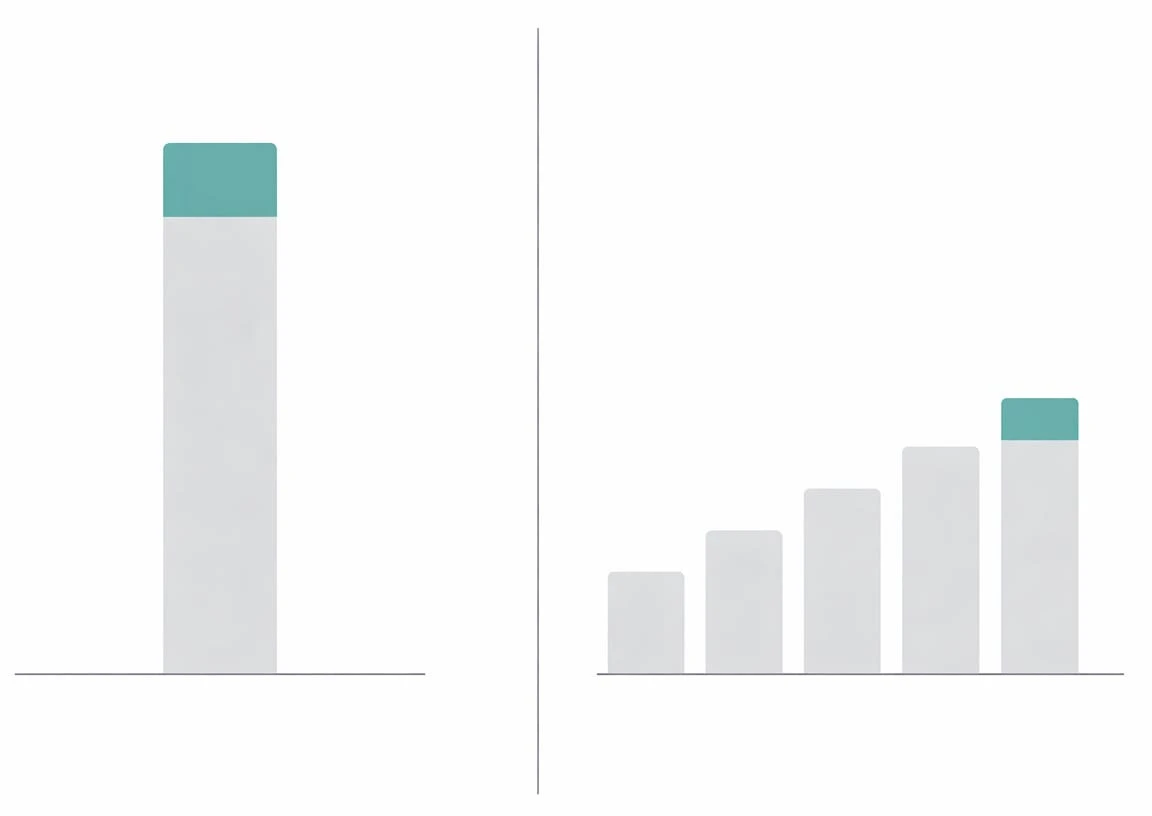
Why this decision is rarely about technology preference
Core banking change decisions are often framed as a choice between âreplaceâ and âmodernize.â In practice, the more consequential question is feasibility: whether the bank can execute the chosen path with acceptable operational risk while still realizing benefits within a timeframe that preserves strategic relevance. Core platforms sit at the center of product processing, accounting integrity, customer servicing, and regulatory reporting. Any material change will be judged by stability, correctness, and control evidence, not only by feature velocity.
Industry commentary frequently compares full replacement to a high-risk procedure, reflecting the reality that core cutovers concentrate operational exposure into a short period. At the same time, progressive modernization can fail when coexistence complexity becomes a permanent condition and the bank loses the ability to decommission legacy processing. Treating the decision as a feasibility test helps executives avoid two common errors: overestimating the bankâs capacity for a compressed cutover, and underestimating the governance discipline required to modernize incrementally without creating a fragmented estate.
Core system replacement as a feasibility proposition
What replacement actually commits the bank to
A âbig bangâ replacement replaces the core in a single cutover event. It typically implies simultaneous conversion of multiple products, account populations, posting logic, interfaces, and operational procedures. Payments system research and industry briefings note that full replacement is a high-risk approach and requires significant planning and resourcing to support the transition. The feasibility test is therefore front-loaded: if the bank cannot prove conversion readiness, the downside risk is concentrated and difficult to unwind.
Where replacement can be compelling
Replacement can be rational when the legacy core is truly obstructive or fragile: end-of-life technology, severe vendor constraints, or structural limitations that prevent reasonable remediation. Advocates argue that replacement can deliver a fully integrated modern infrastructure and allow the bank to re-architect for agility and scale. The feasibility advantage is conceptual clarity: one target state, one processing engine, and a clear end date for the old core if execution succeeds.
Feasibility risks unique to replacement
- Concentrated operational risk because errors in data conversion, posting rules, or interface behavior can impact a broad population simultaneously
- Deferred benefit realization because many benefits are realized only after the cutover and stabilization period, increasing exposure to schedule slip and scope creep
- Evidence and control continuity risk because the bank must demonstrate that reconciliations, interest and fee calculations, and reporting integrity remain correct across the transition
These risk categories are why boards often ask for rigorous, scenario-based readiness proofs and why external stakeholders frequently focus on contingency planning and rollback assumptions.
Progressive modernization as a feasibility proposition
What modernization actually means in practice
Modernization is an umbrella term that typically includes incremental approaches such as component-based replacement, augmentation, and the introduction of modular, API-driven integration patterns. Industry perspectives emphasize modular, cloud-native architectures and ecosystem integration as pathways to continuous innovation at scale. For feasibility, modernization is less about adopting new components and more about sustaining a disciplined coexistence strategy while the estate transitions.
Where modernization is structurally advantaged
Progressive modernization reduces risk by breaking change into smaller steps, enabling earlier value capture and allowing learning to influence sequencing. It can also support faster integration with fintech partners through improved interface layers. Many industry sources describe progressive modernization as increasingly favored because it can deliver incremental benefits while limiting single-event disruption.
Feasibility risks unique to modernization
- Coexistence complexity as products, customers, and processes span both legacy and modern components, increasing reconciliation and servicing burden
- Integration and middleware sprawl when legacy constraints force extensive translation layers that become new points of failure and cost
- Delayed decommissioning when the organization lacks enforceable retirement milestones and legacy platforms remain in place indefinitely
- Inconsistent definitions and controls when data and business rules diverge across components, undermining trusted numbers and reporting confidence
Modernization is feasible when the bank can govern these risks proactively. Without that governance, the estate can become more complex than the starting point, even if individual components are modern.
Decision factors that should drive the feasibility judgment
Risk appetite and tolerance for concentrated failure modes
Replacement concentrates risk in time; modernization distributes risk across a longer period. Executives should test whether the bankâs risk appetite can tolerate a compressed cutover event, including the operational and reputational consequences of errors at scale. Conversely, they should test whether the organization can tolerate prolonged coexistence without losing control of costs, data integrity, and customer experience.
Dependency surface and change blast radius
Core systems connect to channels, payments, finance, risk platforms, data warehouses, and third-party services. Feasibility depends on the âblast radiusâ of each approach. Full replacement can force many dependencies to change at once. Modernization can reduce blast radius per release but may increase the total number of integration points during transition. Research briefings and practitioner articles frequently emphasize that dependencies and transition planning are central to the choice of strategy.
Data and reporting integrity constraints
Both approaches require high-confidence data conversion, consistent business rules, and defensible reconciliations. The feasibility question is which path better matches the bankâs current data quality and lineage maturity. If the bank relies heavily on manual reconciliations and undocumented transformations, replacement will amplify conversion risk, while modernization will amplify coexistence reconciliation burden. Either way, the bank needs a planned path to preserve accounting and risk reporting integrity as products move across platforms.
Operating model readiness and change capacity
Core programs are not technology-only. They change servicing workflows, exception handling, control performance, and customer communications. Feasibility depends on whether operations, finance, risk, and technology teams can sustain disciplined delivery and stabilization routines for multiple years. Many de-risking perspectives emphasize change management investment as a core determinant of modernization success, regardless of the technical path.
Economics of transition and the risk of dual-estate permanence
Replacement typically requires higher up-front investment but offers a clearer path to ending the legacy estate if executed successfully. Modernization can appear less expensive initially, but the economics can deteriorate if dual-running becomes prolonged and if integration and governance overhead grows. Feasibility should be tested by modeling how quickly legacy components can be retired under realistic organizational constraints, not by assuming ideal decommissioning behavior.
Ambition checks that decide which path is feasible
The replacement versus modernization choice becomes clearer when leaders run explicit ambition checks that surface feasibility limits before commitments harden.
- Risk shape: replacement concentrates cutover risk into a short window; modernization spreads risk across a prolonged coexistence period with more integration points to govern.
- Time in coexistence: modernization only remains economical if the bank can enforce legacy retirement timelines and prevent dual-estate permanence.
- Data integrity readiness: replacement amplifies conversion accuracy risk, while modernization amplifies reconciliation and lineage demands across parallel estates.
- Operating model absorption: delivery throughput and operational readiness determine whether the bank can sustain either a concentrated cutover or extended transformation.
How to structure a feasibility-oriented roadmap for either option
Define âproof pointsâ that must be achieved before irreversible steps
Feasibility improves when roadmaps include explicit proof points that test readiness: data mapping completeness, reconciliation performance, test automation coverage, operational runbook readiness, and incident response coordination across internal teams and vendors. For replacement, proof points should emphasize conversion rehearsals and rollback constraints. For modernization, proof points should emphasize coexistence controls and measurable decommissioning progress.
Use staged governance that scales with risk
Governance should be designed to make risk and control evidence visible as change volume rises. Replacement often needs strict release gates and heightened independent assurance in the run-up to cutover. Modernization needs consistent domain standards, API and data governance, and decision rights that prevent fragmented implementations.
Make value capture conditional on decommissioning and process change
Both approaches can promise faster launches and lower costs, but benefits materialize only when legacy work is eliminated and operating procedures are redesigned. A feasibility-oriented roadmap links benefit claims to observable actions such as retiring systems, reducing manual reconciliations, shortening release cycles with stable quality, and improving customer journey completion rates.
Executive metrics that reveal which path is becoming infeasible
Boards and executive committees can improve decision quality by tracking a small set of feasibility indicators throughout planning and execution. Examples include:
- Conversion and reconciliation defect rates, including recurrence trends and remediation aging
- Release stability measures, including incident frequency and customer-impact events for in-scope services
- Dependency readiness, including the number of critical interfaces still operating on undocumented or fragile patterns
- Decommissioning progress versus plan, including reduction in legacy processing volume and support effort
- Change adoption measures, including training completion for control roles and exception handling cycle times
- Cost profile of dual-running, including integration layer growth and operational overhead created by coexistence
These indicators help management decide when to slow scope, change sequencing, increase controls investment, or revisit strategy assumptions before risk compounds.
Strategy validation and prioritization through strategic feasibility testing
Choosing between core replacement and progressive modernization is fundamentally a strategy validation decision. The right answer depends on whether the bankâs current digital capabilities can support the risk posture, governance rigor, data integrity discipline, and operating model change capacity implied by each pathway. Treating the decision as a feasibility test shifts leadership focus from debating end-state preferences to validating the practical conditions required to execute safely and realize benefits on credible timelines.
A structured maturity assessment strengthens this decision discipline by benchmarking the capabilities that determine whether replacement or modernization is executable: architecture and integration governance, data controls and trusted numbers, delivery and testing rigor, operational resilience, third-party dependency management, and change adoption capacity. In this context, executives can use the DUNNIXER Digital Maturity Assessment to establish a fact base for readiness, compare pathways against current capability constraints, and prioritize the specific capability uplift that reduces decision risk before committing to irreversible core banking modernization steps.
Reviewed by

The Founder & CEO of DUNNIXER and a former IBM Executive Architect with 26+ years in IT strategy and solution architecture. He has led architecture teams across the Middle East & Africa and globally, and also served as a Strategy Director (contract) at EY-Parthenon. Ahmed is an inventor with multiple US patents and an IBM-published author, and he works with CIOs, CDOs, CTOs, and Heads of Digital to replace conflicting transformation narratives with an evidence-based digital maturity baseline, peer benchmark, and prioritized 12–18 month roadmap—delivered consulting-led and platform-powered for repeatability and speed to decision, including an executive/board-ready readout. He writes about digital maturity, benchmarking, application portfolio rationalization, and how leaders prioritize digital and AI investments.
References
- https://www.kansascityfed.org/research/payments-system-research-briefings/core-banking-systems-and-options-for-modernization/#:~:text=A%20full%20replacement%20is%20the,resources%20to%20support%20the%20transition.
- https://www.kansascityfed.org/documents/10016/PaymentsSystemResearchBriefing24AlcazarBairdCronenwethHayashiIsaacson0228.pdf
- https://www.linkedin.com/pulse/understanding-legacy-core-banking-systems-need-bharat-kulkarni-ivddf
- https://sbs-software.com/insights/core-banking-transformation-innovation/#:~:text=Modular%2C%20Cloud%2Dnative%20&%20ecosystem,and%20continuous%20innovation%20at%20scale.
- https://www.bai.org/banking-strategies/a-core-issue-surgically-replacing-core-banking-platforms/#:~:text=For%20some%2C%20a%20core%20banking,time%20the%20system%20is%20replaced.
- https://www.bai.org/banking-strategies/a-core-issue-surgically-replacing-core-banking-platforms/#:~:text=While%20a%20traditional%20core%20banking,a%20full%20core%20banking%20replacement.
- https://crassula.io/blog/core-banking-modernization/
- https://www.10xbanking.com/insights/modernizing-core-banking#:~:text=Customer%20experience:%20modern%20systems%20enable,meta%20core%20banking%20platform%20here.
- https://fintechos.com/blogpost/how-to-de-risk-core-modernization-in-banking/#:~:text=Core%20modernization%20is%20no%20longer,and%20investing%20in%20change%20management.
- https://www.oliverwyman.com/our-expertise/insights/2024/oct/5-key-considerations-to-transform-core-banking-systems.html#:~:text=Changing%20the%20core%20banking%20system,a%20core%20system%20migration%20project.
- https://www.meniga.com/resources/core-banking-modernisation/#:~:text=Reduce%20costs%20tied%20to%20legacy,large%20portion%20of%20IT%20budgets.
- https://medium.com/@p.satyakumar/core-banking-modernization-a-blueprint-for-future-banking-3db26d19d93e#:~:text=In%20the%20case%20of%20incremental,the%20center%20of%20their%20work.
- https://mobilelive.ai/blog/the-core-banking-modernization-dilemma-incremental-vs-full-system-upgrade#:~:text=Banking%20Modernization%20Pathway%20%232:%20Full%20System%20Replacement,project%20(or%20tightly%20compressed%20series%20of%20steps).
- https://crassula.io/blog/core-banking-modernization/#:~:text=This%20ambitious%20strategy%20involves%20a%20complete%20overhaul,run%2C%20it%20also%20carries%20the%20highest%20risk.