Institutional real estate investment decisions
Follow the Capital, Authority and Risk: A Practical Map of Institutional Real Estate
Understanding who supplies capital, controls investment decisions, holds legal title, operates property, and bears the financial outcome.
Why the conventional picture is incomplete
An institutional real estate investment can appear straightforward when described through a familiar corporate name: a private equity firm acquires an office building, a REIT owns a logistics portfolio, or a family office invests in residential property. Each description identifies a recognizable participant but leaves important relationships unexplained.
Capital may originate with pension beneficiaries or family principals, pass through a fund, and reach a property-holding company. An investment committee approves the acquisition, another entity signs the documents, asset managers oversee performance, and external providers operate the property. Lenders and joint-venture partners may hold additional consent rights.
Five dimensions require separate examination: economic ownership, legal title, investment authority, operational responsibility, and external control. Economic ownership establishes exposure to gains and losses. Legal title identifies the entity holding the property interest. Investment authority determines who can commit capital. Operational responsibility concerns execution and performance. External control encompasses consent, registration, regulatory, and assurance mechanisms.
One organization may combine several roles; one investment may distribute them across many organizations. The visible corporate brand may be neither the decision-making unit nor the principal risk-bearing entity.
Institutional real estate is therefore better understood through the relationships among capital, authority, ownership, and accountability. Corporate labels become useful when those relationships are established.
The institutional real estate ecosystem
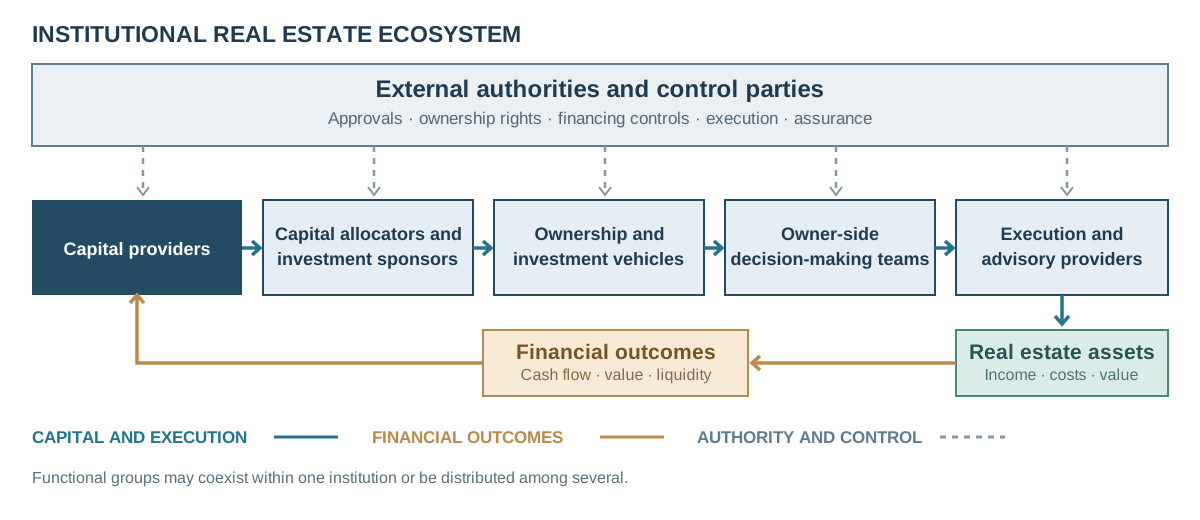
DUNNIXER organizes the institutional real estate ecosystem into six participant groups: Capital providers; Capital allocators and investment sponsors; Ownership and investment vehicles; Owner-side decision-making teams; Execution and advisory providers; and External authorities and control parties.
Capital providers supply equity or debt. Capital allocators and investment sponsors direct investment resources toward strategies and opportunities. Ownership and investment vehicles establish the structures through which assets are held and financed. Owner-side decision-making teams manage acquisition, financing, performance, and disposition decisions. Execution and advisory providers deliver operational and specialist services.
Real estate assets generate income, incur costs, change in value, and create or constrain liquidity. Financial outcomes flow through ownership, financing, and distribution arrangements to the economically exposed parties.
External authorities and control parties influence the chain throughout. Their rights and obligations can affect investment approvals, financing flexibility, legal ownership, execution, and assurance.
Capital, authority, and financial outcomes follow different paths. An investor may delegate investment selection, a committee may approve an acquisition, a vehicle may execute it, and an asset-management team may oversee subsequent performance. These six groups describe functions that can coexist within one institution or be distributed among several.
Capital providers
Capital providers supply the financial resources supporting real estate investment. They include sovereign wealth funds, pension funds, insurance companies, family principals, high-net-worth investors, public-market investors, banks, and institutional lenders.
Equity investors participate in investment gains and losses through their ownership interests and distribution arrangements. Debt providers hold contractual repayment claims and carry credit exposure under the financing terms. Their economic positions, rights, and priorities differ.
Providing capital need not mean selecting individual properties or controlling their operation. A pension fund may delegate investment selection to a manager, a family principal may retain transaction approval rights, and public shareholders may participate economically through a REIT.
Fund documentation can formalize this separation. In its 2017 discussion of English limited partnerships, RPC explains that, where a limited partnership is not a private fund limited partnership, a limited partner's liability is limited to its capital contribution provided the partner does not participate in management. RPC also describes limited partner advisory committees whose approval rights typically concern operational matters and conflicts, without discretion over fund investment decisions.
This English-law illustration shows how capital participation, governance protections, and investment authority can be allocated separately through fund documentation.
Capital allocators and investment sponsors
Capital allocators and investment sponsors direct investment resources toward real estate opportunities. They include private-equity real estate managers, fund managers, REIT managers, institutional family offices, sovereign investment platforms, corporate investment divisions, and investment and wealth managers.
Their responsibilities may encompass defining strategy, raising or allocating capital, selecting markets and asset classes, assessing opportunities, recommending or approving investments, and reporting to investors or principals.
Allocators act in one of two capacities. Some invest their own balance-sheet capital; others act as agents for investors or clients. The difference determines whose capital bears the principal investment exposure when performance deteriorates. Managers may also have economic exposure through co-investment or contractual compensation arrangements.
The U.S. Securities and Exchange Commission's 2015 Investor Bulletin on Non-traded REITs illustrates the distinction between an investment vehicle and its manager. The bulletin explains that non-traded REITs are typically externally managed and have no employees of their own. External managers may receive fees linked to property acquisitions or assets under management that do not necessarily align with shareholder interests.
This U.S.-specific example concerns non-traded REITs. It shows why the named investment vehicle, the organization making investment decisions, and the shareholders bearing economic exposure must be distinguished.
Ownership and investment vehicles
Ownership and investment vehicles provide the structures through which investment interests, property rights, financing obligations, and financial results are held and administered.
They include funds, REITs, joint ventures, corporate subsidiaries, property-holding companies, and special-purpose vehicles. Depending on their structure, they may hold legal title, borrow, enter contracts, receive rental income, record assets and liabilities, and distribute returns.
Nareit defines a REIT as a company that owns, operates, or finances income-producing real estate. It notes that most REITs are public companies trading on major stock exchanges, although other forms are available.
The legal owner or title-holding vehicle is not automatically the practical investment decision-maker. Authority may rest with directors, investment managers, committees, or shareholders under the relevant governance and contractual arrangements.
In an English-law transaction context, Forsters explains that a property may be owned by an SPV whose shares are acquired by the buyer. Through that share acquisition, the buyer effectively acquires all of the SPV's assets and liabilities along with the property it owns.
For an executive reviewing a deal, three things therefore need to be identified separately: the entity that holds title, the interest that actually changes hands, and the liabilities that travel with the holding vehicle.
Owner-side decision-making teams
Owner-side decision-making teams translate investment commitments into actively managed property investments. Their functions include investments and acquisitions, asset management, portfolio management, finance and treasury, leasing and operations, legal and governance, and risk and compliance.
Acquisitions teams assess opportunities and advance transactions through approval. Portfolio management determines capital allocation and portfolio positioning. Asset management oversees business plans, leasing performance, operating expenditure, and capital improvement priorities. Finance and treasury manage funding, liquidity, and financing decisions. Legal, governance, risk, and compliance functions support execution and oversight.
These teams influence what to acquire, how to finance and operate it, where to commit additional capital, and whether to hold, refinance, reposition, or sell.
The functions may reside within the legal owner, an investment manager, a parent institution, or an appointed operating platform. Their authority depends on the relevant delegation and governance arrangements.
This is where investment ownership becomes continuing operational responsibility. An acquisition establishes the investment position; subsequent owner-side decisions shape how the asset performs and how capital is managed throughout the holding period.
Execution and advisory providers
Execution and advisory providers supply specialist capabilities supporting investment decisions and property operations. They include brokers, property and facilities managers, developers, contractors, lawyers, valuers, auditors, consultants, and technology providers.
Brokers support transactions and leasing. Developers and contractors execute development and improvement programs. Lawyers advise on structures and contracts. Property managers administer operations, while technology providers may support the systems and information used for property management and reporting.
These parties can materially influence outcomes through their recommendations and execution. Their authority is determined by appointments, delegated powers, and contractual obligations, while principal investment exposure generally remains elsewhere.
The RICS Property Agency and Management Principles, a global professional standard effective January 2025, defines property management as managing property on behalf of a client and requires members and firms to comply with client instructions.
Operational accountability starts from that split between the client who directs the work and the provider who performs it. A provider's scope of appointment, reporting obligations, and delegated authority identify the responsibilities it actually holds.
External authorities and control parties
External authorities and control parties constrain, validate, or make investment actions legally effective. They include lenders and security agents, joint-venture partners, property registries, regulators and exchanges, municipal authorities, independent auditors, and independent valuers.
Their roles differ. Lenders may control specified financing or disposal decisions through contractual consent rights. Joint-venture partners may retain approval rights over reserved matters. Registries establish or record legal interests under applicable law. Regulators and municipal authorities administer relevant legal requirements. Auditors and valuers provide independent conclusions within their professional responsibilities.
Gowling WLG's 2018 discussion of English-law lender consents explains that loan agreements often restrict how borrowers may deal with financed assets, including provisions requiring lender consent before disposal.
In real estate joint ventures, CMS identifies approval of business plans and third-party debt arrangements among matters that may be reserved for both shareholders in a 50/50 structure.
Registration provides another example. For England and Wales, DAC Beachcroft explains that a buyer becomes the legal owner only when registration is completed; during the intervening period, the buyer holds equitable ownership.
These legal mechanisms depend on jurisdiction and applicable documents. Consent, registration, and assurance differ from making the underlying investment decision, yet each can stop, delay, or condition its implementation.
How major organization types fit the map
Corporate labels provide an initial view of a participant's activities. The relevant economic interests, decision rights, and operating responsibilities emerge from the institution's actual operating structure.
| Organization type | Roles it commonly combines | What the label can hide |
|---|---|---|
| Private equity real estate managers | Capital allocators and investment sponsors that raise or aggregate investor capital, set strategies, sponsor vehicles, and oversee investments, often with Owner-side decision-making teams. | Investor capital may bear the principal exposure. Property operations may be delegated while the sponsor retains investment authority. |
| Family offices | May combine Capital providers, Capital allocators and investment sponsors, and Ownership and investment vehicles, sometimes with internal Owner-side decision-making teams. | The principal's exposure and control depend on direct ownership, delegated management, and retained approval rights. |
| Wealth managers | Usually advise on or allocate client capital, acting as Capital allocators and investment sponsors on the client's behalf. | Client assets may fund investments. Selecting funds need not provide control over underlying properties or create principal exposure. |
| REITs | Function as Ownership and investment vehicles and may combine investment management, financing, and operations through internal or external arrangements. | Shareholders, managers, property subsidiaries, and Execution and advisory providers may perform different roles. |
| Institutional owner-operators | May combine Capital providers, Ownership and investment vehicles, and Owner-side decision-making teams responsible for strategy, financing, performance, and hold-or-sell decisions. | Economic exposure, title, operating responsibility, and approval authority may sit in different group entities. |
Each label is a hypothesis to test against the relevant entities, mandates, contracts, and governance records.
Why the map matters
Identifying whose capital is at risk
Economic exposure must be traced through equity interests, financing arrangements, and contractual claims. Investor commitments, manager co-investment, principal balance-sheet capital, client assets, and lender debt represent different financial positions. The named property owner may hold legal title on behalf of a wider investment structure. Identifying these positions helps an investment executive assess loss allocation, refinancing exposure, liquidity requirements, and the incentives of prospective counterparties. The party accountable for investment decisions may carry substantially different economic exposure from the investors providing the capital.
Locating decision authority
An investment decision may pass through origination, recommendation, approval, signing, funding, and implementation. Different entities or teams may control each stage. Investment mandates, committee records, delegation schedules, board powers, and contractual consent provisions establish the approval path. Corporate branding and senior job titles provide incomplete evidence of authority to commit an institution. For acquisitions, refinancing, joint ventures, and major capital expenditure, the executive should identify the authorized decision-maker and any external party whose consent is required before implementation.
Establishing accountability
Investment selection, financing, asset operations, and financial performance create distinct responsibilities. A sponsor may answer to investors for executing the investment strategy; an asset manager may own delivery of the business plan; a property manager may be accountable for contracted operating services. An adviser can influence decisions without assuming the owner's financial responsibilities. Clear accountability depends on identifying the performance obligation, the party responsible for corrective action, and the authority to replace a manager or provider when necessary.
Understanding where value is created or lost
Capital allocators and investment sponsors influence market selection, acquisition pricing, and portfolio construction. Owner-side decision-making teams shape leasing, capital expenditure, financing, and disposition. Lenders affect borrowing cost and financial flexibility. Execution and advisory providers influence operating performance and implementation quality. External authorities and control parties affect legal certainty and timing. Mapping these contributions helps executives distinguish a strategy problem from an execution problem and identify which participant can change the outcome. It also clarifies where an institution should direct resources when performance diverges from the investment plan.
Finding the real problem owner, decision owner, and budget holder
The team experiencing an operating problem may lack authority or funding to resolve it. An asset-management team facing incomplete tenant data may rely on technology leadership for system decisions, procurement for contracting, and finance for budget approval. The economic beneficiary, operational user, decision owner, and contract signatory may all differ. When appointing a provider or commissioning a change, these roles should be established before commitments are made. The principle also applies externally: the person negotiating for a counterparty may require approval from another individual, committee, or legal entity.
Finding the right evidence
Different participants control different purpose-specific records. Investor agreements and capitalization records establish economic interests. Ownership registers and entity documents identify legal interests. Investment committee minutes and delegated authority matrices explain approvals. Management agreements allocate operating responsibilities; loan and joint-venture documents reveal consent rights. Financial statements, valuation reports, and operating records provide evidence of performance. No single document or interview necessarily explains the entire investment. A useful map connects each responsibility to its governing record and identifies who can provide or verify the relevant evidence.
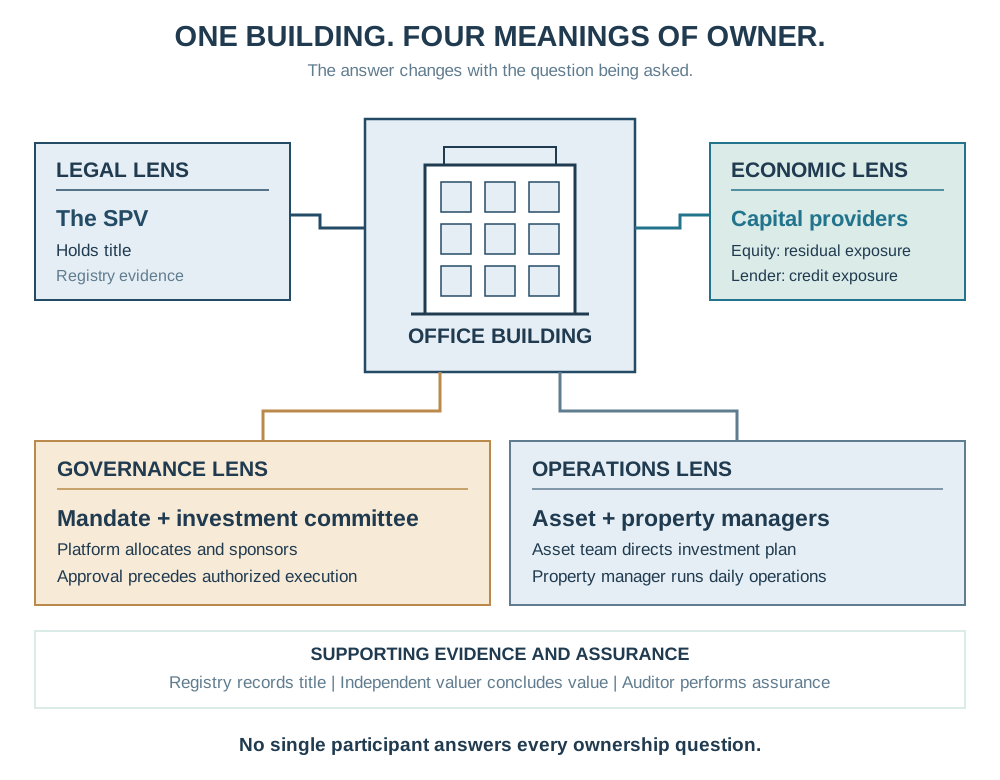
A worked example: Who owns the office building?
Consider a hypothetical institutional acquisition of an office building. The participants are deliberately separated to illustrate the ownership and authority questions; this is not an actual transaction.
Pension or family capital supplies the equity. A fund or investment platform allocates that capital and sponsors the acquisition. A property-holding SPV acquires legal title. An investment committee within the authorized structure approves the transaction, and the relevant legal entity executes it.
A lender supplies debt and imposes financing conditions. An asset-management team oversees the investment business plan, leasing strategy, expenditure, and financial performance. A separately appointed property manager handles day-to-day operations under its management agreement.
An independent valuer provides a valuation conclusion, and an auditor performs the applicable financial assurance work. The property registry records ownership under the relevant legal requirements. Investors ultimately receive the investment's financial outcome through the ownership and distribution structure, subject to financing obligations.
Who is the owner?
For legal title, the SPV is the relevant entity. For economic exposure, the equity investors and lender hold different financial interests. For investment authority, the governing mandate and investment committee approval matter. Operational responsibility rests with the asset-management team and appointed property manager within their respective scopes.
Calling the SPV the owner establishes legal title but leaves the capital and governance arrangements unexplained. Calling the investment manager the owner emphasizes investment control and may obscure the investors' economic exposure. Calling the property manager the owner confuses operational responsibility with principal ownership.
The complete answer identifies each participant's position and the evidence establishing it.
A practical framework for mapping any participant
The DUNNIXER working model reduces participant mapping to four questions. They apply to an institution's own structure, a co-investor, seller, joint-venture partner, manager, or service provider.
Each answer should identify the specific legal entities, authorities, responsibilities, and supporting records.
| Question | What to identify |
|---|---|
| Whose capital is economically exposed? | Identify equity investors, principal capital, client assets, lenders, ownership and financing vehicles, distribution rights, and the relevant supporting agreements. |
| Who has authority to make the investment decision? | Identify who recommends, approves, signs, and funds decisions. Examine mandates, committee powers, delegated authority, and external consent rights. |
| Who executes and operates the investment? | Identify responsible owner-side teams, appointed managers, and service providers. Establish operational responsibilities, contractual scopes, delegated powers, reporting obligations, and the evidence each party controls. |
| Who is accountable for the financial outcome? | Identify risk-bearing entities and those accountable for investment selection, financing, operations, and performance. Examine governance records, management agreements, reporting obligations, and corrective-action authority. |
The resulting map should expose both the flow of capital and the distribution of authority. It should also show where external rights constrain decisions and where evidence is held outside the immediate investment team.
For internal governance, this connects a problem owner to the relevant decision owner and budget holder. For external counterparties, it establishes whether the negotiating party, contract signatory, capital provider, and risk-bearing institution are the same or different participants.
Conclusion
Institutional real estate is more accurately understood as a network of capital, authority, legal ownership, and operational responsibility than as a collection of company labels.
This perspective changes how investment executives evaluate counterparties and govern their own institutions. It makes the approval structure visible before commitments are made, distinguishes operational influence from financial accountability, and connects performance issues to the people and entities authorized to address them.
The reliable discipline is to follow the capital, identify the risk-bearing entity, trace decision authority, and determine who remains accountable for property performance. With those relationships established, the investment structure can be assessed on the basis of its actual responsibilities, rights, and evidence.
References
- RPC (Reynolds Porter Chamberlain LLP). “PE funds: Risks to LP limited liability status.” October 24, 2017. Source.
- Nareit. “What's a REIT (Real Estate Investment Trust)?” Undated. Source.
- U.S. Securities and Exchange Commission, Office of Investor Education and Advocacy. “Investor Bulletin: Non-traded REITs.” August 31, 2015. Source.
- Dubignon, Christine. Forsters LLP. “Special Purpose Vehicle (SPV) Sales – The Key Issues.” May 26, 2022. Source.
- CMS. “Real estate joint ventures: governance and management.” CMS Funds Group Back to Basics briefing. December 2024. Source.
- Gowling WLG. “Lenders beware! Consents come under closer court scrutiny.” June 21, 2018. Source.
- Royal Institution of Chartered Surveyors (RICS). “Property agency and management principles.” First edition, published October 2024, effective January 1, 2025. Source.
- Reynolds, Rachael, and Guy Knight. DAC Beachcroft. “Bridging the Registration Gap.” June 5, 2024. Source.
Explore the Institutional Real Estate collection
Author
Ahmed Abbas - Founder & CEO, DUNNIXER
Former IBM Executive Architect with 26+ years in IT strategy and enterprise architecture. Advises technology providers and delivery leaders on architecture establishment, integration boundaries, decision governance, and complex technology delivery. View author profile on LinkedIn.