Part 3 of 5 — Enterprise Software Evaluation
Evaluate: Move Beyond the Feature Matrix
A credible evaluation measures whether software can enable the organization to operate successfully, a different question from whether a product contains the requested features
This is part 3 of a 5-part series, Enterprise Software Evaluation: A Context-Aware Method for Technology Decisions.
The feature matrix measures the wrong object
A conventional feature matrix is useful for establishing whether a product contains specified functions. Its weakness appears when that answer is treated as equivalent to organizational fit. Enterprise software is rarely valuable because a function exists in isolation. It matters because the organization must be able to use that function within its workflows, controls, architecture, and decision environment.
This changes the object of evaluation. The software itself is an enabler. The capability being evaluated is the organizational ability the software is expected to support. A platform may provide workflow automation, for example, while still failing to enable the required operating ability because integration constraints, administrative complexity, control requirements, or user practices prevent that functionality from working under the organization’s conditions.
The evaluation should therefore begin with the organizational profile and stakeholder map established during the Understand stage. Those inputs define what the organization must be able to do, what conditions must hold for that ability to work, and which stakeholders are qualified to judge the evidence.
Turn business needs into criteria that can be tested
Weighted scoring remains useful when the criteria underneath it are well formed. Responsive describes weighted RFP scoring as a way to assign greater value to requirements that matter more to the business, while Axia Consulting similarly combines requirement importance with a defined evaluation score. The discipline is sound: not every requirement deserves equal influence over the decision.
The categories may include business fit, technical fit, security and compliance, integration, scalability, usability, administration, commercial model, vendor strength, and implementation complexity. Each needs more than a label. A usable criterion has three elements: a precise description of the organizational ability required, an importance weight, and a success measure that tells evaluators what acceptable performance looks like.
The wording matters. “Supports APIs” describes a product property. “Can reliably exchange required business data with the organization’s priority systems under its security, latency, and support constraints” describes an ability that can be evaluated. The second formulation gives technical teams, business owners, and evaluators something concrete to test.
A category also needs defensible boundaries. It should represent a substantive ability, remain stable enough to survive review cycles, stay distinct from adjacent categories, support clear ownership, and avoid becoming so broad that unrelated abilities disappear inside it. Integration and scalability, for example, should remain separate because one concerns interaction across systems while the other concerns sustained operation as demand changes; a catch-all category such as “AI Capabilities” can be too loosely bounded to support consistent ownership or scoring. This capability-versus-enabler distinction and the need for disciplined capability boundaries derive from DUNNIXER’s Institutional Value Realization Model (IVRM), which defines capabilities around enduring, outcome-bearing institutional abilities rather than the technologies, platforms, tools, or methods that enable them.
Track evidence by source and credibility
A score is only as credible as the evidence beneath it. Vendor documentation, demonstrations, proof-of-concept results, analyst material, customer references, technical documentation, commercial information, and API documentation answer different questions and carry different limits. Combining them into a single evaluator impression removes information the decision process needs.
Evidence should instead be tracked with its source, date, scope, completeness, and level of credibility. Axia Consulting makes a simple but important point in its evaluation guidance: vendors present their products in the best light, so evaluators must investigate limitations themselves and record evidence as they find it. That principle becomes more important as products become harder to judge from static documentation alone.
Evidence quality is also contextual. An API specification can establish that an interface exists, but it cannot by itself prove that the organization’s target integration will perform acceptably. An analyst report may help establish market context but cannot verify a specific workflow. A customer reference can provide production experience, but its relevance depends on whether the customer’s operating conditions resemble the criterion being tested. The evidence register should preserve those distinctions rather than allowing several weak sources to acquire the appearance of one strong conclusion.
Separate claimed, demonstrated, and validated capability
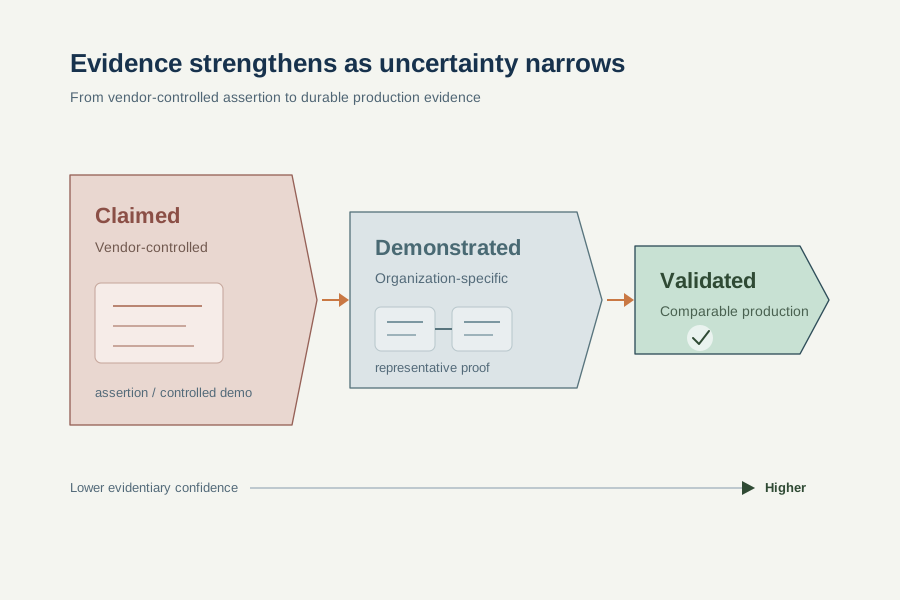
Three evidence states help prevent presentation quality from being mistaken for proof.
- Claimed: the vendor states that the capability exists through a proposal, specification, response, or controlled demonstration.
- Demonstrated: the capability has been exercised against representative organizational data, workflows, systems, users, or success criteria.
- Validated: independent operating evidence supports the conclusion that the same capability can persist under comparable production conditions.
A polished vendor demonstration remains primarily evidence of what the vendor can show under conditions it controls. InvGate’s guidance on software proof of concept distinguishes that situation from testing a product against the buyer’s own environment, workflows, systems, and data. AI Assembly Lines makes a similar distinction between vendor-curated demonstrations and proof exercises using actual organizational data, target workflows, defined success criteria, and the organization’s systems or a close facsimile.
A proof of concept conducted under those conditions materially strengthens the evidence, but it still answers a narrower question than production validation. A reference customer that can confirm comparable behavior in live operations adds evidence about durability beyond the test environment. Where the chain is incomplete, the score should reflect the weakest evidentiary link rather than the strongest presentation. A compelling claim should not receive the same confidence as a capability demonstrated under relevant conditions and corroborated in production.
Score the organization’s ability to operate
The decisive test for every criterion is whether this organization can successfully operate with the capability under evaluation. That judgment incorporates technical presence but extends beyond it. It asks whether the capability works with the organization’s architecture, controls, people, administration model, operating practices, dependencies, and required scale.
This approach also changes how evaluators interpret a high score. A product should not receive maximum credit because its functionality appears comprehensive in a demonstration. Maximum confidence requires evidence that the relevant organizational ability can be supported under the conditions that matter. Where evidence remains vendor-controlled, incomplete, stale, or poorly matched to the organization’s environment, evaluators should make that uncertainty visible rather than hiding it inside a precise-looking number.
The result is still a structured scorecard, but one with a different purpose. Weighting expresses organizational importance. Success measures define what acceptable performance means. Evidence states show how strongly each judgment has been established. Together they make the evaluation less dependent on feature volume, demonstration theater, or evaluator intuition.
Pressure-test the decision before it hardens
When an evaluation has accumulated scores faster than it has accumulated credible evidence, the remaining risk is not a missing spreadsheet field. It is that leadership may be comparing products on assumptions that were never tested against the organization’s actual operating conditions. DUNNIXER can help at that point by pressure-testing whether criteria reflect the abilities the organization truly needs, whether category boundaries are coherent, and whether the evidence supporting high-confidence scores is strong enough to justify a platform decision.
Related in this series
This is part 3 of 5 in the series Enterprise Software Evaluation: A Context-Aware Method for Technology Decisions.
- Part 1: Why Enterprise Software Evaluation Needs to Change
- Part 2: Understand: Begin With the Organization
- Part 4: Reason: Turn Evidence Into a Decision
- Part 5: Recommend: Make Technology Decisions Explainable and Defensible
Browse the full Enterprise Software Evaluation series →
References
- Responsive, RFP evaluation criteria: How to score and select the right vendor
- Axia Consulting, RFI / RFP response evaluation — scoring & evaluation matrix
- InvGate, Proof of Concept: The Smartest Way to Evaluate Software
- AI Assembly Lines, How Do You Evaluate AI Vendors Beyond the Demo? A 5-Stage Proof Framework for Enterprise Buyers
- DUNNIXER, Institutional Value Realization Model (IVRM)
Author
Ahmed Abbas - Founder & CEO, DUNNIXER
Former IBM Executive Architect with 26+ years in IT strategy and enterprise architecture.
Advises leadership teams on enterprise software evaluation, decision-grade evidence, and defensible technology recommendations. View author profile on LinkedIn.