Part 4 of 5 — Enterprise Software Evaluation
Reason: Turn Evidence Into a Decision
Scores compress evidence; decisions must expose the confidence, trade-offs, and risk the score leaves out
This is part 4 of a 5-part series, Enterprise Software Evaluation: A Context-Aware Method for Technology Decisions.
A score is only an input
Enterprise software evaluations often become more misleading precisely when they become more orderly. Criteria are weighted, products are scored, totals are calculated, and the result appears settled. Yet a criterion score says only what the evaluation concluded about that criterion. It does not say how securely that conclusion is supported, which competing objective it sacrifices, or what exposure remains if the organization acts on it.
Two platforms can both receive an 8 out of 10 for the same capability while presenting materially different decision conditions. One score may rest on direct observation, documented evidence, customer references, and consistent findings across evaluators. The other may rest largely on a vendor assertion and an inference from adjacent functionality. Treating those scores as equivalent transfers uncertainty from the evaluation into the decision without making that transfer visible.
That distinction matters because risk-informed decision-making is not static. Research on dynamic risk assessment emphasizes that new knowledge, changing conditions, and altered assumptions can change the basis on which an earlier judgment was made. A score should therefore be treated as an input to reasoning, not as the end of it.
Confidence is a separate judgment from capability
The first discipline is to separate the strength of the judgment from the strength of the capability being judged. A high capability rating built on weak evidence is not the same decision signal as a high rating supported by independent confirmation. Research on uncertainty representation makes the broader point explicit: uncertainty about available knowledge and evidence affects the credibility and interpretability of a risk judgment, and making that uncertainty visible improves the quality and traceability of decisions.
For every material criterion judgment, the evaluator should be able to state four things. First, what is the breadth of evidence: how many sources support the conclusion, and how varied are they? Second, what type of evidence is available: documentation, demonstration, reference evidence, testing, or direct observation? Third, is the evidence direct or proxy: was the capability itself observed, or was its existence inferred from something adjacent? Fourth, what is the single largest uncertainty that could change the conclusion?
This confidence discipline is grounded in DUNNIXER’s Institutional Value Realization Model (IVRM), which requires judgments to distinguish evidence breadth and type, direct from proxy evidence, confidence level, and the major uncertainty affecting the conclusion. High confidence should be reserved for judgments supported by multiple independent sources that are directionally consistent, include at least some direct evidence, and leave no major unresolved uncertainty capable of changing the conclusion. Anything weaker belongs at moderate or low confidence and should remain provisional.
The practical implication is straightforward. “Capability: High” is incomplete. “Capability: High; confidence: Low because the conclusion depends on one vendor-supplied demonstration and an unresolved integration assumption” is decision-grade information. The second statement tells leadership what it knows and what it is still being asked to believe.
Trade-offs, made explicit
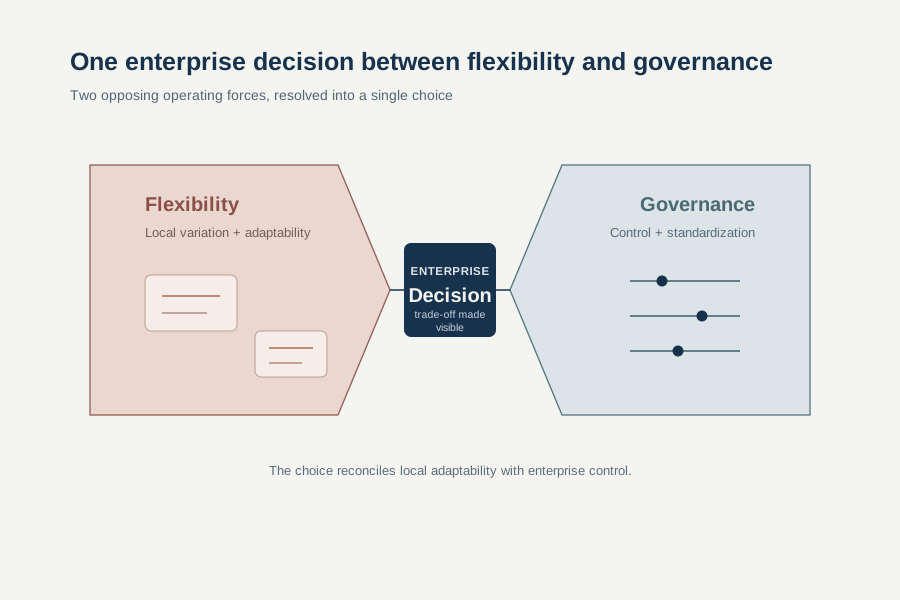
Confidence addresses how much a judgment should be trusted. Trade-off analysis addresses what the organization is choosing when two desirable outcomes cannot both be maximized. Enterprise software decisions routinely contain tensions such as flexibility versus governance, cost versus capability, speed versus customization, innovation versus stability, and ease of use versus control.
A weighted score can obscure those tensions because aggregation converts competing objectives into arithmetic. A high score for flexibility may quietly compensate for a weak score on governance. Strong functionality may outweigh commercial constraints in the total. Ease of deployment may conceal the operational consequences of accepting less control. The mathematics may be correct while the management judgment remains unstated.
That is why the material trade-off should be written as a choice rather than buried inside weighting logic. Leadership should be able to see which objective is being favored, what is being conceded, why that concession is acceptable in this organizational context, and which condition would cause the balance to be reconsidered. The purpose is not to eliminate compromise. It is to prevent compromise from masquerading as an objective score.
The risk that survives the score
The next question is what exposure survives the scoring model. A platform can rate highly on functional capability and still carry material vendor, technical, implementation, adoption, security, commercial, or strategic risk. Those exposures are analytically different from capability. Treating a strong capability score as evidence of low overall risk collapses two separate judgments into one.
Standard enterprise risk practice provides a useful discipline: identify the risk, estimate its likelihood and impact, and state the intended response or mitigation. Applied to software evaluation, that means a recommendation should show not only where risk exists but also which risks are accepted, which are being reduced, which depend on unresolved evidence, and which could alter the recommendation if their likelihood or impact changes.
This also argues against treating risk analysis as a one-time appendix. Dynamic risk research emphasizes that changes in knowledge, context, and available alternatives can justify renewed assessment. The commercial position of a vendor can change. A security assumption can be invalidated. Implementation evidence can strengthen or weaken. Adoption risk can become clearer after stakeholder testing. The reasoning should be capable of changing when the evidence changes.
The objective is not zero risk. Enterprise projects cannot eliminate uncertainty, and risk frameworks are most useful when they support clear decisions about which exposure is tolerable, which requires treatment, and which should prevent commitment. A recommendation becomes stronger when accepted risk is visible rather than silently embedded in its score.
Why this stage is easy to skip and expensive to skip
Reasoning is the least mechanical part of evaluation. It requires evaluators to qualify their own conclusions, surface disagreement, resist false precision, and explain why one compromise is preferable to another. A scoring model can be completed by following a method. A judgment must survive challenge.
That is also why this stage has disproportionate value. Without it, uncertainty appears as certainty, trade-offs disappear into weightings, and risk is mistaken for a weakness already captured somewhere in the matrix. The resulting recommendation may look concise because the difficult questions have been compressed out of view.
A sound decision record should instead make three questions unavoidable: How confident are we in this judgment, given the evidence behind it? What trade-off are we choosing rather than merely scoring? What risk are we accepting even if the capability assessment is favorable? When those answers are explicit, leaders can disagree with the recommendation intelligently. They can test assumptions, request targeted evidence, change a tolerance, or accept an exposure knowingly. That is a stronger basis for executive approval than a higher decimal score.
Before the recommendation reaches the board
A high score can create an unwarranted sense of safety when the evidence behind it is thin, the trade-off is unstated, or the residual risk sits outside the scoring model. For leadership teams preparing to commit, an independent reasoning pass can examine those specific weaknesses before the recommendation becomes an executive position. DUNNIXER can serve that role by testing the confidence attached to material judgments, the compromises embedded in the recommendation, and the risks being accepted rather than treating the evaluation total as sufficient proof.
Related in this series
This is part 4 of 5 in the series Enterprise Software Evaluation: A Context-Aware Method for Technology Decisions.
- Part 1: Why Enterprise Software Evaluation Needs to Change
- Part 2: Understand: Begin With the Organization
- Part 3: Evaluate: Move Beyond the Feature Matrix
- Part 5: Recommend: Make Technology Decisions Explainable and Defensible
Browse the full Enterprise Software Evaluation series →
References
- Extending and improving current frameworks for risk management and decision-making
- Methods for Uncertainty Representation in Risk Management
- Diligent, Enterprise risk management framework
- Plane, How to choose the right risk assessment framework for your enterprise projects
- DUNNIXER, Institutional Value Realization Model (IVRM)
Author
Ahmed Abbas - Founder & CEO, DUNNIXER
Former IBM Executive Architect with 26+ years in IT strategy and enterprise architecture.
Advises leadership teams on enterprise software evaluation, decision-grade evidence, and defensible technology recommendations. View author profile on LinkedIn.