Part 5 of 5 — Enterprise Software Evaluation
Recommend: Make Technology Decisions Explainable and Defensible
A board-ready recommendation shows what to choose, why the choice fits, what remains uncertain, and when the decision should be revisited
This is part 5 of a 5-part series, Enterprise Software Evaluation: A Context-Aware Method for Technology Decisions.
A recommendation has to explain itself
A software selection process can understand the organization, evaluate alternatives against its actual needs, and reason carefully through the evidence, yet still fail at the final step. If the recommendation reduces that work to a winning vendor, a composite score, and a polished approval deck, decision-makers are being asked to accept the conclusion without being shown enough of the judgment behind it.
That standard is becoming harder to defend. In enterprise contracting, Sirion’s work on recommendation traceability reflects a broader expectation that consequential recommendations should be explainable, auditable, and capable of being reconstructed under scrutiny. Its subject is AI-assisted contracting, but the governance principle is wider than AI: a conclusion is easier to defend when its rationale, evidence, uncertainty, and human judgment remain visible.
This is where the full Understand → Evaluate → Reason → Recommend arc resolves. The first three stages create the basis for judgment. Recommend converts that judgment into an institutional decision record: specific enough to approve, challenge, revisit, and defend.
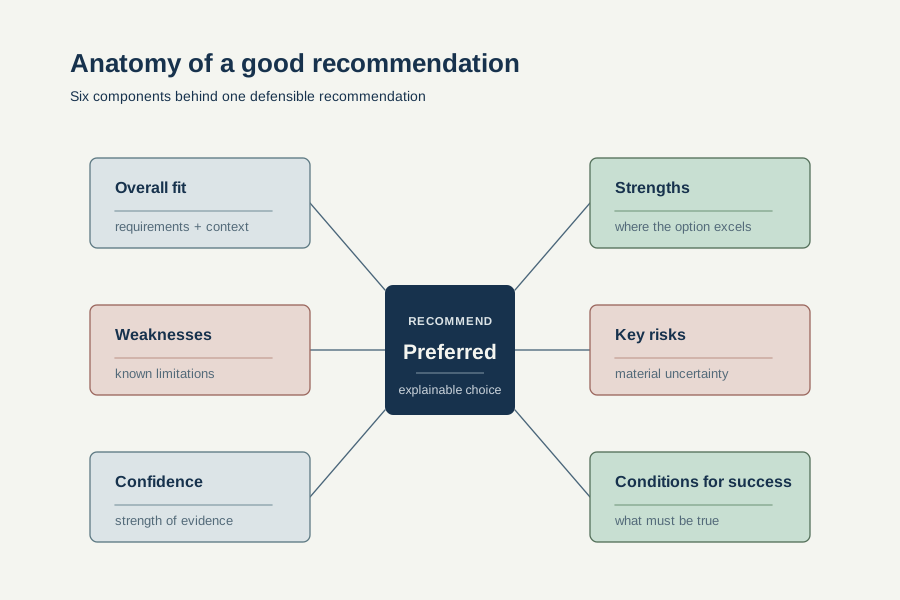
The anatomy of a good recommendation
A defensible recommendation should not force a board or investment committee to reverse-engineer the decision from a score. It should state the major dimensions of judgment separately. Guidance on defensible vendor selection from The Deady Group emphasizes structured evaluation against organizational needs, risk, long-term fit, stakeholder perspectives, and documented decision-making. A useful recommendation turns those considerations into an explicit account of why the preferred option is preferred.
- Overall fit: why this option is the strongest fit for this organization, given its priorities, operating context, constraints, and trade-offs.
- Strengths: the areas where the option provides clear advantages that matter to the decision.
- Weaknesses: material limitations the organization is knowingly accepting rather than hiding inside an aggregate score.
- Key risks: exposures that could change the attractiveness or viability of the choice.
- Confidence: how certain the evaluation team is about the recommendation and where that confidence is weaker.
- Conditions for success: the organizational, commercial, technical, governance, or adoption conditions that must hold for the recommendation to remain sound.
The distinctions matter because two products can arrive at similar scores for very different reasons. One may have stronger functional fit but greater dependency risk; another may be easier to govern but require compromises elsewhere. An approval body needs the shape of that judgment, not only its arithmetic.
Name what still needs to be validated
A thorough evaluation does not eliminate uncertainty. It makes the remaining uncertainty more visible. Before purchase, the recommendation should therefore identify the unknowns, unverified assumptions, and unresolved risks that still require validation.
This distinction is especially important in enterprise software because some issues cannot be fully resolved through demonstrations, written responses, reference calls, or technical documentation. The CIO analysis of enterprise software selection difficulty points to structural problems such as complexity, underestimated effort, incomplete requirements, and unknowns that may emerge only during implementation or operation. Pretending that a pre-purchase process has removed every uncertainty makes the recommendation look cleaner while weakening its usefulness.
The approval document should instead state what is known, what is strongly supported, what is assumed, and what still needs proof. That could include a critical integration behavior that has not been tested under realistic conditions, a commercial assumption dependent on final contract language, an operating-model dependency whose owner has not committed, or a security issue awaiting deeper validation. These items are not drafting defects. They are part of the decision.
Make the recommendation defensible after approval
Defensibility also depends on scope. A recommendation should say for whom the preferred option is a good fit and under what conditions. That prevents a contextual judgment from slowly turning into a universal claim such as “this is our strategic platform” long after the assumptions that justified the choice have changed.
Research into trust in AI-augmented procurement systems provides a useful governance parallel: explainability, visible governance, and meaningful human oversight are treated as distinct factors in whether users can rely on a decision-support system. The specific research concerns AI, but the management implication for a software recommendation is straightforward. Evidence alone does not create accountability; the organization must also preserve the mechanisms through which judgment can be reviewed.
That means the recommendation needs a life after the approval meeting. It should identify who owns the decision going forward, the forum through which its assumptions and results will be reviewed, and the conditions that would trigger reassessment. This owner–forum–trigger mechanism is drawn from DUNNIXER’s Institutional Value Realization Model (IVRM), which connects named accountability, recurrent review, and defined reassessment conditions rather than treating a judgment as complete once it has been made.
Without those elements, the recommendation quietly expires on the day it is approved. The document may remain on file, but nobody is accountable for determining whether the conditions behind it still hold. With them, the recommendation becomes a governed decision that can be re-justified, modified, or replaced as evidence and circumstances change.
From selection project to decision capability
Enterprise software selection is structurally difficult because the decision combines extensive requirements, organizational context, imperfect information, competing stakeholder interests, and consequences that become clearer only after commitment. Treating each major purchase as an exceptional project means rebuilding the discipline for handling those conditions every time.
The stronger institutional response is repetition. Understand establishes the context that should govern the decision. Evaluate examines alternatives against that context. Reason converts evidence and trade-offs into a judgment. Recommend makes the judgment explicit enough to approve, challenge, govern, and revisit.
Run consistently, those stages become more than a method for choosing one platform. They establish a common standard for how meaningful technology decisions are made across the organization. The cumulative advantage extends beyond any single selection document: an organization that runs this method repeatedly becomes more capable of explaining why it committed, what assumptions it accepted, and what evidence would cause it to decide differently next time.
Before the decision reaches the board
When a recommendation reaches leadership without stated confidence, explicit conditions for success, or a clear account of what still requires validation, the immediate problem is decision clarity rather than another round of feature comparison. In that narrow pre-decision context, DUNNIXER can provide leaders with an independent way to examine whether the proposed conclusion, remaining risks, assumptions, and conditions are sufficiently explicit to withstand board-level scrutiny before a platform commitment is approved.
Related in this series
This is part 5 of 5 in the series Enterprise Software Evaluation: A Context-Aware Method for Technology Decisions.
- Part 1: Why Enterprise Software Evaluation Needs to Change
- Part 2: Understand: Begin With the Organization
- Part 3: Evaluate: Move Beyond the Feature Matrix
- Part 4: Reason: Turn Evidence Into a Decision
Browse the full Enterprise Software Evaluation series →
References
- Sirion, AI Recommendation Traceability Standards for Enterprise Contracting in 2026
- Frontiers in Artificial Intelligence, Trust by design in AI-augmented procurement systems
- The Deady Group, Independent Advisory for Regulated Industries: Stronger, Defensible Vendor Selection
- CIO, Why selecting enterprise software is so difficult
- DUNNIXER, Institutional Value Realization Model (IVRM)
Author
Ahmed Abbas - Founder & CEO, DUNNIXER
Former IBM Executive Architect with 26+ years in IT strategy and enterprise architecture.
Advises leadership teams on enterprise software evaluation, decision-grade evidence, and defensible technology recommendations. View author profile on LinkedIn.