Part 1 of 5 — Enterprise Software Evaluation
Why Enterprise Software Evaluation Needs to Change
Feature matrices can document comparison without establishing organizational fit, evidence quality, or decision traceability
This is part 1 of a 5-part series, Enterprise Software Evaluation: A Context-Aware Method for Technology Decisions.
More information has not made the decision easier
Enterprise software evaluators rarely suffer from a lack of information. Vendor sites describe extensive capabilities. Analyst material organizes markets and technology trends. Review platforms surface user experiences. Peers offer implementation lessons. AI-generated summaries can compress all of this into answers within seconds. The problem is that these sources answer different questions, use different standards of proof, and often describe products outside the operating context of the organization making the decision.
The result is a reconciliation problem disguised as a research problem. Teams collect more evidence, but they do not necessarily have a shared method for deciding which evidence matters, how it should be interpreted, or how it relates to the organization’s requirements. CIO’s analysis of enterprise software selection has long emphasized the scale of the requirements problem and the risk of underestimating the work needed to establish fit. The difficulty lies in determining whether those capabilities match the organization’s particular needs closely enough to support a defensible decision, which is a different and harder question than knowing what a platform can do.
Source lineage makes this harder. Analyst perspectives, for example, may reach an evaluation team through vendor commentary rather than through the primary research itself. A 2024 commercetools article discussing Gartner’s Emerging Tech Impact Radar is explicitly a vendor-authored summary of Gartner material. That does not make the information unusable, but it does make the distinction between primary evidence, interpretation, and vendor framing important. Evaluation processes that treat every collected input as equivalent lose that distinction quickly.
The feature-matrix trap
Most evaluation processes attempt to impose order through criteria, scores, and weighted matrices. That structure has legitimate value. Responsive’s guidance on RFP evaluation describes matrices and weighted scoring as common methods for standardizing assessment, prioritizing requirements, and comparing vendors consistently. The problem begins when the matrix becomes the decision model rather than one input to it.
A feature matrix answers a narrow question: how does each option perform against the criteria entered into the matrix? It does not establish whether the criteria accurately represent the organization, whether evaluators interpreted them consistently, whether a claimed capability has been independently validated, or whether a technically strong result fits the organization’s data architecture, governance model, operating practices, and decision rights.
This distinction matters because numerical precision can create confidence without improving the underlying judgment. A platform can accumulate a strong score because it satisfies many documented requirements while still conflicting with a small number of conditions that matter disproportionately to the organization. A detailed matrix can therefore be procedurally rigorous and strategically weak at the same time.
Four structural gaps weaken the evaluation
The recurring weaknesses in enterprise software selection are less about the absence of evaluation activity than about what that activity fails to connect.
Organizational context is incomplete
Requirements often describe desired functionality more clearly than they describe the environment in which that functionality must operate. CIO’s coverage of software selection repeatedly stresses that requirements discovery is substantial work and that incomplete requirements surface later as mismatches. For executive decision-making, context has to extend beyond functions into the operating model, architecture, constraints, dependencies, and governance conditions that determine whether a capability is genuinely usable.
Evaluators do not always apply the same decision logic
A committee can appear aligned because everyone uses the same spreadsheet while individual members interpret criteria through different priorities and experience. CIO’s examination of selection committees describes inadequate requirements discovery, uneven experience, group decision problems, and difficulty tracing a consensus decision back to requirements. A common scoring tool cannot compensate for inconsistent reasoning behind the scores.
Evidence quality is flattened
A vendor statement, a scripted demonstration, a customer reference, an architectural review, and observed behavior in a controlled test should not carry the same evidentiary weight. Yet evaluation artifacts often capture the conclusion without preserving how it was established. Once evidence provenance disappears, a claim that a product “supports” a requirement can conceal very different levels of confidence.
Recommendations lose their reasoning trail
The final recommendation often compresses months of evaluation into rankings, totals, and a short narrative. CIO’s committee analysis makes the traceability problem explicit: when a selection rests on voting or consensus without a logical path back to requirements, its correctness is difficult to verify. Leadership may receive an answer, but not a sufficiently clear account of why that answer remains valid under the organization’s actual constraints.
A better model separates four different jobs
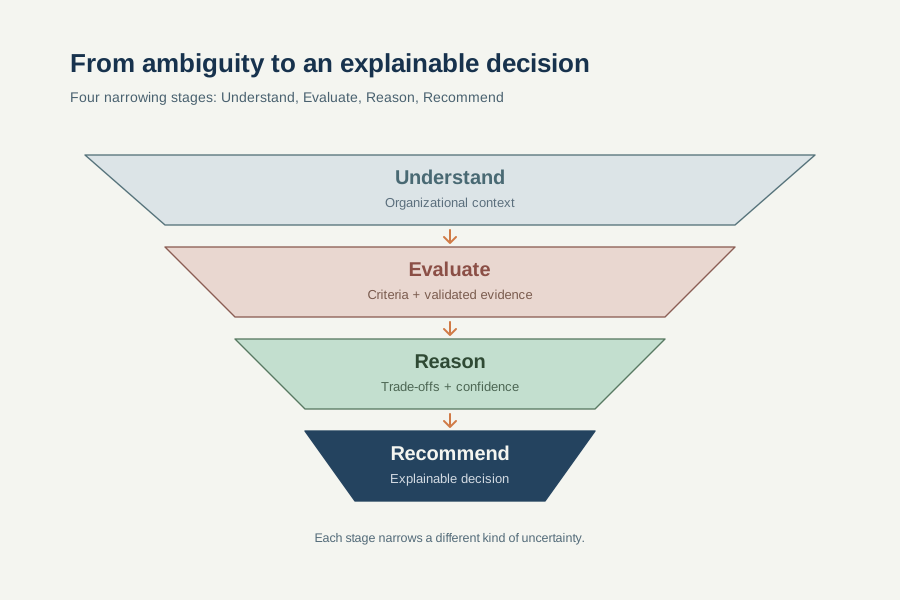
A more defensible evaluation treats software selection as four connected but distinct stages: Understand → Evaluate → Reason → Recommend. The value of separating them is that each stage resolves a different source of ambiguity that a feature matrix alone cannot address.
Understand establishes the organizational conditions against which software should be judged: objectives, operating realities, architecture, governance, constraints, dependencies, and the relative importance of different needs.
Evaluate tests candidate platforms against those conditions using explicit criteria and evidence, while distinguishing what a vendor states from what the evaluation has actually validated.
Reason interprets the evidence. It addresses trade-offs, conflicts between criteria, uncertainty, dependencies, and the consequences of choosing one strength at the expense of another.
Recommend turns that reasoning into an explainable decision: what should be selected, why it fits better than the alternatives, which assumptions the conclusion depends on, and which material risks remain.
This model does not eliminate scoring, RFPs, demonstrations, analyst research, or matrices. It gives those tools a defined place inside a larger decision structure. The central shift is from documenting product comparison to establishing organizational fit through evidence and traceable reasoning.
Where the series goes next
Part 2, Understand: Begin With the Organization, addresses how organizational conditions establish the basis for evaluation. Part 3, Evaluate: Move Beyond the Feature Matrix, focuses on criteria and evidence that test fit rather than simply catalog capabilities. Part 4, Reason: Turn Evidence Into a Decision, examines how evidence becomes comparative judgment. Part 5, Recommend: Make Technology Decisions Explainable and Defensible, covers how that judgment is carried into a recommendation leadership can interrogate and defend.
Test the evaluation before the commitment
When an organization has completed extensive research but still struggles to explain why one platform is the right fit, the weakness may sit in the evaluation approach rather than in the amount of information collected. Before a platform commitment is treated as settled, leaders need confidence that organizational context is represented, evidence is differentiated, trade-offs are explicit, and the recommendation can be traced back to the conditions that matter. DUNNIXER’s role in that situation is focused on helping leadership examine whether those decision foundations are sufficiently clear to support the choice being made, rather than adding another layer of product comparison.
Related in this series
This is part 1 of 5 in the series Enterprise Software Evaluation: A Context-Aware Method for Technology Decisions.
- Part 2: Understand: Begin With the Organization
- Part 3: Evaluate: Move Beyond the Feature Matrix
- Part 4: Reason: Turn Evidence Into a Decision
- Part 5: Recommend: Make Technology Decisions Explainable and Defensible
Browse the full Enterprise Software Evaluation series →
References
- CIO, Why selecting enterprise software is so difficult
- CIO, 8 reasons why committees fail when selecting enterprise software
- commercetools, Exploring Emerging Enterprise Software Tech with Gartner
- Responsive, RFP evaluation criteria: How to score and select the right vendor
Author
Ahmed Abbas - Founder & CEO, DUNNIXER
Former IBM Executive Architect with 26+ years in IT strategy and enterprise architecture.
Advises leadership teams on enterprise software evaluation, decision-grade evidence, and defensible technology recommendations. View author profile on LinkedIn.