Part 2 of 5 — Enterprise Software Evaluation
Understand: Begin With the Organization
A defensible software evaluation begins by defining the organization's objectives, constraints, operating realities, and stakeholder priorities before any vendor enters the frame
This is part 2 of a 5-part series, Enterprise Software Evaluation: A Context-Aware Method for Technology Decisions.
The same platform can produce two different outcomes
A platform can be a strong choice for one organization and a poor choice for another without anything about the product itself changing. The difference may sit in operating complexity, governance, technical dependencies, regulatory obligations, available skills, decision rights, or the outcomes leadership actually needs the investment to produce. Product quality and organizational fit are related questions, but they are not the same question.
This is why enterprise software evaluation cannot begin with the market. CIO’s analysis of software-selection difficulty cautions against assuming that a product is suitable because it succeeded at a previous company, is used by competitors, leads the market, or ranks well in analyst research designed for an average buyer rather than a particular organization. The relevant standard is the organization’s own needs and context.
The previous article in this series established the sequence of understanding, evaluating, reasoning, and recommending; the first stage exists to prevent vendor comparison from defining the decision before leadership has defined the institution making it.
Decision context comes before evaluation criteria
Before requirements are scored, leaders need a clear account of the decision itself. What business problem is being addressed? Which strategic objective does the decision serve? What outcome would make the investment worthwhile? Which constraints are fixed, and which are negotiable?
Those constraints should be explicit. Budget may limit the feasible solution class. A regulatory obligation may eliminate architectures that would otherwise appear attractive. A deadline may make one implementation path unrealistic. Existing integration patterns, data residency requirements, security controls, contractual commitments, or scarce internal capabilities may narrow the decision further. None of these factors is background information. Each can change what “best fit” means.
Hartman Executive Advisors makes the same sequencing point from a software-selection perspective: leadership should begin with the business outcomes the organization needs rather than a feature list, and the evaluation team should be aligned across the functions affected by the decision. If those choices remain implicit, evaluators can still produce a detailed scorecard, but the scorecard will be optimizing against assumptions that were never formally agreed.
The organizational profile is a fit variable
The second input is an Organizational Profile: the characteristics of the enterprise that materially affect whether a product can work well there. Size, industry, geographic footprint, operating model, technology maturity, governance model, and the existing technology estate should be treated as evaluation variables rather than descriptive context.
A globally distributed organization with federated decision rights presents a different fit problem from a centralized enterprise operating in one jurisdiction. A company with mature integration, identity, data, and platform-engineering capabilities can absorb a different level of architectural complexity from one that depends heavily on vendors for technical change. A highly governed environment may value configurability, auditability, and control separation differently from a business optimized for rapid local autonomy.
The practical consequence is that the same capability claim can carry different value and risk depending on where it lands. “Highly configurable” may represent flexibility in one operating model and governance burden in another. A broad integration surface may be essential where the technology estate is heterogeneous but unnecessary where standardization is the strategic objective. Context changes the interpretation of the feature before it changes the score.
Stakeholder priorities are part of the decision
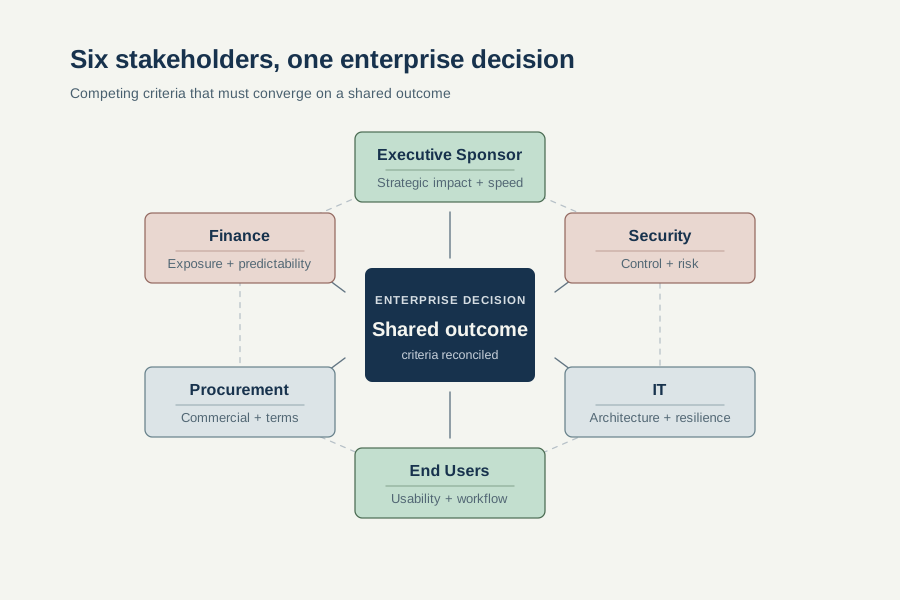
Enterprise software decisions also have multiple definitions of success. An executive sponsor may prioritize strategic impact and speed. Finance may focus on economic exposure and predictability. Security may care about control design and risk acceptance. IT may be concerned with architecture, supportability, integration, and operational resilience. Procurement introduces commercial and contractual requirements. End users judge whether the system helps or obstructs the work it is supposed to support.
Buying-committee research reflects this cross-functional structure. Traction Complete maps enterprise purchasing across roles including project and executive sponsors, financial approvers, technical buyers, operations owners, business users, legal reviewers, influencers, and final authorities, noting that their priorities can overlap or conflict. Industry guidance from Jolly Marketer likewise treats stakeholder disagreement and distributed influence as normal features of complex B2B decisions rather than exceptions.
A Stakeholder Map therefore needs more than names and titles. It should record what each group is trying to achieve, which criteria it considers decisive, what risks it can veto, where decision authority actually sits, and where priorities conflict. Surfacing those conflicts before comparison starts turns disagreement into an evaluation input. Discovering them after a preferred product has emerged turns the same disagreement into a challenge to the decision itself.
What the understand stage must produce
A credible Understand stage should leave three explicit artifacts behind: a Decision Context, an Organizational Profile, and a Stakeholder Map.
- Decision Context: the problem being solved, the outcomes sought, and the strategic, financial, regulatory, technical, and timing constraints governing the choice.
- Organizational Profile: the operating characteristics that determine how a proposed capability would fit, including scale, structure, maturity, governance, geography, and the existing technology estate.
- Stakeholder Map: the people and functions that influence, approve, use, fund, govern, or can block the decision, together with their success criteria and unresolved conflicts.
Missing any one of the three creates an opening for a feature-driven evaluation to take control. Without decision context, criteria become a catalog of desirable attributes. Without an organizational profile, product strengths are judged as though they have the same significance everywhere. Without a stakeholder map, hidden disagreements surface only after evaluators have invested time and credibility in a preferred answer.
The sequencing into the next stage is therefore a precondition rather than a matter of presentation: evaluation criteria can only be meaningful after the institution in which those capabilities must operate has been made explicit. That premise — a capability has to be interpreted relative to the institution that needs and governs it, rather than as a context-free technology label — traces back to DUNNIXER’s Institutional Value Realization Model (IVRM).
Clarity before comparison
When an evaluation starts with vendors, the organization risks spending the rest of the process translating product differences into a decision it never properly defined. The more consequential the platform, the more costly that inversion becomes because stakeholder priorities, governance limits, technical dependencies, and institutional constraints eventually re-enter the process anyway. The question is whether they shape the evaluation at the beginning or disrupt it near the end. DUNNIXER’s role in this context is narrowly focused on helping leadership make those decision conditions explicit and reconcile material stakeholder and constraint conflicts before a platform choice hardens around the wrong definition of fit.
Related in this series
This is part 2 of 5 in the series Enterprise Software Evaluation: A Context-Aware Method for Technology Decisions.
- Part 1: Why Enterprise Software Evaluation Needs to Change
- Part 3: Evaluate: Move Beyond the Feature Matrix
- Part 4: Reason: Turn Evidence Into a Decision
- Part 5: Recommend: Make Technology Decisions Explainable and Defensible
Browse the full Enterprise Software Evaluation series →
References
- CIO, Why selecting enterprise software is so difficult
- Traction Complete, Mapping the B2B Buying Committee
- Jolly Marketer, B2B Buying Committee Roles: Complete Mapping Guide
- Hartman Executive Advisors, 6 Strategies for a Successful Software Selection
- DUNNIXER, Institutional Value Realization Model (IVRM)
Author
Ahmed Abbas - Founder & CEO, DUNNIXER
Former IBM Executive Architect with 26+ years in IT strategy and enterprise architecture.
Advises leadership teams on enterprise software evaluation, decision-grade evidence, and defensible technology recommendations. View author profile on LinkedIn.