Digital Maturity Assessment Providers: How to Choose a Partner
A short guide for CIOs and CDOs comparing global firms, boutiques, platforms, and public programs.
Use this guide to compare partner types for digital maturity assessment and implementation governance, and select a provider that fits your operating model and budget.
Organizations evaluating digital maturity assessment providers must distinguish between advisory-led, platform-led, and implementation-led approaches. The right choice depends on operating model, budget, internal capability, and transformation scope.
If you still need to define your framework and scoring approach, see model comparison and benchmark/survey design.
Why This Question Matters
Most CIOs and CDOs are not looking for another maturity model—they are looking for decision clarity: a credible baseline, defensible benchmarking, and a prioritized roadmap.
You are “hiring” a partner to do three jobs:
• Baseline – Establish a credible, shared view of where you stand today.
• Benchmark – Put that baseline in context (peers, segments, and patterns).
• Prioritize – Turn gaps into a sequenced roadmap that leadership can fund and govern.
This guide is written for leaders who own those jobs and need clarity on who really specializes in digital maturity assessment and roadmap work (without confusing it with implementation delivery).
The Main Types of Maturity Specialists
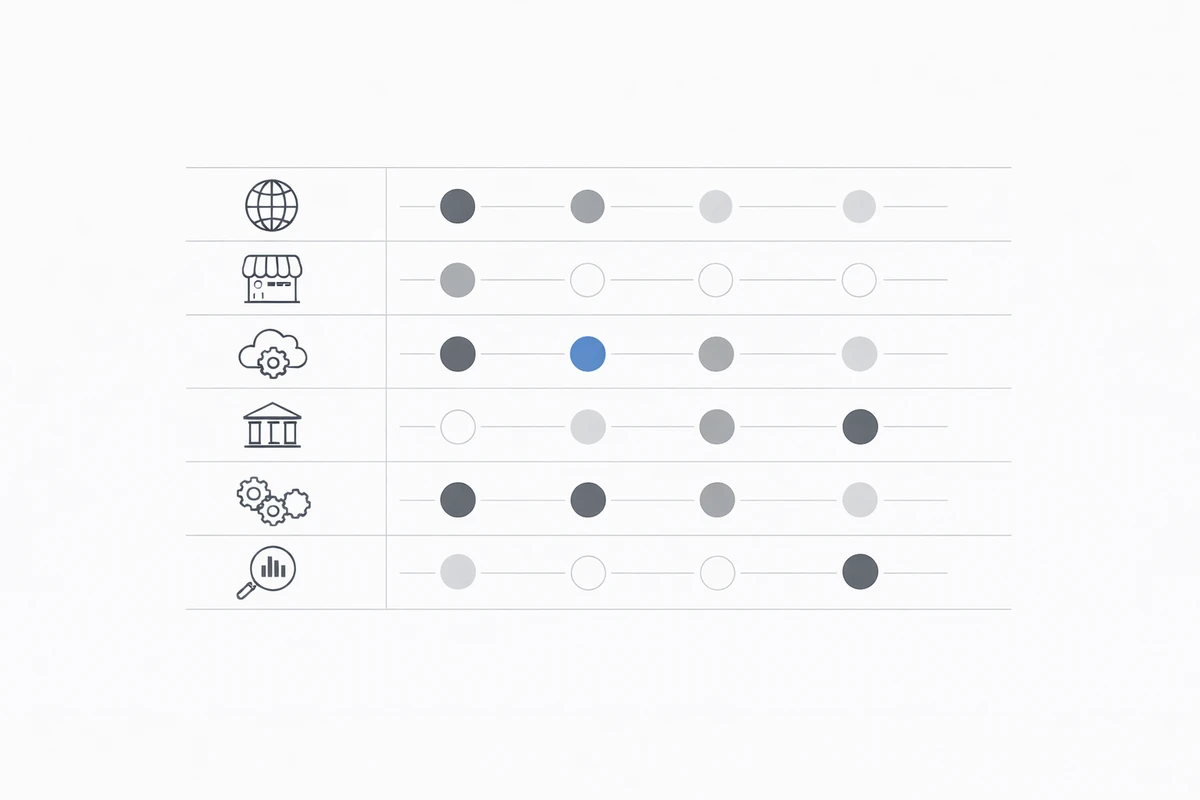
In practice, most options fall into six patterns:
• Global consulting firms – Broad coverage, strong governance, high price point.
• Boutique and specialist firms – Focused on maturity + roadmap (and sometimes execution governance), lighter structures, mid-market friendly.
• Technology providers/platforms – SaaS-based assessments, dashboards, and benchmarks tied to specific stacks.
• Public programs – Governmental and non-governmental frameworks designed for policy alignment and sector-wide benchmark.
• System integrators – Deep technology implementation capability once the roadmap is clear.
• Analyst and research firms – Benchmarks, frameworks, and thought leadership—but not delivery by themselves.
Provider Type Comparison for Digital Maturity Consulting Firms
| Provider Type | Strength | Limitation | Best For | Risk If Misaligned |
|---|---|---|---|---|
| Global consulting firms | Scale, governance depth, and executive credibility | Higher cost and slower setup | Complex multinational programs | Over-scoped engagements for narrower needs |
| Boutique digital maturity assessment consultants | Speed, focus, practitioner-led delivery | Smaller team bandwidth | Mid-market and focused enterprise transformation | Capacity mismatch for broad global rollout |
| Platform and tool providers | Repeatable self-service benchmarking workflows | Limited facilitation and change leadership | Internal teams with strong execution capacity | Data-rich output but weak organizational adoption |
| Public programs | Policy alignment and sector comparability | Generic enterprise fit | Regulated/public-sector contexts | Weak linkage to portfolio execution priorities |
| System integrators | Delivery horsepower after strategy is set | Assessment neutrality can vary | Technology-heavy implementation waves | Roadmaps tied too early to chosen stack/vendor |
How to Match Partner Type to Your Situation
Instead of asking “Who is best?”, ask:
• Scope – Do you need an enterprise-wide baseline or a focused lens (e.g., data, customer, operations)?
• Budget and speed – Can you fund a large, multi-quarter engagement, or do you need sharper, time-boxed support?
• Internal capacity – Do you have a strong internal PMO/strategy/architecture team, or are you short on execution bandwidth?
• Technology commitments – Are you standardizing on specific cloud/data platforms where vendor tools matter?
Global firms tend to fit large, complex programs with high governance requirements. Boutiques fit well when you need sharp focus, speed, and a practitioner-led engagement without Big-4 overhead. Platforms and public programs are powerful when ongoing self-assessment, compliance, or policy alignment are primary needs.
How to Evaluate Digital Maturity Assessment Providers
Regardless of category, good partners share a few non-negotiable traits:
• Evidence of execution – Not just diagnostics; examples of assessments leading to funded roadmaps and measurable outcomes.
• Fit with your operating model – Ability to plug into your governance, release cycles, and portfolio process instead of forcing a one-size-fits-all playbook.
• Relevant benchmarks – Sector- and scale-appropriate benchmarks that influence decisions, not vanity comparisons.
• Capability-building – Clear plan to leave your teams stronger and able to run the next assessment themselves.
• Neutrality – Independence from specific vendors where it matters, so recommendations do not become disguised sales motions.
Decision Tree: Which Provider Type Fits Your Situation?
Use this quick decision tree before building a shortlist:
• Need an enterprise-wide transformation mandate with deep change capacity? Start with global consulting firms or large system integrators, then test whether assessment neutrality is preserved.
• Need a focused baseline, benchmark, and roadmap in weeks rather than quarters? Compare specialist boutiques and platform-supported advisory firms.
• Already have a strong internal strategy or enterprise architecture team? Consider a platform-led assessment if your team can interpret results and run prioritization internally.
• Need policy alignment, sector comparability, or public-program compliance? Review public frameworks and sector programs, then decide whether a consulting partner is needed to translate them into execution.
• Need implementation delivery after the roadmap is set? Separate the maturity-assessment decision from the implementation-provider decision so the roadmap is not biased toward a predetermined vendor.
Shortlist Questions and Red Flags
Ask each provider the same questions so the comparison is fair:
• What evidence will you collect before scoring maturity?
• How are dimensions weighted, and can we see the scoring logic before kickoff?
• Which benchmarks are relevant to our sector, scale, and operating model?
• Who will interpret findings and lead the executive readout?
• How will the assessment translate into a funded, sequenced roadmap?
• What will our team be able to reuse after the engagement?
Red flags include vague maturity dimensions, black-box scoring, benchmark claims without context, roadmaps that ignore capacity constraints, recommendations tied to a preferred technology vendor, and outputs that cannot be rerun or compared over time.
Why Most Provider Comparisons Miss the Implementation Layer
Most digital maturity consulting comparisons stop at methodology and brand. The real selection risk appears later: whether the provider can connect assessment output to implementation governance.
Common failure patterns include:
• Assessment-only outputs that end in slideware, not measurable baselines and funded work.
• Roadmaps that ignore dependency sequencing, capacity limits, or governance cadence.
• Platform-only approaches without facilitation support for executive alignment.
The implementation layer is where maturity diagnostics become portfolio decisions and execution outcomes.
When a Boutique Like DUNNIXER Is the Right Fit
DUNNIXER sits in the boutique/specialist category:
• We work with CIO/CDO teams inside mid-market and enterprise B2B organizations.
• We bring a structured, analyst-informed digital maturity framework and platform.
• We focus heavily on turning assessment findings into a prioritized roadmap, executive narrative, and governance cadence.
• We do not sell cloud, ERP, or SaaS licenses; our role is to help you sequence investments and make vendors compete on outcomes.
DUNNIXER is usually a fit when you want a neutral, practitioner-led partner to run a maturity assessment and produce decision-ready artifacts—and (if needed) support implementation governance (not delivery) without adding an outsourcing layer.
A Shortlist Checklist for CIOs and CDOs
When you are down to two or three finalists, use a simple checklist and rate each provider high/medium/low:
• Outcomes – Can they show examples where assessments became funded programs with tracked benefits?
• Adaptability – Will their framework adapt to your structure, or will they insist you adopt theirs wholesale?
• Data and benchmarks – Do they bring benchmarks that map to your sector and size—and do those benchmarks actually drive decisions?
• Operating model fit – Are they comfortable working with your internal PMO, product, and engineering teams rather than replacing them?
• Bias and incentives – Are recommendations independent of specific technology vendors or tied to a sales target?
• Budget and scale – Is the engagement sized to your ambition, not to their utilization targets?
This will quickly highlight who is selling a maturity “product” versus who is prepared to help you change how your organization invests and executes.
Putting It All Together
The right maturity partner helps you move from ambition to an evidence-based roadmap, not just a new vocabulary for slides.
Whether you choose a global firm, boutique, platform, or public program, anchor your decision on evidence of execution, operating model fit, and the ability to build internal capability.
If you need a neutral, practitioner-led partner to run a digital maturity assessment and turn it into a board-ready roadmap, explore DUNNIXER’s Digital Maturity Assessment for CIOs and CDOs or run a self-serve assessment on our platform as a starting point.
2026 Consideration: AI-Augmented Maturity Assessments
AI-assisted survey design, scoring checks, and benchmark segmentation can improve speed and consistency, but only if governance remains explicit. In 2026, enterprise teams should ask providers how AI is used in assessment workflows, how traceability is preserved, and how human review protects decision quality.
Author
Ahmed Abbas - Founder & CEO, DUNNIXER
Former IBM Executive Architect with 26+ years in IT strategy and enterprise architecture.
Advises CIO and CDO teams on digital maturity, portfolio governance, and decision-grade modernization planning. View author profile on LinkedIn.
Sources
- [01] McKinsey Digital Quotient
- [02] BCG Digital Acceleration Index
- [03] PwC Digital Operations Maturity Assessment
- [04] Deloitte Digital Maturity Index
- [05] EY.ai Maturity Model
- [06] Digitopia Digital Maturity Platform
- [07] UNDP Digital Transformation
- [08] TDRA Digital Government Maturity
- [09] Forrester Digital Maturity Model
Start with a quantified baseline and roadmap
If you need an advisor-led baseline, benchmark view, and prioritized roadmap in 4–6 weeks, explore our Digital Maturity Assessment.
Ready to move from comparing providers to running a credible assessment? Our Digital Maturity Assessment for CIOs and CDOs is built for leadership teams that want a board-ready scorecard, benchmarked gaps, and a funded roadmap—not another theoretical model. Need to understand how we show up as a consulting team? Review the Digital Maturity Assessment summary for the engagement structure, team, and delivery cadence.
If you want to see how this would look in your own organization, request a sample output.
Frequently asked questions
Practical questions CIOs and CDOs ask when choosing a digital maturity assessment and implementation partner.
- Digital Maturity Assessment in Banking: Serving 2026 Mandates — Agentic autonomy readiness and governance in banking
- Bridging the Gap in Digital Maturity Models — From vision to execution
- The Hurdles of Digital Evolution — Overcome the blockers that stall transformation
- Why It’s Time to Retire CMMI — Build maturity models fit for modern delivery