Overview
Bank transformation strategy defines how the institution turns ambition into governed, financeable, and auditable change.
Transformation rarely stalls because banks lack ideas. It stalls because sequencing, ownership, delivery capacity, control design, and value realization are handled too late, after commitments have already been made.
What Bank Transformation Strategy Must Address
It covers current-state baselining, scope definition, prioritization, operating-model design, core modernization, portfolio management, funding logic, dependency mapping, resilience, compliance-by-design, AI readiness, and benefits realization.
That breadth matters because it reflects the real shape of bank transformation. In practice, the portfolio is not split neatly into strategy, technology, operations, and risk. Leadership decisions in one area immediately constrain the others.
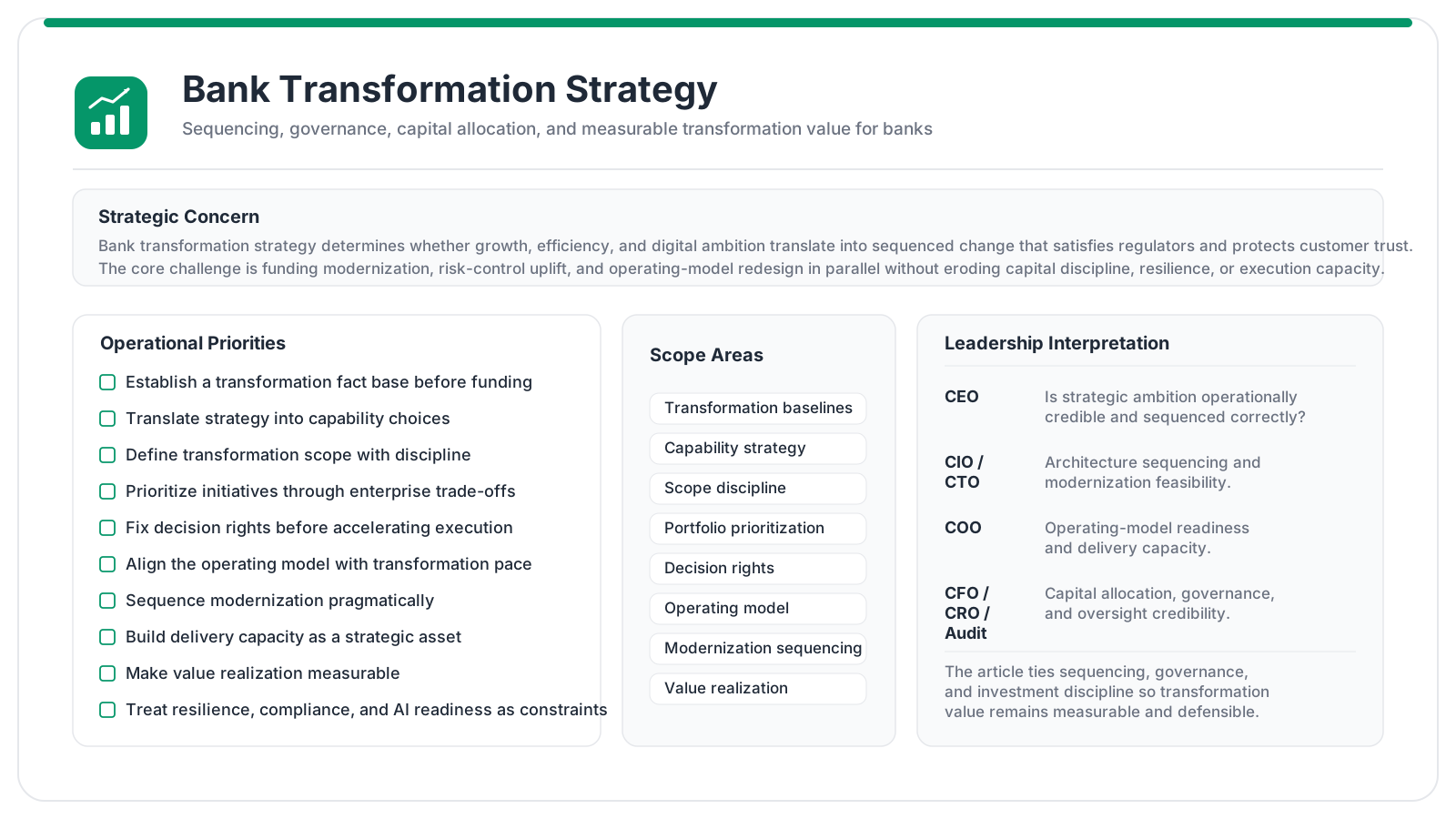
Ten Priorities That Define a Credible Strategy
1. Establish a fact base before committing capital. Leadership teams need a usable baseline across technology debt, process friction, control effectiveness, data quality, delivery throughput, and run-vs-change economics.
2. Translate strategy into explicit capability choices. Transformation should be framed in terms of capabilities to build, retire, industrialize, or de-risk, not just projects to launch. See Capability Mapping in Banking.
3. Define scope with discipline. The bank needs clear boundaries for what is in scope now, what is deferred, what minimum viable change looks like, and what architectural decisions are non-negotiable. See How to Define Transformation Scope.
4. Prioritize through enterprise trade-offs. Every major initiative should be assessed against strategic value, regulatory relevance, execution risk, dependency load, and capacity consumption.
5. Fix decision rights before accelerating delivery. Weak ownership, ambiguous escalation paths, and fragmented steering are recurring causes of transformation drag.
6. Align the operating model with the intended pace of change. Product, technology, operations, risk, finance, and audit all need a coherent role in the target model rather than parallel governance structures.
7. Sequence modernization pragmatically. Core, channels, data, cloud, and control modernization should be staged according to dependency logic, not vendor pressure or internal politics.
8. Build delivery capacity as a strategic asset. Portfolio ambition must match the bank's actual ability to design, test, govern, migrate, and stabilize change.
9. Make measurable value realization part of strategy governance. Transformation should produce board-grade evidence on cost, growth, resilience, control quality, and customer outcomes.
10. Treat resilience, compliance, and AI readiness as design constraints. They are not separate workstreams to be added later; they define whether the strategy is executable at all.
How Leadership Should Use This
For the CEO, this is a test of whether the bank's strategic ambition is credible. For the CIO and CTO, it is a sequencing and architecture discipline. For the COO, it is an operating-model and capacity problem. For the CFO, it is a capital-allocation and benefits-realization question. For the CRO and Chief Audit Executive, it is a question of whether transformation can scale without weakening oversight.
Its role is to force a single conversation about sequence, ownership, and funding before the institution commits itself to conflicting promises.
What a Credible Approach Looks Like
A strong transformation strategy shows a defensible baseline, a sequenced roadmap, explicit investment logic, named decision owners, clear gating criteria, a target operating model for execution, and a small set of outcome metrics that the board can actually challenge.
It should also make trade-offs visible. If the bank is choosing resilience over speed in one domain, or core simplification over feature velocity in another, the strategy should state that directly. Ambiguity is usually where transformation cost and risk accumulate.
What Matters Most
A strong bank transformation strategy creates order around change. Its value is not in the number of issues it addresses. Its value is in organizing them around the real leadership problem: how to sequence, govern, fund, and measure change without outrunning the institution's control and delivery capacity.
The strategic question is not whether to transform. It is whether the bank can do so credibly.
More Information
- Banking Strategy-to-Execution Plan 2026: Governance Language and Objective Trees
Banking Strategy-to-Execution Plan 2026. Shows how governance design and decision rights accelerate execution while preserving accountability and control.
- AI Strategy for Banks: Prerequisites That Validate Ambition
AI Strategy for Banks: Prerequisites. Provides practical guidance to prioritize investments, manage execution risk, and improve transformation outcomes.
- Bank Digital Transformation Scope Language 2026: In-Scope, Out-of-Scope, and Exit Criteria
Defines practical scope language with in-scope, out-of-scope, and exit criteria so programs avoid ambiguity and rework.
- Mobile App Capability Gaps That Undermine Digital Channel Strategy
Mobile App Capability Gaps That Undermine Digital. Defines capability gaps, readiness signals, and concrete actions that turn strategy into executable change.
- Banking Transformation Domains Framework for 2026
Domain and workstream scoping that creates an objective baseline and keeps banking transformation delivery measurable over time, end to end.
- Defining In-Scope Capabilities for Transformation: Capability Taxonomy and Ownership Rules
Shows how to define in-scope capabilities with taxonomy and ownership rules so portfolios stay coherent across domains.
- Is Our Digital Transformation Plan Realistic for a Bank
Is Our Digital Transformation Plan Realistic. Provides practical guidance to prioritize investments, manage execution risk, and improve transformation outcomes.
- Modernization Roadmap for Banks in 2026: A Stage-Gated Example
Modernization Roadmap for Banks in 2026: A. Outlines sequencing choices, dependency trade-offs, and implementation checkpoints that improve delivery confidence.
- Modernization Program Sequencing Language That Improves Prioritization Decisions
Modernization Program Sequencing Language. Clarifies control priorities, resilience requirements, and practical risk-reduction actions for banking leaders.
- Modernization Under Scrutiny: Framing Technology Strategy for Boards and Examiners
Modernization Under Scrutiny: Framing. Clarifies control priorities, resilience requirements, and practical risk-reduction actions for banking leaders.
- Transformation Roadmap Sequencing in Banking: The Language Executives Use to Prioritize What Happens First
Transformation Roadmap Sequencing. Clarifies control priorities, resilience requirements, and practical risk-reduction actions for banking leaders.
- Defining Transformation Scope by Wave in Banking for 2026
How rolling-wave planning turns a multi-year scope into governed releases with measurable gates, controlled risk, and durable baselines
- Bank Transformation Vision Narratives That Validate Ambition
Bank Transformation Vision Narratives That Validate. Defines capability gaps, readiness signals, and concrete actions that turn strategy into executable change.
- Bank Transformation Strategy Hub
Browse all briefs and supporting analysis connected to bank transformation strategy.
- Digital Maturity Assessment
Consulting-led baseline, benchmark, and roadmap support for major transformation and investment decisions.
- U.S. Banking Maturity Assessment Consulting
How maturity baselines and roadmap work can support bank-wide transformation planning and governance.
- Delivery and Operating Model
How team design, governance, and capacity shape execution performance.
- Governance and Decision Rights
How accountability, escalation, and decision structures affect transformation speed and control.
Related Briefs
FAQs
What does a strong bank transformation strategy need to answer?
It should answer what must change first, what constraints are binding, what sequence is financially and operationally credible, who owns each cross-functional decision, and how value and risk will be tracked during execution.
Why is sequencing more important than ambition in 2026?
Because most banks already have more demand than delivery capacity. The stronger strategy is the one that chooses a defensible sequence across modernization, resilience, data, and AI rather than launching too many loosely governed initiatives at once.
How should senior leaders use a bank transformation strategy?
They should use it to decide what moves first, what must wait, where governance needs to tighten, and how progress will be measured. A strong strategy connects investment choices to execution realities.
What makes transformation strategy useful to senior leaders?
It clarifies capital allocation, decision rights, sequencing logic, enterprise risk, operating-model implications, and board-level measures of progress rather than focusing only on local delivery techniques.