Overview
Governance and decision rights determine whether a bank can make important decisions quickly, clearly, and accountably enough to move strategy forward without creating unmanaged risk.
These structures usually fail when ownership is blurred, escalation is undefined, or approval layers accumulate faster than decision quality improves. Governance design is often the source of delivery delay.
What Governance and Decision Rights Must Address
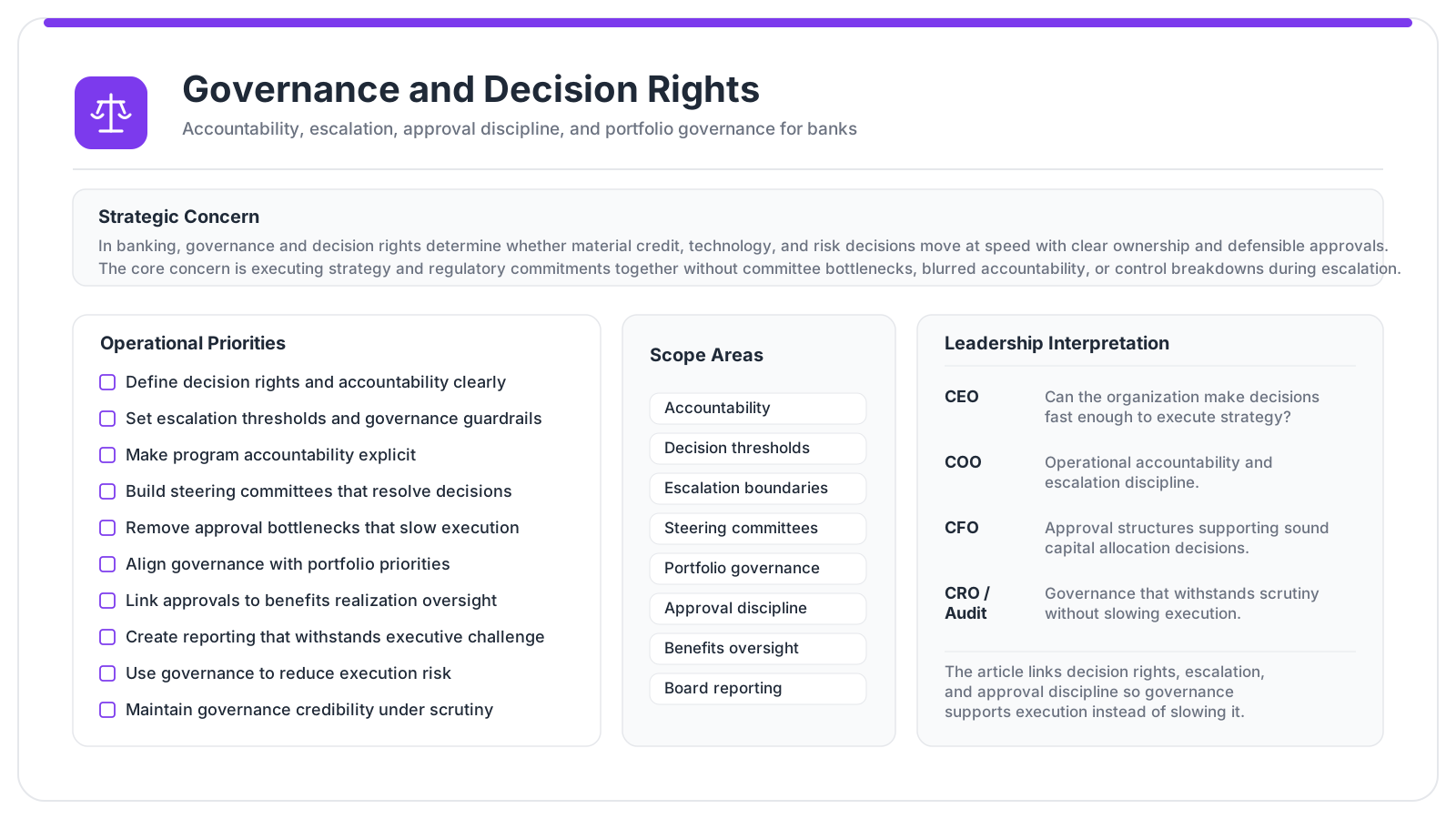
It covers accountability, decision thresholds, escalation boundaries, steering committees, RACI structures, portfolio governance, approval discipline, benefits oversight, and board-level reporting.
That breadth matters because the institution needs a decision system strong enough to allocate capital, resolve conflicts, govern risk, and keep delivery moving under pressure.
Ten Priorities That Define a Credible Approach
1. Define decision rights precisely. The bank needs clarity on who can decide, who must be consulted, and where accountability sits when trade-offs become material.
2. Set guardrails, thresholds, and escalation boundaries. Governance becomes more effective when escalation is triggered by clear conditions rather than by confusion or politics.
3. Make accountability visible at program level. Execution weakens when ownership is assumed rather than explicitly assigned.
4. Build steering committees that actually decide. Governance forums should resolve issues, set priorities, and unblock progress rather than merely review status.
5. Remove approval bottlenecks that add delay without raising control quality. The point of governance is better decisions, not more meetings.
6. Align governance with portfolio priorities. Decision rights are weak when prioritization logic and committee authority do not match. See Transformation Portfolio Governance.
7. Link governance to benefits oversight. The institution should know not only what was approved, but whether expected value is actually being realized.
8. Create reporting that can withstand challenge. Boards and executives need metrics that support oversight rather than cosmetic confidence.
9. Use governance to reduce execution risk, not just document it. Strong governance should lower delivery uncertainty through clearer decisions, tighter accountability, and faster issue resolution.
10. Keep governance credible under regulatory and board scrutiny. The bank needs a model that remains defensible when outcomes, controls, and decisions are challenged.
How Leadership Should Use This
For the CEO, this is a question of whether the institution can make the decisions required to execute strategy at the pace it expects. For the COO, it is about how accountability and escalation shape operating discipline. For the CFO, it is about whether approval structures support sound capital allocation. For the CRO and Chief Audit Executive, it is about whether governance can stand up to challenge without slowing the organization into paralysis.
Its role is to turn fragmented approvals and overlapping ownership into a usable decision structure.
What a Credible Approach Looks Like
A strong governance model shows clear decision rights, explicit thresholds, visible escalation paths, accountable steering structures, disciplined portfolio governance, and metrics that link approvals to outcomes.
It should also make trade-offs visible. If the bank is tightening control in one area or simplifying approvals in another, that choice should be explicit and governed rather than left to drift into inconsistency.
What Matters Most
Governance and decision rights matter most when pressure rises and ambiguity becomes expensive. Their value lies in making decisions faster, clearer, and more defensible without weakening accountability.
The strategic question is not whether more governance exists. It is whether the bank has the right governance to move.
More Information
- Avoiding Overlapping Transformation Initiatives in Banking
Scope definition language for program setup that prevents change saturation and keeps transformation baselines comparable over time
- Program Boundary Definition RACI: Operating Model Guardrails that Prevent Scope Creep
A practical responsibility model for defining transformation scope, enforcing governance boundaries, and sustaining alignment over time
- Stage-Gate Governance and Decision Rights for Banking Transformation
How to combine stage-gate governance, decision-rights matrices, and evidence standards so banking transformation programs move faster with stronger control.
- Transformation Initiative Inventory Template for Portfolio Baselining
A governance-ready inventory structure that makes transformation initiatives comparable and establishes a measurable delivery baseline for banks.
- Transformation Portfolio Governance and Management for Executable Delivery
Transformation Portfolio Governance. Clarifies control priorities, resilience requirements, and practical risk-reduction actions for banking leaders.
- Governance and Decision Rights Hub
Browse all briefs and supporting analysis connected to governance and decision rights.
- Digital Maturity Assessment
Useful when leadership needs a more objective baseline for governance, ownership, and decision quality.
- Regulatory Alignment Crosswalk for Community Bank Technology Exams
A practical view of how governance and accountability need to hold up under supervisory scrutiny.
- Delivery and Operating Model
How operating-model choices interact with governance and execution discipline.
- Technology Investment and ROI
How governance affects investment prioritization, approvals, and value tracking.
Related Briefs
FAQs
What should governance and decision rights make clear?
They should answer who decides what, when escalation is required, what thresholds trigger review, how accountability is assigned, and how leadership will know whether governance is improving execution or slowing it down.
Why do decision rights matter so much in transformation?
Because execution slows when authority is ambiguous, ownership is shared loosely, or approvals are added without discipline. Strong decision rights reduce delay, overlap, and rework.
How should senior leaders use this?
They should use it to identify where decisions are unclear, where approvals are excessive, where ownership is fragmented, and what governance changes are needed to raise decision quality without reducing speed.
What makes this useful?
It clarifies accountability, escalation, decision thresholds, portfolio governance, benefits oversight, and the controls required for faster but still defensible execution.