Overview
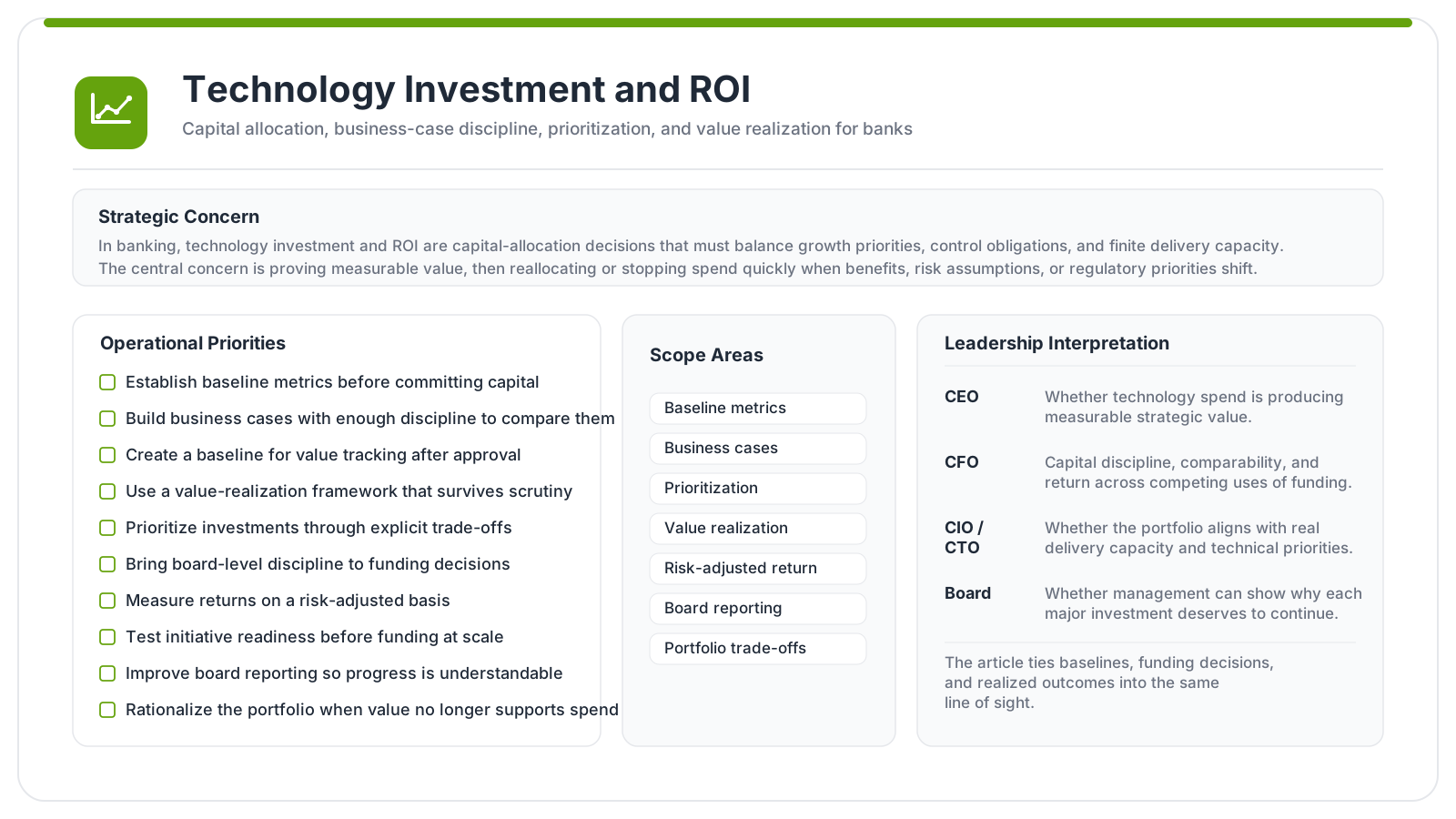
Technology investment and ROI start with disciplined capital allocation: where to invest, what value to expect, and when to redirect spending if outcomes do not hold.
These decisions usually weaken when baselines are poor, business cases are inconsistent, and portfolio trade-offs are made without a common scoring logic. Spending increases, but decision quality does not.
What Technology Investment and ROI Must Address
It covers baseline metrics, business-case design, prioritization, value realization, risk-adjusted return, board reporting, portfolio trade-offs, and funding readiness.
That breadth matters because the bank must fund each initiative with a clear value case, compare it against alternatives, and prove whether the expected return was achieved.
Ten Priorities That Define a Credible Approach
1. Establish baseline metrics before committing capital. Value is hard to defend when the bank cannot show where performance started.
2. Build business cases with enough discipline to compare them. A weak business case creates weak prioritization later.
3. Create a baseline for value tracking, not just for project approval. The bank needs to know what measures will be used after funding decisions are made.
4. Use a value-realization framework that survives scrutiny. Promised value should translate into measurable outcomes rather than broad optimism.
5. Prioritize investments through explicit trade-offs. The bank needs a common model for comparing strategic value, cost, timing, and execution burden across competing initiatives.
6. Bring board-level discipline to funding decisions. Oversight improves when technology investments are reviewed through a structured prioritization lens rather than ad hoc sponsorship.
7. Measure returns on a risk-adjusted basis. Some investments protect the institution more than they grow it, and the value case needs to reflect that reality.
8. Test initiative readiness before funding scale. Not every attractive idea is ready for capital at the same moment.
9. Improve board reporting so progress is understandable and comparable. Capital discipline weakens when reporting is inconsistent or overly tactical. See Board Reporting for Transformation Progress.
10. Rationalize the portfolio when value no longer supports the spend. The bank should be willing to retire, consolidate, or re-scope investments that no longer justify capital. See Application Portfolio Rationalization.
How Leadership Should Use This
For the CEO, this is a question of whether technology spend is producing measurable strategic value. For the CFO, it is about capital discipline, comparability, and return. For the CIO and CTO, it is about whether the portfolio is aligned with the bank's real capacity and technical priorities. For the board, it is about whether management can show why each major investment deserves to continue.
Its role is to hold baselines, funding decisions, and realized outcomes in the same line of sight.
What a Credible Approach Looks Like
A strong investment discipline shows baseline measures, a consistent business-case structure, an explicit prioritization model, risk-adjusted investment logic, board-level reporting, and a value-realization discipline that can redirect spend when assumptions no longer hold.
It should also make trade-offs visible. If the bank is prioritizing resilience over cost takeout, capacity relief over feature growth, or strategic positioning over near-term return in different areas, those choices should be explicit and governed rather than buried in business-case language.
What Matters Most
Technology investment and ROI matter when capital has to be defended against alternatives. Its value lies in helping the bank decide where to invest, what to expect in return, and when to change course.
The strategic question is not whether the bank is spending enough on technology. It is whether the spending is producing defensible value.
More Information
- 2026 Operational Resilience Investment Guide for Banks
2026 Operational Resilience Investment Guide. Provides practical guidance to prioritize investments, manage execution risk, and improve transformation outcomes.
- Reality Checking Bank Technology Transformation Costs and Capacity
Reality Checking Bank Technology. Provides practical guidance to prioritize investments, manage execution risk, and improve transformation outcomes.
- Transforming Board Reporting in Banking to Align Leaders on Priorities
Transforming Board Reporting in Banking. Clarifies control priorities, resilience requirements, and practical risk-reduction actions for banking leaders.
- Technology Investment and ROI Hub
Browse all briefs and supporting analysis connected to technology investment and ROI.
- Institutional Value Realization Diagnostic
A bounded executive diagnostic for identifying blocked value, ownership signals, and credible first-scope decisions.
- Digital Maturity Assessment Tool
A self-serve assessment platform for teams that need structured baselines, scoring, and benchmark-ready outputs.
- Bank Transformation Strategy
How investment logic fits into broader transformation sequencing and execution choices.
- Core Modernization
How major modernization decisions should be evaluated through business-case and return logic.
Related Briefs
FAQs
What should a technology investment and ROI strategy make clear?
It should answer what value is expected from each major investment, how that value will be measured, what trade-offs are being made, what baseline is required to judge progress, and how capital will be redirected if outcomes do not materialize.
Why is technology ROI hard to judge in banking?
Because many investments affect cost, risk, resilience, customer experience, and delivery capacity at the same time. The challenge is not only measurement; it is deciding which value matters most and when it should appear.
How should senior leaders use this?
They should use it to decide which initiatives deserve funding, what evidence supports each business case, how to compare competing uses of capital, and how to track whether promised value is being realized.
What makes this useful?
It clarifies baselines, business-case logic, prioritization discipline, board-level reporting, risk-adjusted returns, and the management routines needed to connect technology spend to measurable outcomes.