Overview
Core modernization strategy decides how a bank will change its operating backbone across platform direction, dependency management, sequencing, governance, migration, resilience, and value realization. It is the broad decision frame; timeline, integration, data-migration risk, ROI, and funding evidence belong to the specialist decisions linked below.
These programs usually underperform when leaders make the platform decision before clarifying the migration path, application dependencies, interface constraints, and customer impact. Modernization succeeds when the path is credible, not when the announcement is ambitious.
What Core Modernization Must Address
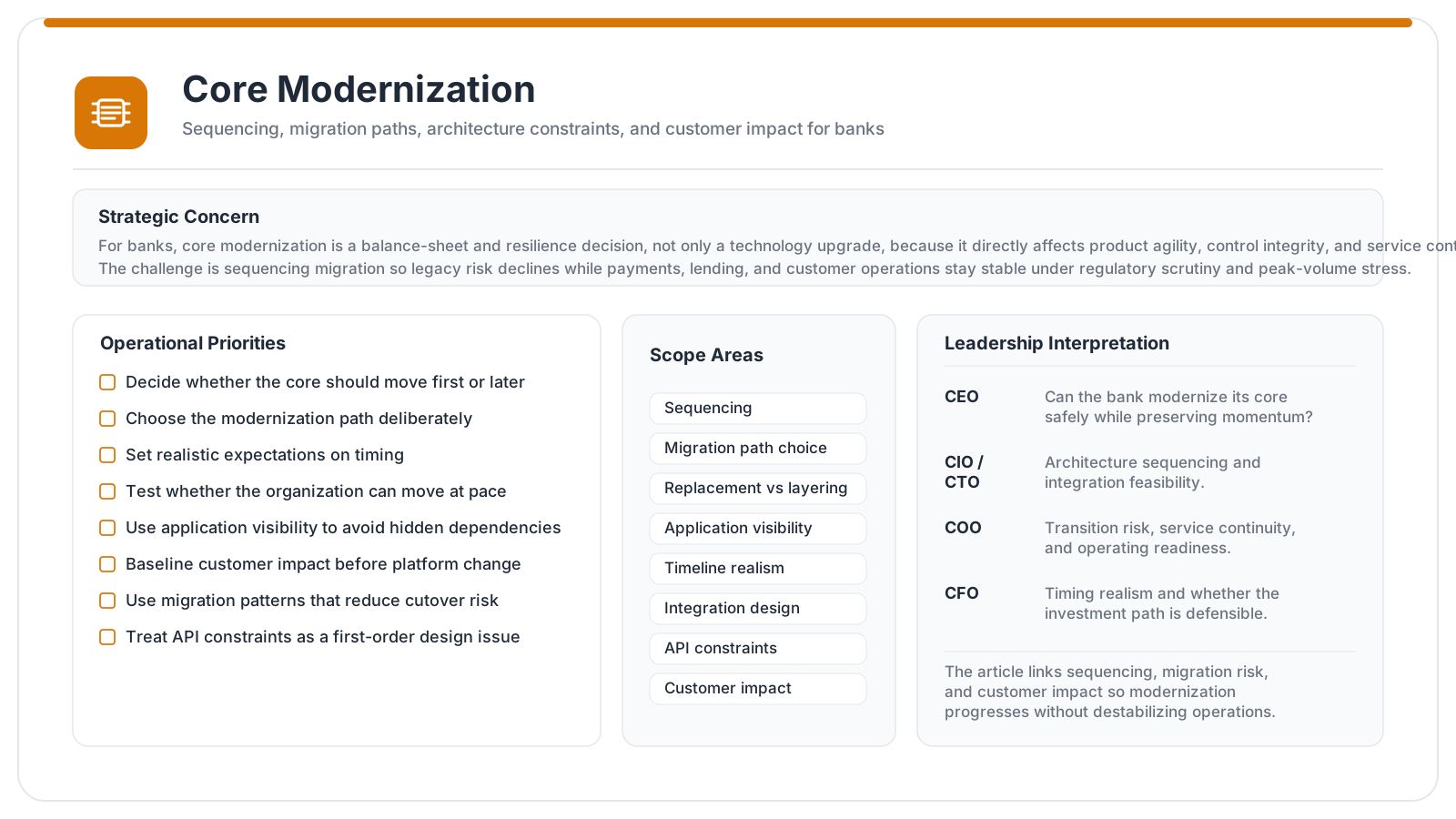
It covers sequencing, migration path selection, replacement versus layering, application visibility, customer-impact baselines, timeline realism, integration design, and API constraints.
That breadth matters because the central question is rarely whether change is needed. The harder question is how to modernize the core without creating new operational, architectural, and customer-facing problems in the process.
Eight Priorities That Define a Credible Approach
1. Decide whether the core should move first or later. The order of operations matters because it determines where risk, cost, and dependency pressure will accumulate.
2. Choose the modernization path deliberately. Full replacement, progressive modernization, and digital layering each create different control and execution demands. See Core Replacement vs. Digital Layer Sequencing.
3. Set realistic expectations on timing. A weak timeline undermines funding, delivery planning, and governance credibility from the outset. See How Long Core Banking Modernization Takes.
4. Test whether the organization can move at the intended pace. Speed assumptions should reflect actual delivery conditions, not vendor narratives or internal optimism.
5. Use application visibility to avoid blind spots. Core modernization is often constrained by unclear application interdependencies, ownership gaps, and hidden technical debt. See Application Portfolio Visibility Gaps in Banking.
6. Baseline customer impact before changing the platform. If the bank cannot measure service, onboarding, or experience outcomes before modernization, it will struggle to prove whether change improved anything.
7. Use migration patterns that reduce cutover risk. A staged design can lower execution risk, but only if the architecture and governance are strong enough to support coexistence. Use the protected Data Migration Risk Management in Banking guide for reconciliation, validation, cutover, rollback, and go/no-go controls.
8. Treat API constraints as a first-order modernization issue. Weak API management and integration discipline can turn a sound modernization plan into a bottleneck.
How Leadership Should Use This
For the CEO, this is a question of whether the bank can modernize its operating backbone without destabilizing customer experience or execution performance. For the CIO and CTO, it is a question of architecture, sequencing, and integration feasibility. For the COO, it is about transition risk, continuity, and operating readiness. For the CFO, it is about timing, funding discipline, and the realism of expected returns.
Its role is to keep architecture choices, customer impact, and funding logic tied to the same transition path.
What a Credible Approach Looks Like
A strong core modernization plan shows a clear modernization path, realistic timing, an explicit migration method, a view of application and API constraints, a customer baseline, and governance strong enough to manage coexistence and phased transition.
It should also make trade-offs visible. If the bank is reducing transition risk by slowing the pace, or choosing speed at the cost of added complexity, that choice should be explicit and monitored rather than buried inside delivery assumptions.
What Matters Most
Core modernization succeeds when an attractive target architecture is supported by a credible transition path. Its value lies in creating a path to better capability without losing control over timing, dependency, resilience, and customer outcomes.
The strategic question is not whether the core must change. It is whether the bank can change it through a path that is both executable and worth funding.
More Information
- How Long Core Banking Modernization Takes
Define credible core-banking modernization timeline bands, separate first value from legacy exit, and set evidence gates for duration decisions.
- As Is Architecture Assessment in Banking for 2026
Current state documentation artifacts that establish an objective baseline for AI readiness, resilience, and compliance by design
- Core Replacement vs Digital Layer First as Sequencing
Core Replacement vs Digital Layer First as Sequencing. Explains how banks should choose between structural simplification and faster front-end progress without misreading the long-term risk trade-off.
- Core Modernization Blockers in Banking
Core Modernization Blockers in Banking. Explains why bank programs stall around data, controls, dependencies, funding, and operating-model readiness rather than around technology alone.
- Application Rationalization Feasibility for Core Banking
Use application dependencies, coupling, fragility, and control continuity to decide whether core banking modernization can proceed and in what sequence.
- Integration Strategy for Core Banking Modernization
Test core-banking integration feasibility across API and data-layer patterns, coexistence, resilience, controls, testing, and operations.
- Defining Integration Scope for Core Modernization
Treating integration as a governed scope boundary that protects resilience, control integrity, and value capture
- Data Migration Risk Management in Banking
Reduce banking data-migration risk with a phased control framework for reconciliation, validation, cutover, rollback, and evidence-based go/no-go readiness.
- Build, Buy, or Buy-and-Build for Digital Banking Platforms
Build, Buy, or Buy-and-Build for Digital. Clarifies control priorities, resilience requirements, and practical risk-reduction actions for banking leaders.
- Banking Modernization Business Case for Board Funding
Build a board-ready banking modernization business case across portfolio value, funding logic, risk concentration, readiness, and decision evidence.
- Risk-Adjusted ROI Model for Banking IT Modernization
Build a risk-adjusted banking IT modernization ROI model across value drivers, cost timing, benefit confidence, scenarios, and measurable outcomes.
- Prioritizing Banking Transformation Investments
Classify, score, sequence, fund, and govern banking transformation investments using comparable portfolio criteria and dependency evidence.
- Core Modernization Hub
Browse all briefs and supporting analysis connected to core modernization.
- Application Portfolio Rationalization Case Studies
Examples of how leaders use portfolio rationalization to shape modernization sequencing and investment choices.
- Digital Maturity Assessment
A maturity baseline that helps clarify modernization readiness, dependencies, and prioritization trade-offs.
- Delivery and Operating Model
How delivery structure and capacity affect the feasibility of large modernization programs.
- Technology Investment and ROI
How to evaluate the business case and return logic behind major modernization investments.
Related Briefs
FAQs
What does a credible core modernization strategy need to answer?
It should answer what the bank is trying to change, which migration path is feasible, how long the change is likely to take, what customer and operational risks must be controlled, and which dependencies could slow or derail execution.
What is the central decision in core modernization?
The central decision is how to sequence core modernization so the bank improves capability, reduces technology drag, and protects operations without taking on unmanageable execution risk.
How should senior leaders use this?
They should use it to decide whether the bank is ready for full replacement, progressive modernization, a digital layer strategy, or a staged hybrid path, and what evidence supports that choice.
What makes this useful?
It clarifies sequencing decisions, timeline realism, architecture constraints, customer impact, application dependencies, and the operating risks tied to each modernization path.