Overview
Delivery and operating model design determines whether the bank can turn strategic priorities into governed, repeatable delivery without exhausting capacity or increasing control risk.
These models usually underperform when structure, governance, and prioritization evolve separately. Execution slows when teams are added without clarifying decision rights, work design, bottlenecks, or the trade-offs required under limited capacity.
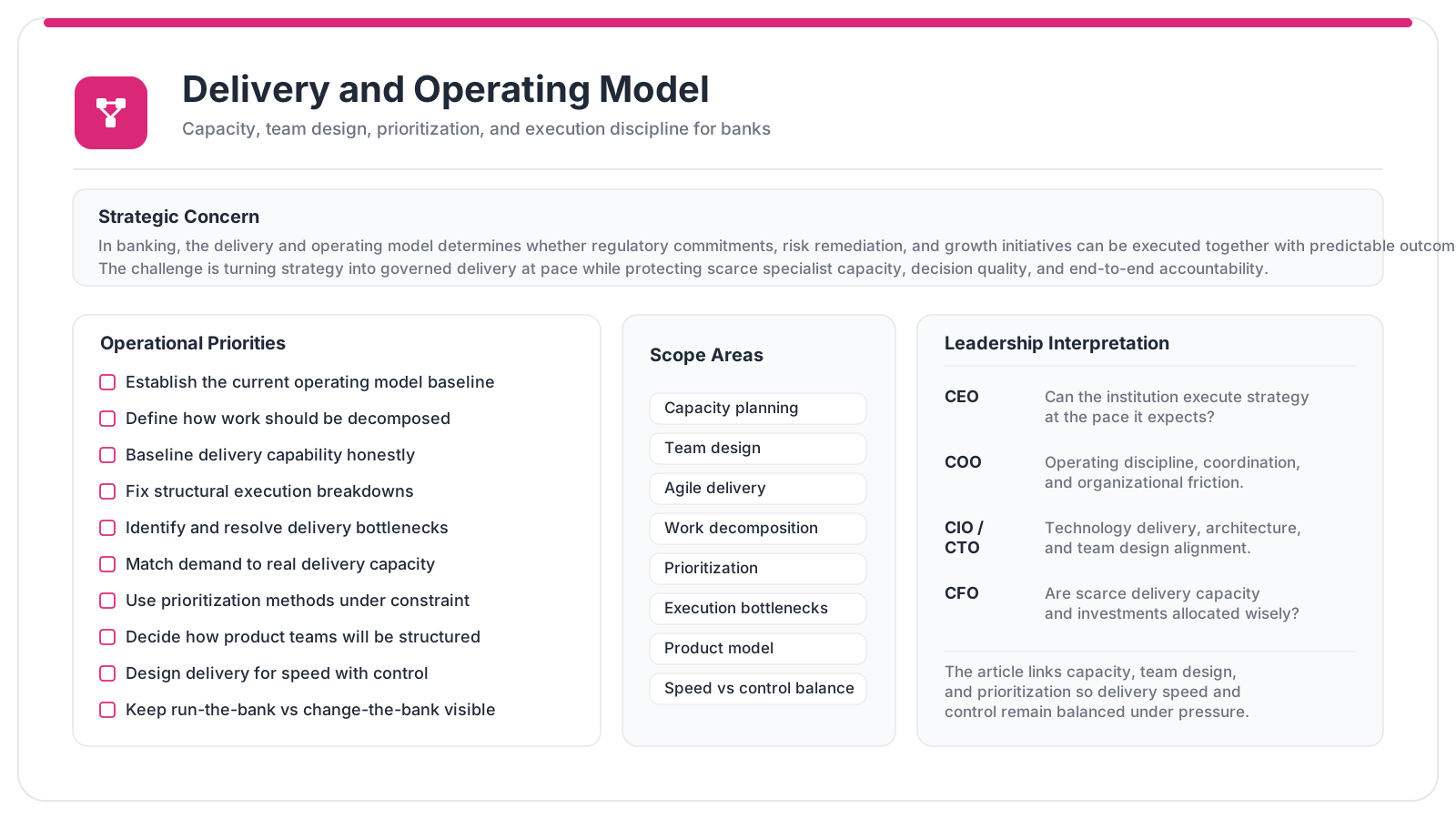
What Delivery and Operating Model Must Address
It covers capacity, governance, team design, agile delivery, work decomposition, prioritization, execution bottlenecks, product-model rollout, and the balance between speed and control.
That breadth matters because the operating model must absorb demand, allocate scarce capacity, govern trade-offs, and produce reliable execution across the bank.
Ten Priorities That Define a Credible Approach
1. Establish the current operating model clearly. Leadership needs a fact base on how delivery works today before redesigning teams, governance, or work allocation.
2. Define how work should be decomposed. Programs stall when large ambitions are not translated into governable workstreams with clear ownership and dependency logic.
3. Baseline delivery capability honestly. The bank needs to know whether current agile, engineering, and governance practices can support the pace of change being asked of them. See Agile Delivery Baseline.
4. Fix the model where execution is already breaking down. Slow handoffs, fragmented accountability, and weak coordination often point to operating model gaps rather than team underperformance.
5. Address delivery bottlenecks as a management problem. Speed improves only when the bank identifies where approvals, dependencies, and scarce skills are constraining flow.
6. Match demand to actual capacity. Portfolio ambition has to reflect the real limits of people, governance bandwidth, and delivery throughput.
7. Use prioritization methods that work under constraint. The bank needs a defensible way to compare initiatives when not everything important can move at once.
8. Decide how product teams will be structured and scaled. Team topology has to fit the bank's change agenda, governance demands, and cross-functional dependencies.
9. Design for speed with control, not speed alone. Fast delivery is useful only when the bank can preserve risk discipline, documentation, and accountability as it accelerates.
10. Keep the run-the-bank and change-the-bank balance visible. The model breaks when transformation commitments are layered onto an operating base that already lacks room to absorb them.
How Leadership Should Use This
For the CEO, this is a question of whether the institution can execute its strategy at the pace it expects. For the COO, it is about operating discipline, handoffs, and organizational friction. For the CIO and CTO, it is about how technology delivery, architecture, and team design interact. For the CFO, it is about whether scarce investment and delivery capacity are being allocated with enough discipline.
Its role is to make capacity, team design, and prioritization part of the same operating conversation.
What a Credible Approach Looks Like
A strong delivery model shows a current-state assessment, visible bottlenecks, clear work decomposition, realistic capacity limits, defined prioritization rules, a workable team model, and governance strong enough to maintain control under pressure.
It should also make trade-offs visible. If the bank is optimizing for speed, specialization, platform reuse, or tighter control in different parts of the model, those choices should be explicit and governed rather than left to emerge by accident.
What Matters Most
Delivery and operating model design matters because execution quality is built into the system before projects begin. Its value lies in creating a system that can absorb demand, govern decisions, and deliver change without letting complexity outrun control.
The strategic question is not whether the bank has more ideas. It is whether the organization is built to deliver them.
More Information
- Agile Operating Models in Banking
Agile Operating Models in Banking. Explains why banking agile transformations fail at the operating-model layer and what executives should measure instead of ceremony adoption.
- Bank Transformation Strategy
A practical view of bank transformation strategy focused on sequencing, governance, capital allocation, modernization, and measurable value.
- Delivery and Operating Model Hub
Browse all briefs and supporting analysis connected to delivery and operating model design.
- Digital Maturity Assessment
A structured baseline for evaluating delivery capability, governance cadence, and operating-model readiness.
- Digital and Data Maturity for Community Banks
Shows how operating-model clarity, accountability, and delivery maturity fit together in banking.
- Governance and Decision Rights
How decision structures and accountability affect delivery throughput and control.
Related Briefs
FAQs
What should a delivery and operating model clarify?
It should answer how the bank organizes teams to deliver change, how priorities are set under limited capacity, where governance sits, what work is in scope, and how execution speed will improve without weakening control.
Why is the operating model a strategic issue?
Because strategy fails when the organization cannot translate priorities into governed delivery. The operating model determines decision speed, handoff quality, accountability, capacity use, and the bank's ability to sustain execution.
How should senior leaders use this?
They should use it to decide whether the current model supports the intended pace of change, where bottlenecks are structural, how teams should be organized, and what governance changes are needed before more initiatives are added.
What makes this useful?
It clarifies capacity limits, delivery bottlenecks, team design, work decomposition, prioritization logic, and the management disciplines required to convert strategy into execution.