Overview
Cloud and third-party risk begins with external dependency, but it becomes a question of control, resilience, and management visibility. The core issue is whether the bank can rely on external providers without weakening resilience, compliance, or management visibility.
These programs usually break down when dependency grows faster than governance. Risk accumulates when outsourcing decisions, cloud adoption, architecture choices, and oversight routines evolve separately instead of through one clear control model.
What Cloud and Third-Party Risk Must Address
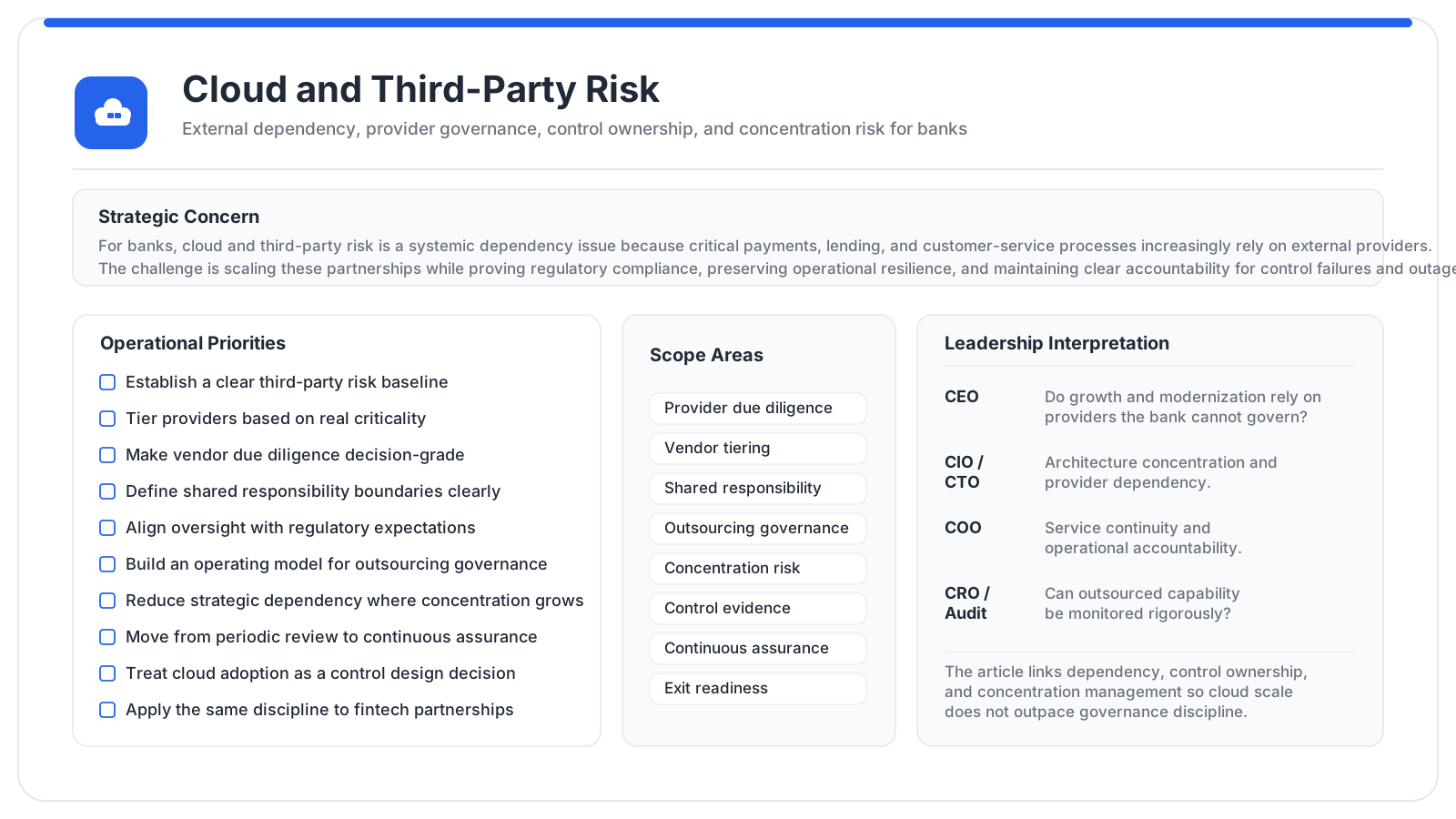
It covers provider due diligence, criticality assessment, vendor tiering, shared responsibility, outsourcing governance, concentration risk, control evidence, continuous assurance, compliance exposure, and exit readiness.
That breadth matters because the real problem is not any single vendor review. It is whether the bank can scale cloud services, technology providers, and fintech dependencies without losing control over accountability, evidence, and operational resilience.
Ten Priorities That Define a Credible Approach
1. Establish a clear third-party risk baseline. Leadership needs to know which providers are material, where risk is concentrated, and which dependencies already sit outside the bank's effective control.
2. Tier providers by actual risk, not by procurement labels. Criticality, substitutability, regulatory exposure, and operational dependency should drive oversight intensity.
3. Make due diligence decision-grade. The bank needs enough evidence on financial strength, security posture, resilience, controls, and delivery capability before expanding dependency.
4. Define shared responsibility precisely. Cloud risk increases when teams assume the provider owns more of the control environment than it actually does.
5. Align the program with regulatory expectations. Third-party oversight has to stand up to supervisory scrutiny, not just internal policy checks.
6. Build an operating model for outsourcing governance. Accountability, escalation, service ownership, monitoring, and issue resolution need a clear structure across the enterprise.
7. Reduce dependency where concentration becomes strategic risk. A provider relationship becomes dangerous when switching costs, architectural lock-in, or operational reliance exceed the bank's ability to respond.
8. Move from periodic review to continuous assurance. The bank needs current evidence on control performance, not delayed comfort from static onboarding files.
9. Treat cloud adoption as a control design decision. Workloads should not move until governance, security, resilience, and evidence requirements are defined clearly enough to scale.
10. Apply the same discipline to fintech and partner relationships. Growth partnerships can create the same control failures as core outsourcing when governance lags behind commercial ambition.
How Leadership Should Use This
For the CEO, this is a question of whether growth and modernization plans rely on external dependencies the bank cannot fully govern. For the CIO and CTO, it is a question of architecture, provider concentration, and control ownership. For the COO, it is an issue of service continuity and operational accountability. For the CRO and Chief Audit Executive, it is about whether outsourced capability can be monitored with enough rigor to withstand review.
Its role is to keep provider decisions, architecture choices, and oversight expectations from drifting into separate conversations.
What a Credible Approach Looks Like
A strong cloud and third-party risk program shows a current dependency baseline, clear provider tiering, strong due diligence discipline, explicit shared-responsibility boundaries, defined control owners, active monitoring, escalation paths, and a plan for concentration and exit risk.
It should also make trade-offs visible. If the bank is accepting more dependency to move faster, or narrowing provider choice to gain stronger control, that choice should be explicit and monitored rather than buried inside project decisions.
What Matters Most
Cloud and third-party risk becomes manageable only when external dependency is governed as carefully as internal capability. Its value is in showing whether the bank can rely on partners and providers without giving up control over resilience, evidence, and accountability.
The strategic question is not whether to use outside providers. It is whether the bank can do so without creating hidden concentrations of risk.
More Information
- Cloud Vendor Risk Assessment as a Feasibility Test for Third-Party Dependency
Cloud Vendor Risk Assessment as a Feasibility. Clarifies control priorities, resilience requirements, and practical risk-reduction actions for banking leaders.
- Cybersecurity Posture Baseline 2026: Defining “Normal” Readiness for Financial Services Transformation
How leaders establish an objective security starting point that withstands DORA-era scrutiny and supports scaled change
- Sequencing a Hybrid Cloud Roadmap Under Banking Constraints
Hybrid cloud roadmap for banks with sequencing gates, control prerequisites, and migration decisions that improve resilience and delivery confidence.
- IAM Modernization Execution Risks Under Cyber Constraints
IAM Modernization Execution Risks Under Cyber. Clarifies control priorities, resilience requirements, and practical risk-reduction actions for banking leaders.
- Identity and Access Management Roadmap: Sequencing Gates for Bank Cloud Modernization
An IAM roadmap for banking with sequencing gates for cloud and infrastructure change, prerequisite controls, and evidence artifacts to track.
- Implementation Best Practices for Auditing AI Driven Transactions
How banks should design audit trails, model governance, and identity controls so AI-driven transaction decisions stay reconstructable later.
- Legacy Decommissioning Roadmap in Banking: Realistic Timelines, Gates, and Ambition Checks
Legacy Decommissioning Roadmap in Banking. Outlines sequencing choices, dependency trade-offs, and implementation checkpoints that improve delivery confidence.
- Defining Scope for Bank Cloud Migration Programs
Domain and workstream scoping to establish a controlled starting point and measurable progress for a bank's cloud migration program end to end.
- Fintech Partnership Readiness: TPRM Constraints That Limit Bank Partnership Ambition
Fintech Partnership Readiness: TPRM Constraints. Defines capability gaps, readiness signals, and concrete actions that turn strategy into executable change.
- Defining Third-Party Scope and Vendor Governance in Banking for 2026
How executives set risk and control boundaries when regulators expect third parties to be governed as extensions of the bank
- Cloud and Third-Party Risk Hub
Browse all briefs and supporting analysis connected to cloud and third-party risk.
- Reducing Vendor and Execution Risk in Community Banking
A focused view of vendor dependency, governance weaknesses, and execution-risk reduction in banking.
- AI Vendor Evaluation Scorecard
A structured way to compare vendor fit, control exposure, and decision quality before deeper dependency forms.
- Data Governance and Quality
How trusted data, controls, and documentation affect third-party oversight and accountability.
Related Briefs
FAQs
What does a strong cloud and third-party risk strategy need to answer?
It should answer which external dependencies matter most, what risks are concentrated in them, where accountability sits, what controls are required before scale, and how the bank will monitor those relationships over time.
Why is cloud risk inseparable from third-party risk?
Because cloud adoption changes neither the bank's accountability nor its control obligations. It shifts how risk is distributed across providers, internal teams, contract structures, architecture decisions, and ongoing oversight.
How should senior leaders use this strategy?
They should use it to decide which providers are critical, what level of dependency is acceptable, where governance must tighten, and what evidence is needed before more services, workloads, or partnerships are added.
What makes this useful?
It clarifies concentration risk, control ownership, operating-model gaps, vendor dependency, compliance exposure, and the metrics required for board-level oversight.