Overview
Data governance and quality determine whether the bank can rely on its data for reporting, risk management, regulatory response, operational control, and AI-enabled decisions.
These programs usually fail when ownership, standards, controls, and documentation evolve unevenly. Problems accumulate when leaders ask more of the data than the operating model can reliably support.
What Data Governance and Quality Must Address
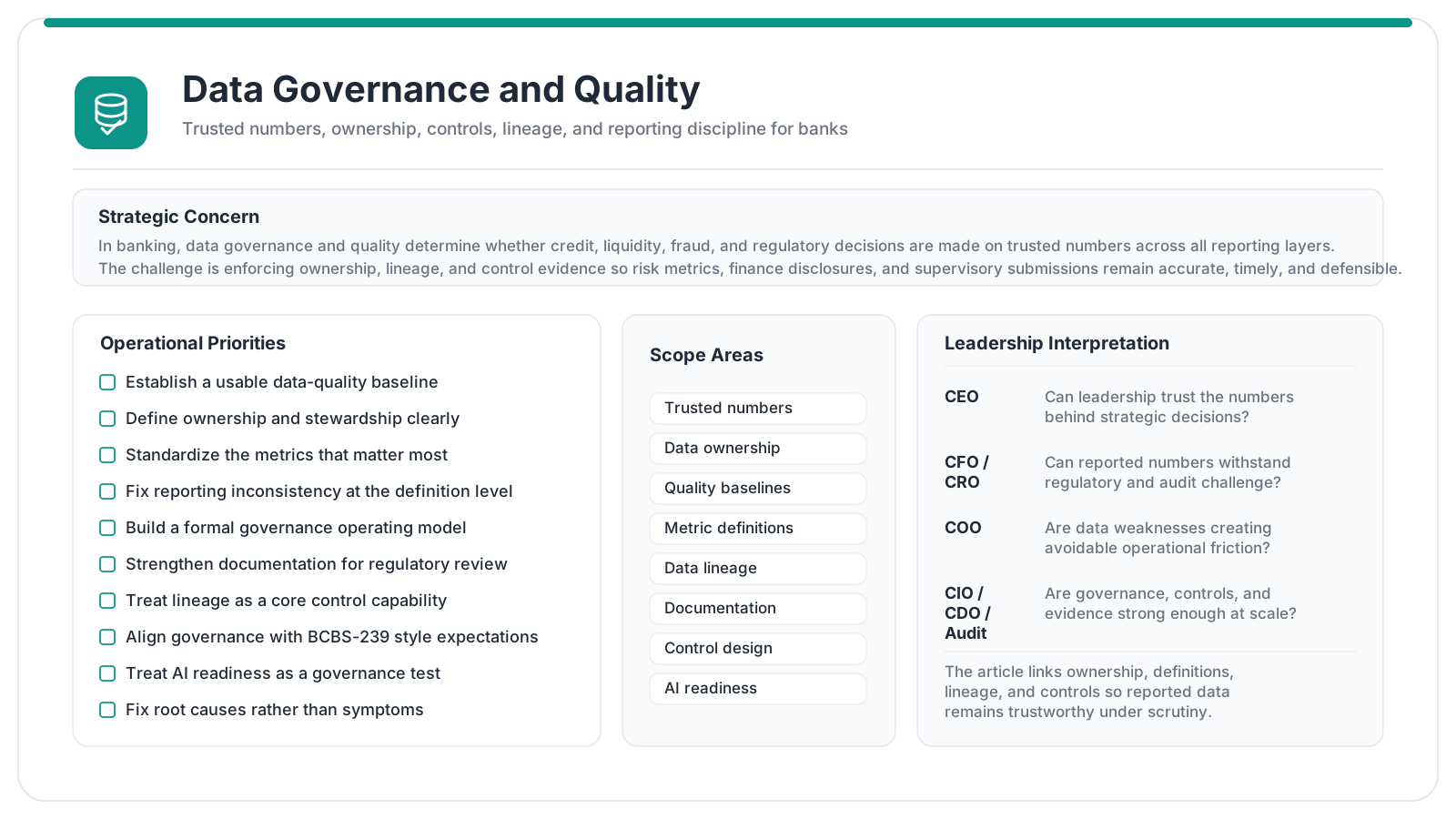
It covers trusted numbers, data ownership, quality baselines, reporting consistency, metric definitions, lineage, documentation, audit evidence, control design, and AI readiness.
That breadth matters because the bank must defend how data is defined, controlled, reconciled, traced, and used in decisions with operational, regulatory, and financial consequences.
Ten Priorities That Define a Credible Approach
1. Establish a usable data-quality baseline. Leadership needs to know where data is incomplete, inconsistent, delayed, or unreliable before larger remediation or analytics programs are funded. See Data Quality Baseline.
2. Define ownership clearly. Data governance weakens quickly when lineage, stewardship, quality accountability, and escalation routes are left ambiguous.
3. Standardize the numbers that matter most. The bank cannot claim strong governance if key metrics mean different things across finance, risk, operations, and business units.
4. Fix reporting inconsistency at the definition level. Reconciliation issues often reflect weak metric definitions and fragmented control logic, not just poor reporting tooling.
5. Build a formal governance operating model. Policies alone do not create trusted data; the bank needs decision rights, escalation routines, and clear control ownership.
6. Strengthen documentation for audit and regulatory review. If the bank cannot show how data is defined, sourced, controlled, and reconciled, it will struggle to defend management reporting or risk decisions.
7. Treat lineage as a control capability, not a technical afterthought. Without lineage, the bank cannot explain how critical data moves from source to report, model, or operational decision.
8. Tie governance to BCBS 239-style expectations where relevant. Trusted numbers require stronger aggregation, reporting discipline, and evidence than many banks assume.
9. Treat AI readiness as a data-governance test. Weak data quality and weak controls become more dangerous when decisioning, automation, or model use depends on them. See AI Readiness Data Requirements.
10. Fix root causes rather than symptoms. Repeated data issues often point to fragmented ownership, poor process design, weak controls, or conflicting standards across the enterprise.
How Leadership Should Use This
For the CEO, this is a question of whether the institution can trust the information behind strategic and operating decisions. For the CFO and CRO, it is a question of whether reported numbers can withstand challenge. For the COO, it is about whether data weaknesses are creating avoidable operational friction. For the CIO, CDO, and Chief Audit Executive, it is about whether governance, controls, and evidence are strong enough to support change at scale.
Its role is to stop trusted numbers, control quality, and AI readiness from being managed as disconnected initiatives.
What a Credible Approach Looks Like
A strong data-governance program shows clear ownership, standard definitions, a current quality baseline, strong documentation, usable lineage, defined controls, measurable remediation priorities, and governance routines that resolve issues rather than simply record them.
It should also make trade-offs visible. If the bank is prioritizing speed over standardization in one area, or stronger control over local flexibility in another, that choice should be explicit and governed rather than left to drift.
What Matters Most
Data governance and quality matter because trusted numbers do not happen by accident. Its value lies in allowing the bank to act on information that is explainable, defensible, and fit for operational, regulatory, and strategic use.
The strategic question is not whether more data is available. It is whether the bank can trust the data it is already using.
More Information
- AI Ambition Checks: Data Readiness Requirements for Bank-Grade AI
AI Ambition Checks: Data Readiness. Clarifies control priorities, resilience requirements, and practical risk-reduction actions for banking leaders.
- Data Quality Baseline 2026: Establishing an AI-Ready Data and Reporting Starting Point for Banks
Practical bank data quality baseline guidance for 2026, including BCBS 239 lineage, rules, ownership, evidence artifacts, and AI-ready reporting controls.
- Data Governance and Quality Hub
Browse all briefs and supporting analysis connected to data governance and quality.
- Digital and Data Maturity for Community Banks
A banking-focused view of data, governance, accountability, and operating-model maturity.
- Assessment Models
Explore the assessment structures behind data, governance, and digital capability benchmarking.
- Open Banking and Data Sharing
How data access, consent, and API control depend on strong governance and quality discipline.
Related Briefs
FAQs
What should leadership expect from a data governance and quality strategy?
It should answer which data matters most, who owns it, how quality is measured, what controls support trusted reporting, how exceptions are resolved, and what evidence proves the data can support risk, regulatory, and decision-making needs.
Why is data quality a strategic issue rather than a reporting issue?
Because weak data quality affects capital decisions, risk reporting, regulatory response, operational control, customer outcomes, and AI readiness. The problem is not limited to dashboards or reconciliations.
How should senior leaders use this?
They should use it to decide where trusted numbers break down, which controls are weak, where ownership is unclear, and what investments are needed before the bank scales analytics, automation, or AI-dependent decisions.
What makes this useful?
It clarifies data ownership, control design, reporting consistency, lineage, documentation, auditability, and the operating discipline required for dependable decisions.