Overview
Open banking and data sharing require the bank to expand external data access without weakening customer protection, control integrity, or implementation discipline.
These efforts usually underperform when APIs, consent, data governance, and operating procedures evolve separately. Risk grows when external access expands faster than the bank's ability to govern who gets data, under what terms, and with what evidence.
What Open Banking and Data Sharing Must Address
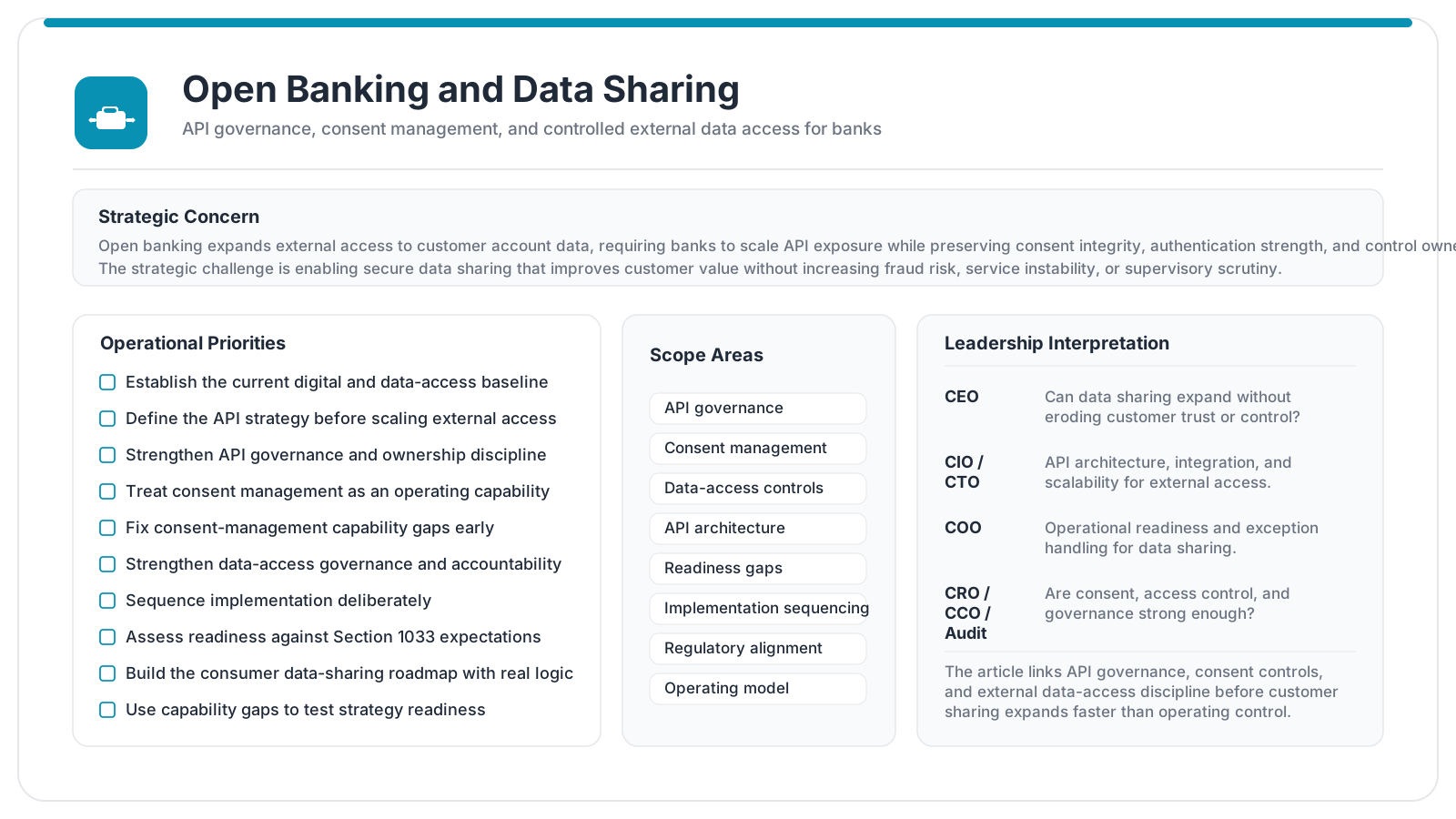
It covers API governance, consent management, data-access controls, readiness gaps, implementation sequencing, regulatory alignment, and operating-model design for external data sharing.
That breadth matters because external data access must be controlled, explainable, customer-safe, and operationally sustainable.
Ten Priorities That Define a Credible Approach
1. Start with the current state. The bank needs a clear view of how digital channels, customer journeys, and data access work today before adding external sharing commitments.
2. Define the API strategy before scaling access. Open banking becomes fragile when data-sharing ambition runs ahead of API design, reuse, and governance discipline. See API Strategy for Open Banking and Data Sharing.
3. Address API governance as a first-order control issue. Data sharing breaks down quickly when API ownership, standards, change control, and exception handling are weak.
4. Treat consent as an operating discipline, not just a policy statement. The bank needs a model for capture, refresh, revocation, auditability, and exception handling that can scale. See Open Banking Consent Requirements.
5. Fix consent-management capability gaps before volume grows. Weak consent operating practices create control failures that are hard to reverse once external access has expanded.
6. Strengthen data-access governance. External sharing requires clearer rules on data scope, entitlement, lineage, monitoring, and accountability than many banks currently maintain.
7. Sequence implementation deliberately. The bank should know what must be built first, what can follow, and what dependencies make the roadmap credible.
8. Assess readiness against Section 1033-style expectations. Strategic readiness matters more than surface compliance if the bank intends to scale consumer data sharing safely.
9. Build the consumer data-sharing roadmap with real implementation logic. The program needs operating, control, and delivery sequencing that can hold up under scrutiny.
10. Use capability gaps to test whether the strategy is actually ready. Missing controls, data governance, API maturity, or consent discipline should change the roadmap rather than be tolerated as hidden risk.
How Leadership Should Use This
For the CEO, this is a question of whether the bank can expand data sharing without eroding trust, control, or execution discipline. For the CIO and CTO, it is about API architecture, integration design, and scalability. For the COO, it is about readiness of operating procedures and exception handling. For the CRO, CCO, and Chief Audit Executive, it is about whether consent, access control, and governance are strong enough to withstand challenge.
Its role is to keep customer access, API design, and control design moving in the same sequence rather than in parallel but unaligned workstreams.
What a Credible Approach Looks Like
A strong open-banking program shows a clear API strategy, strong governance, a workable consent model, visible data-access controls, a sequenced implementation roadmap, and readiness evidence that supports expansion.
It should also make trade-offs visible. If the bank is prioritizing speed of rollout, broader data access, or stronger control in different areas, those choices should be explicit and governed rather than left to emerge through delivery pressure.
What Matters Most
Open banking and data sharing succeed only when access expands more slowly than the bank's control failures. Its value lies in enabling customer-directed sharing without losing control over consent, governance, and operational discipline.
The strategic question is not whether data can be shared. It is whether the bank can share it in a way that remains safe, credible, and scalable.
More Information
- API Strategy for Open Banking Data Sharing
Test whether API architecture, security patterns, standards, lifecycle controls, resilience, observability, and ownership can support secure open-banking data sharing.
- CFPB Section 1033: Open Banking Feasibility Test and Data Sharing
CFPB Section 1033 as a Feasibility Test. Clarifies control priorities, resilience requirements, and practical risk-reduction actions for banking leaders.
- Open Banking Consent Requirements as a Feasibility Test
Open Banking Consent Requirements as a. Provides practical guidance to prioritize investments, manage execution risk, and improve transformation outcomes.
- Open Banking Data Access Governance
Open Banking Data Access Governance: The. Clarifies control priorities, resilience requirements, and practical risk-reduction actions for banking leaders.
- Open Banking and Data Sharing Hub
Browse all briefs and supporting analysis connected to open banking and data sharing.
- Digital and Data Maturity for Community Banks
A banking-focused maturity view of data, governance, and capability readiness behind data-sharing programs.
- Digital Maturity Assessment Tool
A structured platform for internal teams that need a repeatable maturity baseline across digital and data capabilities.
- Data Governance and Quality
How trusted data and governance discipline support open-banking readiness.
- Cloud and Third-Party Risk
How external dependencies and provider controls affect data-sharing programs.
Related Briefs
FAQs
What should an open banking and data sharing strategy make clear?
It should answer what data will be shared, under what consent model, through which API and control architecture, with what governance, and how the bank will manage operational, compliance, and partner risk as sharing expands.
Why is open banking more than an API program?
Because success depends on consent management, data-access governance, customer controls, operational readiness, and regulatory discipline, not just on exposing endpoints.
How should senior leaders use this?
They should use it to decide whether the bank is ready to scale consumer data sharing, what capabilities are missing, how sequencing should work, and where governance must tighten before external access expands.
What makes this useful?
It clarifies API strategy, consent design, data-access control, readiness gaps, implementation sequencing, and the management disciplines required to expand data sharing responsibly.